Please click here for an earlier article on Eden's Serpent and its pre-biblical background from which some of the below data has been borrowed and reformatted. This earlier article is still important and should be read because not all of its information and insights have been transferred to this article.
Please click herefor PhD scholars' proposals, 1854-2009, for the protagonist/s who were recast as Eden's serpent (some 15 mythical characters have been proposed by 40 scholars).
To buy my book Eden's Serpent: Its Mesopotamian Originsplease click here
This research is best encapsulated by the Latin Motto currently found on the money of the United States of America:
E PLURIBUS UNUM, "From Many, One." It is argued that Eden's Serpent is a _recast_ of several Mesopotamian gods bearing the Sumerian epithet ushumgal (ushum = "serpent", gal = "great") meaning "great serpent" or "dragon" who were held responsible for: (1) man's creation; (2) man's being denied knowledge; (3) creating a fruit tree garden in edin/eden for man to care for on their behalf; (4) man's being warned not to eat forbidden food; (5) man's being offered forbidden food; (6) man's acquistion of "god-forbidden knowledge";(7) man's being denied immortality; (8) the removal of "man" from a god's garden in edin/eden for rebellion because of an ushumgal's actions.
I have identified 10 protagonists appearing in Mesopotamian myths as behind Eden's Serpent: (1) Anu/An; (2) Dumuzi/Tammuz; (3) Ningishzida/Gishzida; (4) Ea/Enki; (5) Enlil/Ellil; (6) Marduk/Merodach; (7) Inanna/Ishtar; (8) Nergal as the equivalent of Satan, "ruler" of Hell; (9) Saidu (Sadu) the Hunter; and (10) Shamhat (Ukhat). Please click here for the details. Some of these protagonists are also behind Eden's God, Yahweh-Elohim and Eden's Cherubim.
Black and Green on the Sumerian epithet ushumgal being applied to gods (as well as kings) as a metaphor:
"Dragon (Greek drakon, 'serpent') is the word usually used in English for a terrifying mythical monster with a scaly snake-like or lizard-like body...Mesopotamian art includes a number of such dragon-like creatures, of malevolent and beneficent natures. Most closely corresponding to the general image is the so-called snake-dragon...In Sumerian poetry, ushumgal, a serpentine monster, can be a metaphor for a god or king; it is a term of praise and not necessarily evil or unpleasant."
(p. 71. "Dragons." Jeremy Black & Anthony Green. Gods, Demons and Symbols of Ancient Mesopotamia, An Illustrated Dictionary. Austin, Texas. University of Texas Press in association with the British Museum Press. London. 1992)
My investigations suggest that the epithet ushumgal ("dragon" or "great serpent") was intended to strike fear and terror into the hearts of men, especially rebels to the gods' will or the king's will. The Sumerian warrior-king of Ur of the Chaldees, Shulgi (reigned circa 2029-1982 BC) likened himself to an venomous ushumgal that terrorizes its enemies:
"I the king, a hero...
I, Shulgi, a mighty man...
A fierce-eyed lion, born of the ushumgal, am I..."
(p. 44. David G. Firth & Philip Johnston. Editors. Interpreting the Psalms: Issues and Approaches. Downers Grove, Illinois. Inter-Varsity Press. 2005)
"Shulgi...the venom-spitting ushumgal (Dragon): Inanna fills the (inimical) land with venom "like an ushumgal"; Weapons pour venom into the enemy "like an ushumgal prepared to bite"; weapons devour corpses "like an ushumgal"; Enmerkar's herald is said to travel as swiftly as an ushumgal seeking his prey in the steppe."
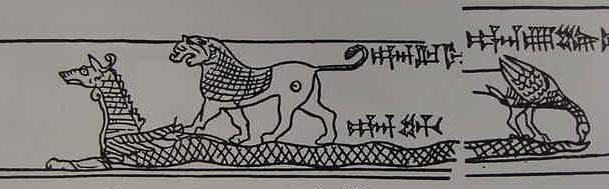
The British Museum (London) on the ushumgal as being a 'snake-dragon' and its being also called in Akkadian (Babylonian) mushhushshu 'furious snake' (please click here for the below quote and a color photo of a clay plaque showing an ushumgal/mushhushshu in the British Museum's collection):
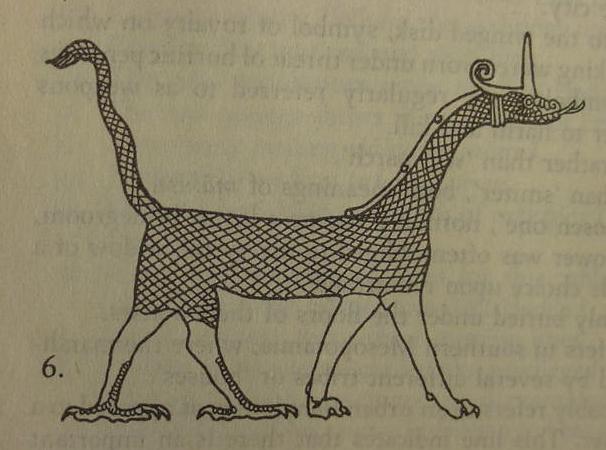
"...the ushumgal, the 'snake-dragon' of Sumerian poetry...has horns, the body and neck of a snake, the forelegs of a lion, and the hind legs of a bird. It is represented in art from 2300 B.C. ...as a symbol of various gods or as a magically protective hybrid. It has been identified as the Akkadian mushhushshu or 'furious snake'."
Please click here for a color photo of a stele of Ushumgal, a king of Sumer, circa 2900-2600 B.C. in the collection of the Metropolitan Museum of Art, New York.
Some scholars have expressed the opinion that Eden's serpent "might be" a later Hebrew recasting of some unknown god or demi-god in some long-lost Mesopotamian myth.
Almost 100 years ago (1910) Professor Skinner made just such an observation:
"It is more probable that behind the sober description of the serpent as a mere creature of Yahwe, there was an earlier form of the legend in which he figured as a god or a demon." (pp. 71-72. John Skinner. A Critical and Exegetical Commentary on Genesis. Edinburgh, Scotland. T. & T. Clark. 1910. Revised edition 1930. Reprint 1994)
Some 50 years years later (1960) the late (1923-2006) Professor Brevard S. Childs of Yale Divinity School (as noted by Professor John Martin Evans of Sanford University) also expressed a similar notion, that Genesis' serpent was "possibly" a re-casting of some individual in an earlier Mesopotamian myth:
"In a recent study of this conflict between the story and the mythical relics it preserves B. S. Childs has remarked that 'behind the figure of the serpent shimmers another form still reflecting its former life.' A tension exists because this independent life of the original figure still struggles against the framework of a simple snake into which it has been recast." (p. 20. John Martin Evans. Paradise Lost and the Genesis Tradition. Oxford, England. Clarendon Press. 1968, citing from B. S. Childs. "Myth and Reality In the Old Testament." Studies in Biblical Theology. Vol. 27. 1960. pp. 45-48)
The above "insights" of these two Professors of Biblical Studies (Skinner and Childs) caused me to investigate the ancient Mesopotamian myths to see if I could "find" the Mesopotamian "prototype" to Eden's serpent. The surprise? I found _several_ Mesopotamian "prototypes" which apparently had been fused together, transformed and recast into Eden's Serpent. They are the Sumerian deities Enki (Akkadian Ea), An (Akkadian Anu), Dumuzi (biblical Tammuz) and Ningishzida (also rendered Gizzida).
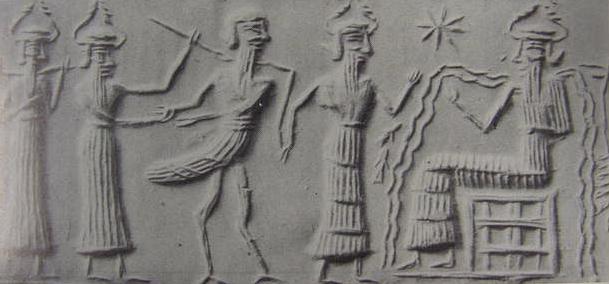
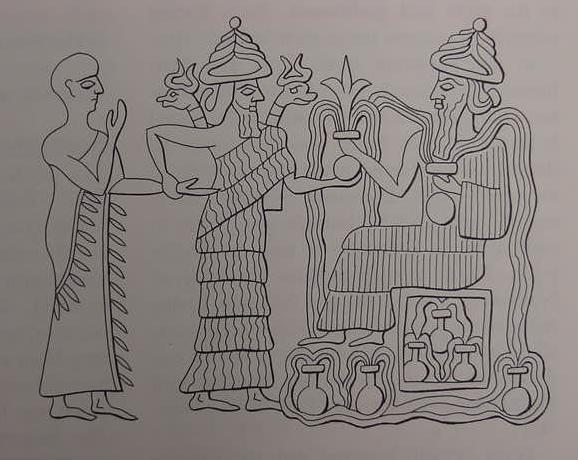
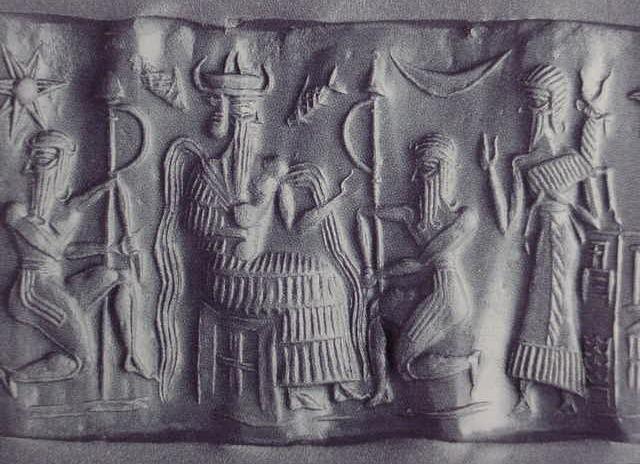
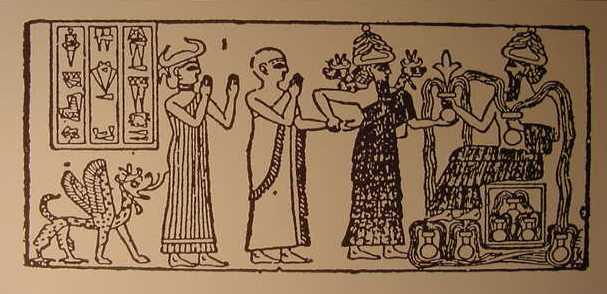
Below, Nin-gish-zida (Gishzida) with "serpent-dragon" heads erupting from his shoulders (indicating he can alternately assume the form of a walking four-legged, winged and horned dragon), presents a human petitioner, King Gudaea of Lagash in ancient Sumer, to a seated god holding a vase of flowing waters, "the water of life" (seated on a throne of flowing waters). This god may be Enki (Ea), the Sumerian god of Wisdom and Knowledge (Akkadian: Ea), whose main temple was at Eridu (in other myths, Enki lives in the marshlands on the paradise island called Dilmun). He is the god who provides mankind with freshwaters emanating from under his throne in the "abzu" house. The Sumerians, in myths, explained the source of the Tigris and Euphrates as the abzu (Akkadian: apsu) the subterranean fresh-water sea.
In the Adapa and South Wind Myth Gishzida (Ningishzida in other myths) on Anu's behalf offers man (Adapa) the "bread of life" which, if eaten, will give mankind immortality. Adapa refuses to eat of it having been forewarned by his god Ea of Eridu that it is the "bread of death" and do not eat of it or he will surely die. Unlike Adam, Adapa obeys his god and refuses to eat the "forbidden food," and thus forfeits immortality. I understand the Hebrews reworked this story via an inversion and had man eating the forbidden food and thus losing at a chance at immortality. Thus Ningishzida "plays the role" of Eden's Serpent in that he offered man what man thought was the "food of death." Ningishzida was not a successful tempter as Adapa refused to disobey his god's warning and did not eat. Ningishzida in art and myth is an ushumgal, a serpent-dragon with four legs and also at other times a human-being with serpent-dragon heads erupting from his shoulders as in the below images. Like Satan in the New Testament Book of Revelation (Rev 20:1-3) Ningishzida can assume at will the form a serpent or snake, a dragon, and a human-being.
Black and Green, identifying the seated god as being Enki:
"Gudea, prince of Lagash, is introduced to the god Enki by his personal deity Ningishzida, shown with horned serpents
(basmu) rising above his shoulders. Detail from Gudea's own cylinder seal, Neo-Sumerian Period."
(cf. p. 139, figure 115. showing the below seal, identifying the seated god as Enki. Jeremy Black & Anthony Green. Gods , Demons and Symbols of Ancient Mesopotamia, An Illustrated Dictionary. Austin, Texas. University of Texas Press. Published in co-operation with the British Museum Press, London. 1992)
Alternately, the seated god might _not_ be Enki, but instead Gudea's god, Ningirsu, who in a dream tells Gudea that once his temple's foundation has been laid, he will provide an abundance of water for the crops Lagash is dependent upon. That is to say, this story suggests Ningirsu is the god providing water for Lagash rather than Enki.
Campbell:
"Gudea offered sacrifical beasts, burned aromatic woods, and flung himself before his god in prayer, to be given a sign.
"O my King and Lord, Ningirsu, tamer of the raging waters, begotten of Enlil...Like the heart of the sea, you burst forth, like the world tree you stand firm,,,Said the god: "The day that Gudea, my shepherd true, sets hand to the building of my temple, Eninnu, there will be heard in the sky a wind of rain. And there will fall upon you abundance. The realm will swell with abundance. When the ground-work of my temple has been laid, abundance shall appear. The great fields shall produce bounteously. Water shall rise in ditches and canals: from the cracks of the earth water shall gush. There shall be oil in Sumer in abundance, to be poured; wool in abundance, to be weighed...I will send a wind, so that it may bring to your land the breath of life." (pp. 118-119. "Gods and Heroes of the Levant." Joseph Campbell. The Masks of God: Occidental Mythology. New York. Viking Penguin Inc. 1964. Reprint 1991 by Arkana).
Enki is usually portrayed in glyptic art (cylinder seals) as having two streams of water erupting from his shoulders (the Tigris and Euphrates rivers?), in hymns he fills the beds of these rivers with sperm from his penis and these two streams are described as "falling from his sides". The seated god approached by Gudea and Ningishzida does _not_ have two streams of water erupting from his shoulders, so this might be Gudeas's god, Ningirsu.
Ningishzida besides appearing in human form as a god (the horned headress denoting he is a god), appears again on this cylinder seal in animal form as a winged and two-horned walking "serpent-dragon." It is my understanding that the serpent in the garden of Eden is -in part- drawing from this Sumerian motif. The illustration is from a cylinder seal of King Gudaea of Lagash in Sumer ca. 2100 B.C. Other gods being recast into Genesis' serpent are Ea (Enki), Anu (An), and Dumuzi (Tammuz) all of whom appear in theAdapa and the Southwind myth, a story of how man personified in Adapa lost out on a chance to achieve immortality by being tricked into believing by his god Ea (Enki) that the "bread of life" and "water of life" to be presented him by the god Anu in heaven was "bread of death" and "water of death". Being warned by his lying patron-god of Eridu, Ea (Enki) _not_ to consume this food, he refused it when it was proffered by Ningishzida and Dumuzi on Anu's behalf and thus he _and_ mankind lostout on a chance to become immortal.
Please click here for my article which explores in depth the various gods which were fused together and recast as Eden's Serpent. In Sumerian myths Enki of Eridu bears the Sumerian epithet ushumgal, meaning "great-serpent-dragon" and it is he who plants a great fruit tree in his garden at Eridu called the Mes-tree and another wonderous tree called the Kiskanu. He is described in Sumerian hymns "as the great dragon" (ushumgal) who STANDS in Eridu." His double-meaning words that confound and ensnare an unwary mankind (Adapa) are likened in hymns to the "poisonous venom of a great viper." He is portrayed as the creator of mankind and the god of wisdom, who bestows knowledge on mankind at Eridu (and at Nippur) and he allows man (in the form of Adapa) to obtain forbidden knowledge reserved for the gods but denies him and mankind immortality (cf. the Adapa and the Southwind myth). That is to say, Enki (Ea) is not only one of several prototypes that was later transformed into Eden's serpent, he is also one of several prototypes that was transformed into Eden's God, Yahweh-Elohim.
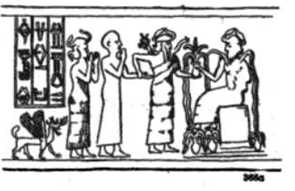
Below, three drawings of Ningishzida on Gudaea's cylinder seal from 1910, 1928 and 1992:
Below, a drawing (1910) of the Sumerian King of Lagash Gudaea's cylinder seal (cf. figure 368a. William Hayes Ward.
The Seal Cylinders of Western Asia. Washington D.C. Carnegie Institute of Washington. 1910).
The late Joseph Campbell on the Sumerian serpent-deity being recast into a new and CONTRARY role by the Hebrews as the Garden of Eden's serpent (Emphasis mine in bold print and capitals):
"In Primitive Mythology I have employed the term "mythogenetic zone" to designate any geographical area in which such a language of mythic symbols and related rites came be shown to have sprung into being. However, when the forms of the rites and symbols are then diffused to other zones, or passed on to later generations no longer participating in the earlier experience, they lose depth, lose sense, lose heart..they are consciously reinterpreted and applied to new and even CONTRARY themes -as occurred in the case, for example, of the serpent symbol in the Near East, when it passed from Sumero-Babylonian mythology to the Bible." (p. 90. "The Word Behind the Word." Joseph Campbell. The Masks of God: Creative Mythology. New York. Viking Penguin, Inc. 1968. Reprinted 1976)
Campbell (1959) suggested that Eden's serpent was a later recasting of an earlier mythic protagonist, the Sumerian god of Wisdom who dwelt on the earth at the city of Eridu called Enki (Akkadian/Babylonian: Ea). Below, Campbell is discussing the Mesopotamian myth about Inanna's (Akkadian: Ishtar) descent into the underworld and her warning her servant that if she fails to return after three days and nights to have the great gods effect her release and restoration back to life (emphasis mine):
"Ninshubur, known too as Papsukkal, "chief messenger of the gods," and Ilabrat, "the god of wings," was told by the goddess before her departure that is she did not return he should weep before Enlil (the air-god), weep before Nanna (the moon-god), and if these failed to respond, then weep before ENKI, the lord of Wisdom (THE SERPENT), who knows the food of life and water of life. He, she said, "will surely bring me to life." (p. 416. "Thresholds of the Neolithic." Joseph Campbell. The Masks of God: Primitive Mythology. New York. Viking Penguin Inc. 1959, reprinted 1971-1976; 1991 by Arkana)
Campbell in a follow-up volume (1964) also identified the Sumerian god Ningishzida as "another" prototype for Eden's serpent (emphasis mine):
"In Eve's scene at the tree...nothing is said to indicate that the serpent who appeared and spoke to her was a deity in his own right, who had been revered in the Levant for at least seven thousand years before the composition of the Book of Genesis. There is in the Louvre a carved green steatite vase, inscribed c. 2025 B.C. by King Gudea of Lagash, dedicated to a late Sumerian manifestation of this consort of the goddess, under his title NINGIZZIDA, "Lord of the Tree of Truth." (p. 9. "The Serpent's Bride." Joseph Campbell. The Masks of God: Occidental Mythology. New York. Viking Penguin Inc. 1964. Reprint 1991 by Arkana)
Campbell suggests Yahweh-Elohim, Eden's god may be a "serpent-spouse":
"Moreover, as in the early Bronze Age seals of Ningizzida and his serpent porter, we have clear and adequate evidence throughout the biblical text the the Lord Yahweh was himself an aspect of the serpent power, and so himself properly the serpent spouse of the serpent goddess of the cauduceus, Mother Earth." (p. 30. "The Serpent's Bride." Joseph Campbell. The Masks of God; Occidental Mythology. New York. Viking Penguin Books. 1964. Arkana reprint 1991)
Most amazingly Campbell _never_ identified _the Mesopotamian name_ of the "Serpent's Bride," he suggested two Sumerian gods lurked behind the serpent: Enki (Ea) of Eridu and Ningishzida (Gizzida) of Lagash. Enki's wife's name was Damgalnuna (Damkina) meaning in Sumerian "the rightful wife" her son was Marduk the god of Babylon, the animal associated with her was a lion. Ningishzida's wife was Geshtinanna, meaning "Lady of the Grape-vine," or "Heavenly Vine-stock," and she was a scribe of the underworld; she was assimilated to the Akkadian Belit-Seri (Sumerian: Nin-Edin "the Lady of Edin"). She dwelt in a sheep stall in the edin and was the sister of Dumuzi, who also had a sheep stall in the edin. She volunteers to be her brother's annual surrogate for six months of the year in the underworld, allowing his resurrection to the earth's surface as the life-force in edin's new-growth grasses and trees. So we have _two_ Sumerian goddesses who both bore the epithet nin edin, "lady of edin,": Inanna the wife of Dumuzi and Geshtinanna his sister. All three deities, Dumuzi, Inanna and Geshtinanna were associated with the edin, all "died" and dwelt for a time in the underworld, all were resurrected back to life and the earth's surface to dwell once again in the edin by having a surrogate spend time for them in the underworld.
Campbell suggests serpent associations with Yahweh in that he made Moses' wooden staff into a serpent, and caused Moses to create a bronze serpent to heal people bitten by snakes in the Exodus wanderings, and that this bronze serpent was worshipped in the Temple of Solomon until removed by King Hezekiah (cf. p. 30. The Masks of God: Occidental Mythology).
In his final volume in his Masks of God series (The four volumes were released 1959 through 1968), Campbell again stresses that Eden's serpent is a recast of a serpent deity known in earlier Ancient Near Eastern myths (cf. above his comments on the Sumerian deities Enki and Ningishzida):
"So let us return our gaze, now, to the great creative masters of the West, bearing in mind, as a basic principle of our study, that the symbols put to use by them have come from afar. Their sources are far deeper, broader, and more ancient...like the serpent of the Garden of Eden, who had been known to the peoples of the ancient Near East long before the advent of Yahweh." (p. 170. "The Word Behind Words." Joseph Campbell. The Masks of God: Creative Mythology. New York. Viking Penguin, Inc. 1968. Reprinted 1976)
If Campbell is correct, that Eden's serpent is a recast of the Sumerian deities Enki and Ningishzida, then these two gods appear on the above seal. Enki is dispensing the "water of life" to Ningishzida, who will in turn pass it on to Gudaea, the king of Lagash, who will utilize this water to maintain the gods' garden at Lagash. Thus dear reader, you are not only holding beholding what Eden's serpent looked like in pre-biblical times, you are also beholding Yahweh-Elohim in his earlier pre-biblical form as Enki/Ea, the god who allowed man (Adapa) to obtain forbidden knowledge but denied him and mankind immortality. If, however the god dispensing water is Ningirsu, the motif of life-giving water and a serpent mediator, Ningishzida, is of note between a man, Gudea and a god, Ningirsu. Ningirsu is likened to a "world tree," and Yahweh's garden has water, trees, and a serpent.
Campbell noted that Abraham of Ur of the Chaldees was possibly a near-contemporary of Gudea who regarded Ningishzida as his patron-god, suggesting Abraham may have recast Eden's Serpent from this deity:
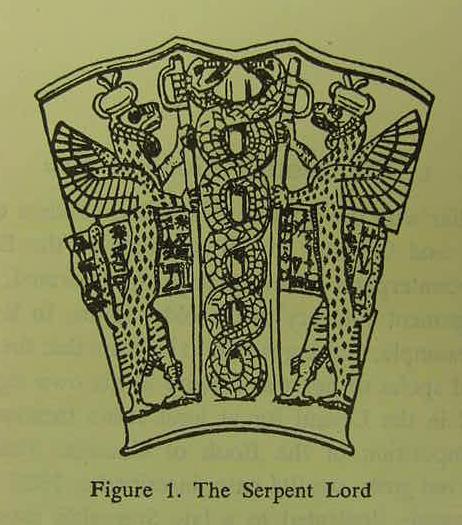
"For many years it was customary among certain Bible readers to assign a date of c. 1996 B.C. to Abraham, who was born, as the Book of Genesis declares, in "Ur of the Chaldeans,"...This date falls within the period of the brief restoration and flowering of Sumerian culture that took place during the reign of pious King Gudea of Lagash (c. 2000 B.C.), whose vision of Ningishzida was the inspiration of our figure 1." (pp. 115-116. "God and Heroes of the Levant." Joseph Campbell.The Masks of God: Occidental Mythology. New York. Viking Penguin Inc. 1964. Reprint 1991 by Arkana) Please click here for a picture of figure 1 (on page 10 of Campbell), apparently (?) after a similar drawing published by Langdon who identified Ningishzida as a prototype of Eden's serpent in 1931(cf. p. 285. figure 88. Stephen Herbert Langdon. The Mythology of All Races: Semitic. Volume 5. Boston. Archaeological Institute of America. Marshall Jones Company. 1931)
Professor Langdon (Assyriologist and Professor at Oxford University) on Eden being a recast of the Sumerian edin, meaning "plain" and the morphing of Ningishzida and Tammuz (Sumerian Dumuzi) into Eden's serpent in 1931 some 30 years _before_ Campbell's similar 1959 and 1964 association of Enki and Ningishzida being the Edenic serpent:
"...Yaw-Elohim planted a garden in eden toward the east. This is surely a survival of a Sumerian legend; for the word edin in Sumerian means "plain," and "Eden to the eastward," refers to some legendary part of Sumer, from the point of view of a writer in Canaan...It was the plan of Anu to keep man (amelutu) in ignorance of the secrets of Heaven and Earth, and when he found that Adapa had learned them from Ea, he had no alternative but to give him the bread and water of life. Yaw had the same intention for Adam, who became a gardener in Eden...Yaw caused a deep sleep to fall upon Adam...into this garden of Paradise came the serpent, in Sumerian mythology symbol of the earth's fertility, and especially connected with Ningishzida and Tammuz...This condemnation of the serpent...rests surely upon the Babylonian theory of the jealousy of the gods of fertility, probably of Ningishzida and Tammuz, of whom the serpent was symbolic..." (pp. 183-185. "The Myth of Adapa and Adam." Stephen Herbert Langdon. The Mythology of All Races: Semitic. Volume 5. Boston. Archaeological Institute of America. Marshall Jones Company. 1931).
Did Campbell make his 1964 association of Eden's serpent with Ningishzida from Langdon's earlier 1931 identification? Campbell _does list_ Langdon's Semitic Mythology, 1931, in his reference notes under "Chapter One: The Serpent's Bride," footnote number 2, on page 527 of "Reference Notes." Joseph Campbell. The Masks of God: Occidental Mythology. (New York. Viking Penguin Inc. 1964. Reprint 1991 by Arkana)
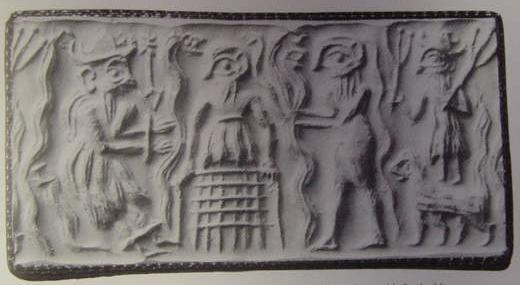
Below, a picture of the Sumerian god Enki (Akkadian: Ea) seated on a throne with two streams of water erupting from his shoulders. A bound bird-man ("Zu-bird") is being led before him after its capture for judgement and execution of sentence. The seal is dated circa 2340-2180 B.C. (cf. p. 19. John Gray. Near Eastern Mythology. London. Hamlyn House Ltd. 1969).
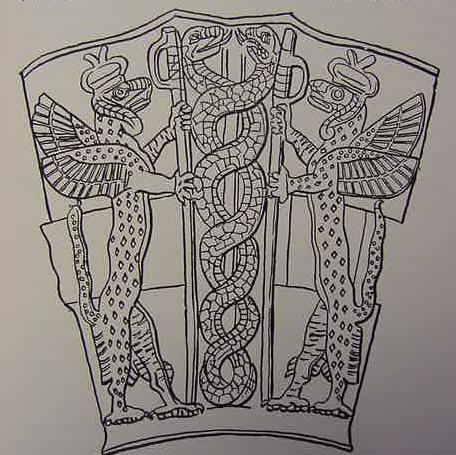
Below, from a stone vase, Ningishzida standing on hind-legs holding stylized door hinges (?), suggesting his role as a portal guardian. In the Adapa and the Southwind myth Ningishzida with Dumuzi are gate guards for Anu's heavenly abode, they present Adapa before Anu, and apparently speaking favorably of Adapa convince Anu to offer the man immortality by presenting him the "bread of life" and "water of life" to consume. Adapa refuses to consume the items obeying his lying god Ea's (Sumerian: Enki) warning he will die for it is the "bread of death and "water of death," thus losing out on a chance to obtain immortality for himself and mankind. The inscription in cuneiform identifies King Gudea of Lagash in Sumer as the dedicator of the ritual vase of carved steatite stone ca. 2100 B.C. Ningishzida's serpent-dragon body is very similar to the above rendering on Gudea's cylinder seal (for the drawing cf. p. 10. figure 1. "The Serpent Lord." Joseph Campbell. The Masks of God: Occidental Mythology. New York. Viking Penguin Inc. 1964. Reprint 1991 by Arkana).
Below, another picture of Enki with two streams of water erupting from his shoulders from a cylinder seal. Emerging from the mountain's depths is the Sumerian sun-god Utu (Akkadian Shamash) holding his saw-sword. Above in the air hovers Inanna (Akkadian Ishtar) the lady of heaven (p. 19. John Gray. Near Eastern Mythology. London. Hamlyn House Ltd. 1969).
Below, a picture of Dumuzi from a cylinder seal impression. To the degree that he offers Adapa (an Adamic prototype) "forbidden food and drink" _contra_ Ea's (Yahweh's) orders, he too "plays the part" of Eden's serpent, along with Ningishzida and Anu.
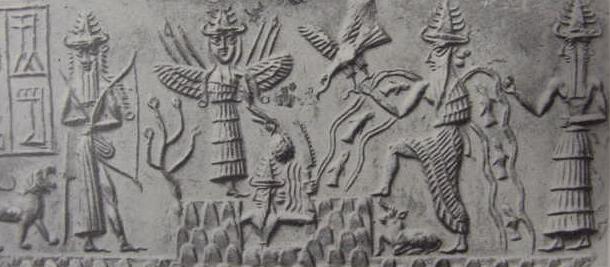
The seal shows Dumuzi being captured at his sheepfold in the Sumerian edin and bound by the serpent-like Ugalla demons who carry him off to the underworld as his bride, Inanna's replacement or surrogate. He is shown in scene one fully clothed with sceptre and crown, his hands and feet being bound with sticks, scene two: half-naked descending via Hell's gate, Scene three: fully naked in the underworld and finally, scene four: fully clothed, holding two fruit-bearing branches atop a walking serpent-dragon, showing his "return" to the earth's surface each spring as the life-force in the new plantlife or regrowth of the edin which surrounds the gods' city-gardens which man was created to toil in to feed the gods and free them of toil (for the photo cf. p. 71.Henrietta McCall. Mesopotamian Myths. [The Legendary Past series]. Austin, Texas. University of Texas Press. In co-operation with the Trustees of the British Museum, London. 1990, 1993).
The Galla (Ugalla) demons of the underworld in one scenario succeed in binding Dumuzi's hands and feet with sticks of wood. Dumuzi asks the sun-god (Sumerian Utu, Akkadian Shamash) to turn him into a serpent, the plea is granted and Dumuzi in the form of a snake slithers out of his bonds to escape the demons for a time.
Sandars:
"They [the demons] held on fast to holy Inanna and stricken with terror she gave Dumuzi into the power of the devils. They said, ' This boy, put fetters on his feet, truss him up, pinon his neck in stocks...they pinioned that boy by the arms..." (p. 156. "Inanna's Journey to Hell." N. K. Sandars. Poems of Heaven and Hell from Ancient Mesopotamia. Penguin Books. London. 1971)
"Utu, you are the brother of my wife, Inanna, I am your sister's husband...Change me, TRANSFORM MY BODY INTO A _SNAKE_ and TAKE MY HANDS AND FEET AWAY. Transform me so that my devils will not hold me and I shall escape. Utu received his tears, CHANGED HIS BODY and Dumuzi escaped." (p. 151. "Inanna's Journey to Hell." N. K. Sandars. Poems of Heaven and Hell from Ancient Mesopotamia. Penguin Books. London. 1971)
Black renders the above verse somewhat differently mentioning snake hands and snake feet:
"Utu accepted his tears. Utu turned Dumuzid's hands into SNAKE'S HANDS. He turned his feet into SNAKE'S FEET. Dumuzid escaped his demons." (p. 75. "Inana and Dumuzid." Jeremy Black, Graham Cunningham, Eleanor Robson & Gabor Zolyomi. The Literature of Ancient Sumer. Oxford University Press. 2004 hardback edition, 2006 paperback edition with corrections)
That is to say, Dumuzi in this myth is portrayed as able to take on the form of a snake or serpent. So Dumuzi is not only associated with the steppe rendered in Sumerian as the edin (alternately, arali) and able to assume a _serpent_ as well as human form, he also bears the Sumerian epithet ama-ushumgal-an-na, "the mother is a great serpent-dragon of heaven." Dumuzi who could assume the form of a serpent and who bore a serpent epithet, who "LOST HIS LEGS" like Eden's serpent, offered man (Adapa) once upon a time a chance to obtain immortality for himself and mankind with the FORBIDDEN "bread and water of life" on Anu's behalf.
Foster noted Dumuzi was A SON OF EA who bore the epithet Nudimmud meaning "creator" and Dumuzi's wife Inanna/Ishtar in one hymn is likened to being a terrifying DRAGON. So Dumuzi has connections with Eridu's principal god Ea/Enki and his wife is likened to a terrifying serpent/dragon to her enemies:
"Tammuz/Dumuzi is celebrated in various Sumerian religious poems as the shepherd boy who wooed and married the youthful Inanna/Ishtar and subsequently met a violent death. He was also known as a netherworld deity, and is here referred to as A SON OF EA (Nudimmud, line 2 is an epithet of Ea's meaning "creator of mankind").
"O lord DUMUZI, awe-inspiring shephed of Anu,
Lover of Ishtar the queen, ELDEST SON OF NUDIMMUD...
Drive away from the 'evil gazer', the worker of evil..."
(p. 222. "To Dumuzi." Benjamin R. Foster. From Distant Days, Myths, Tales, and Poetry of Ancient Mesopotamia. Baltimore, Maryland. CDL Press. 1995. ISBN 1-883053-09-9. paperback)
Professor Batto (1992) on the Gilgamesh serpent being recast as the edenic serpent:
"It is likely that the Yahwist derived the character of the serpent in part from Gilgamesh, as J's serpent bears some semblance to the serpent that had a part in depriving the semidivine Gilgamesh of the plant of life. In any case, the serpent of Genesis 3 is more a mythic character than an ordinary animal, as is evident from its ability to talk and to walk upright...Indeed, given the later presence of cherubim to guard the divine tree of life (3:24), one wonders whether the serpent here is not to be connected with the awesome seraphim who stand in the presence of Yahweh (Isa 6:1-7), which in turn are to be identified with the divine winged uraeus or cobra well known in Egyptian art as the protector of the deity, and thus a semidivine figure in its own right. The serpent's principal distinction, however, was its possession of wisdom." (p. 60. "The Yahwist's Primeval Myth." Bernard F. Batto. Slaying the Dragon, Mythmaking in the Biblical Tradition. Louisville, Kentucky. Westminster/John Knox Press. 1992)
Professor Clifford (1994) on the edenic serpent being a recast of the Gilgamesh serpent (note: Clifford cites Batto's above work in his bibliography, did he get the notion Eden's serpent is a recast of the Gilgamesh serpent from Batto?):
"The J-storyteller takes the Gilgamesh motif of the snake's theft of the plant of life from the hero (a postflood occurrence in Gilgamesh XI) and places it before the flood (Genesis 3). As in Gilgamesh, Adam is naked when the loss takes place, the snake deceitfully steals the fruit supposed to transform life, and a tree or plant of life is involved. Such kaleidoscopic reuse of traditional details may seem strange to modern readers, but ancient authors evidently like to put familiar objects in new contexts." (p. 148. "Genesis 1-11." Richard J. Clifford. Creation Accounts in the Ancient Near East and in the Bible. Washington, D.C. The Catholic Biblical Association of America. The Catholic Biblical Quarterly Monograph Series # 26. 1994)
Professors Graves and Patai understood that the motif of Eden's Serpent attempting to foil God's warning to Adam and Eve is drawing from the Adapa and the Southwind myth:
"Another source of the Genesis Fall of Man is the Akkadian myth of Adapa, found on a tablet at Tell Amarna, Pharaoh Akhenaten's capital...Ea summoned Adapa...and warned him that, having displeased Anu...the gods would offer him the food and drink of death, which he must refuse. Anu, however, learning of this indiscreet disclosure, foiled Ea by offering Adapa the bread of life and the water of life and, when he refused them at his father's orders, grimly sending him back to the earth as a perverse mortal. This myth supplies the theme of the Serpent's warning to Eve: that God had deceived her about the properties of the forbidden fruit." (p. 79. "The Fall of Man." Robert Graves & Raphael Patai. Hebrew Myths: The Book of Genesis. New York. Greenwich House, distributed by Crown Publishers, Inc. 1963, 1964, reprinted 1983)
I disagree with the above analysis. I understand Ea did not want Adapa to have immortality, he knew it would be offered by Anu, thus he tricked Adapa into believing he would die if he ate the bread of death and drank the water of death. I understand that Anu plays the part of Yahweh-Elohim in that he is upset to learn that man has obtained forbidden knowledge (curses taught him illegally by Ea to overpower the wind god). But Anu's reaction is not to deny man immortality because he has obtained forbidden knowledge, but rather to offer man immortality making him a full-fledged god. The Hebrews have "reversed" the story line, because man has obtained forbidden knowledge immortality has been denied him by his God.
Graves and Patai on Yahweh-Elohim as a Serpent-God:
"The Brazen Serpent made, according to Hebrew tradition, by Moses at God's command (Numbers 21:8-9) and revered in the temple Sanctuary until the reforming King Hezekiah destroyed it (2 Kings 18:4), suggests that Yahweh had at one time been identified with a Serpent-god..." (p. 32. "The Creation According to Other Biblical Texts." Robert Graves & Raphael Patai. Hebrew Myths: The Book of Genesis. New York. Greenwich House, distributed by Crown Publishers, Inc. 1963, 1964, reprinted 1983)
Graves and Patai on Ea being portrayed in art as a Serpent-god:
"The Babylonian Ea, as god of the Euphrates, was shown in serpent shape, or riding a serpent." (p. 87. "The Births of Cain and Abel." Robert Graves & Raphael Patai. Hebrew Myths: The Book of Genesis. New York. Greenwich House, distributed by Crown Publishers, Inc. 1963, 1964, reprinted 1983)
Unfortunately Graves and Patai do not give a bibliographic source for their assertion that Ea was portrayed as a Serpent in Babylonian art. and I am unaware of any such representation. I am aware, however that the Akkadian god Ea in his earlier manifestation as the Sumerian god Enki bore the epithet ushumgal meaning "great serpent-dragon" and that his "double-meaning" words which entrapped sinners and the naive were likened in hymns to the "venom of a serpent."
I have finally tracked down and found the "source" of Hea being Eden's serpent, its Sir Henry Creswicke Rawlinson (considered one of the founding fathers of modern Assyriology) who made this association as early as 1854 and it reappears in 1858, 1859, 1881 in his works ("Essays") on the religious beliefs of the Babylonians and Assyrians. He rendered, in error, Ea as Hea or Hoa and thought it might be cognate with Arabic hiya, "serpent" and "life." Today scholars render Hea as Ea and derive it from e="house," a="water" in the Sumerian language. So Rawlinson was wrong about the serpent association as it is _not_ a cognate of hiya. However, he was _partially right_, how so? He also noted _correctly_ that Hea was associated with wisdom and knowledge, motifs associated with Eden's serpent, for all the details please click here.
Smith (1876) noted that some scholars (Henry C. Rawlinson, 1854, 1858, 1859) had suggested that a serpent "might" be a symbol of the god Ea/Enki (Smith's Hea), but no inscription (as of 1876) bore testimony to this proposal (note: Smith was unaware of the existence of the Adapa and South-wind myth which was found after his death):
"A companion deity with Anu is Hea, who is the god of the sea...he is lord of the sea or abyss; he is the lord of generation and of all human beings, he bears the titles lord of wisdom...It has been supposed that THE SERPENT WAS ONE OF HIS EMBLEMS, and that he was the Oannes of Berosus; these things do not, however, appear in the inscriptions." (p. 57. George Smith. The Chaldean Account of Genesis. London. 1876. Reprinted 1977, 1994 by Wizards Bookshelf, San Diego, California)
Professor Sayce (1887) apparently thought Enki/Ea was also represented by a serpent, following, perhaps, Rawlinson's proposal:
"Ea...was symbolised, it would seem by a serpent...the primaeval seat of the worship of Ea was the city of Eridu, now represented by the mounds of Abu Shahrein on the east bank of the Euphrates, and not far to the south of Mugheir or Ur."
(p. 134. Archibald H. Sayce. The Hibbert Lectures 1887: Lectures on the Origin and Growth of Religion as Illustrated by the Religion of the Ancient Babylonians. London. Williams and Norgate. fourth edition, 1897. Reprinted by Kessinger Publishing. Whitefish, Montana)
Professor Sayce noted that Ea was associated with the apsu a source of freshwater in springs and rivers and that one river was called the snake river. He also noted Eridu lay near a snake marsh. So he extrapolated serpents as being associated with Ea (Enki). Of interest is that excavations at Eridu revealed clay coils modeled into serpents in Ea's temple, under its altar, suggesting serpents were worshipped in some way at this site. Hymns mention Enki/Ea delighting in punting his boat through the "snake-marsh" that lies near Eridu, and to this day snakes abound in the marshlands of Lower Mesopotamia, gliding over the waters' surface. Could these clay serpents in Ea's temple "be" Enki, to the degree that Sumerian hymns speak of him as a great serpent-dragon or ushumgal in the midst of Eridu's fruit-tree garden? If so, then Enki may have been portrayed in the form of a serpent. Note: the Sumerian word ushumgal means ushum ="serpent", gal ="great," however, scholars usually translate ushumgal not as "great-serpent" but as "dragon," hence the reason _I prefer to render_ ushumgal as "great serpent-dragon." The Greek word dragon (used by scholars to render into English the Sumerian ushumgal) means literally "great serpent."
Sayce on Ea and serpents:
"There was yet another animal with which the name of Ea had been associated. This was the serpent. The Euphrates in its southern course bore names in the early inscriptions which distinctly connect the serpent with Ea...It was not only called "the river of the great deep"...it was further named..."the river of the snake"...it is not difficult to disentangle the primitive relation that existed between the totems of the antelope, the fish and the serpent, at Eridu. Ea was the antelope as god of the river; as god of the deep he was Oannes the fish. His daughter was denoted by a compound ideograph which represented her birth from the residence of the fish-god, though she was herself one of the poisonous reptiles that swarmed in the marshes at the mouth of the Euphrates. It was in this way that the serpent connected with the god of wisdom, "more subtil than any beast of the field" which had been created in the land of Edina...Ea, the lord of wisdom...the god of the house of Eden."
(pp. 281-282, 289. Archibald H. Sayce. The Hibbert Lectures 1887: Lectures on the Origin and Growth of Religion as Illustrated by the Religion of the Ancient Babylonians. London. Williams and Norgate. fourth edition, 1897. Reprinted by Kessinger Publishing. Whitefish, Montana)
Sayce thought the Garden of Eden was at or near Eridu:
"The fact that Tammuz was the son of Ea...the god of Eridu...But the primitive home of Tammuz had been in that "garden" of Edin, or Eden, which Babylonian tradition placed in the immediate vicinity of Eridu...Perhaps it was originally as the god of the river that Ea had been adored under the form of the wild beast of the Eden or desert."
(pp. 236-238, 281. Archibald H. Sayce. The Hibbert Lectures 1887: Lectures on the Origin and Growth of Religion as Illustrated by the Religion of the Ancient Babylonians. London. Williams and Norgate. fourth edition, 1897. Reprinted by Kessinger Publishing. Whitefish, Montana)
Leick (2001) noted that Eridu, modern Tell Abu Shahrein, is about 24 kilometers south of Ur (where Abraham once lived according to some traditions), and that archaeologists understand it was settled circa 4900 B.C. (cf. pp. 4 & 6). Note: 10 kilometers equals about 6 miles and on a good clear day a man standing atop the Ur ziggurat can see Eridu's ziggurat.
Several snake-like clay coils were found buried beneath the altar of Ea/Enki's temple at Eridu:
"Buried beneath the pavement of the nave, directly below the 'altar', were a number of curious snake-like coils some 30 to 40 centimeters long. These may have had something to do with an underworld cult." (p. 7. "Digging up Eridu." Gwendoyn Leick. Mesopotamia, The Invention of the City. London. Penguin Books. 2001, 2002)
Naked male and female figurines were found at Eridu:
"Few objects of value were recovered: Some clay figurines of naked male and female humans, small animal figures, a model snake decorated to look like one of the serpents still common around Abu Shahrein and the buried clay snake coils mentioned above." (p. 8. "Eridu." Gwendolyn Leick. Mesopotamia, The Invention of the City. London. Penguin Books. 2001, 2002)
Leick (2001) on Eridu being the Mesopotamian equivalent of Genesis' "Garden of Eden" (Sayce in 1887 having made the same association):
"Eridu is the Mesopotamian Eden, the place of creation...the Mesopotamian Eden is not a garden but a city...mankind is created to render service to god..." (pp. 1-2. "Eridu." Gwendolyn Leick. Mesopotamia, The Invention of the City. London. Penguin Books. 2001, 2002)
Tsumura citing Sjoberg notes that there is no mention in any Sumerian or Akkadian text of a 'Tree of Life':
"However, according to Sjoberg, who recently reexamined Sumerian connections with regard to the "tree of life," there is "no evidence" for such a tree in Mesopotamian myth and cult. He says, "The identification of different trees on Mesopotamian seals as a Tree of Life is a pure hypothesis, a product of pan-Babylonianism...There is no Sumerian or Akkadian expression 'Tree of Life'."
(p. 39. footnote 70. David Toshio Tsumura. "Genesis and Ancient Near Eastern Stories of Creation and Flood: An Introduction." pp. 27-57. in Richard S. Hess & David Toshio Tsumura. Editors. "I Studied Inscriptions from before the Flood" Ancient Near Eastern, Literary, and Linguistic Approaches to Genesis 1-11. Winona Lake, Indiana. Eisenbrauns. 1994, citing A. W. Sjoberg, "Eve and the Chameleon," pp. 219-221, In the Shelter of Elyon: Essays on Ancient Palestinian Life and Litereature in Honor of G. W. Ahlstrom. Sheffield: JSOT Press. 1984.
Eden's serpent and its setting in the Garden _in_ Eden is an amalgum or fusion of motifs from several different Mesopotamian myths and characters, but primarily the Adapa and the Southwind myth and
The Epic of Gilgamesh as has been noted by several scholars over the past 100 years.
All of the following mythical protagonists are fused into Eden's serpent: Anu, Ea (Enki), Ningishzida (Gizzida) and Dumuzi (Tammuz).
Eve's association with a serpent is perhaps via Inanna the "lady of edin" (Inanna-edin-na), who was called Ama-ushumgal-an-na "the mother is a great serpent-dragon of heaven." With her brother Utu the sun-god she descends to the earth to _acquire knowledge by eating of trees and other herbs_ to perform her wifely conjugal duties with her new bridegroom Dumuzi, the "lord of edin" (mulu-edin-na), hence her connection with eating of a tree's fruit as Eve of Eden. Eve's becoming a more "fit companion" for Adam instead of animals is a recast of Shamhat (a prostitute-priestess of Inanna at Uruk), who seduces Enkidu at edin's watering hole, Gilgamesh having told her that Enkidu's animal companions will shun him after he has intercourse with her, and thus he will give up his animal companions and dwell with womankind and man in the city of Uruk (reformatted in Genesis as mankind being expelled from the garden to live in a city founded by their son Cain).
One gets the notion from Genesis's narrator that by "eating a fruit" of a tree one can "obtain knowledge." This concept appears in Sumerian myths. The Sumerian myth about "the Queen of Heaven," Inanna, has her speaking to her brother, Utu the sun-god, to the effect that she has no knowledge about love and sex, she requests that he accompany her in a descent to the earth, to the mountains, where she will eat the various plants there. It is only after having eaten these assorted, un-named herbs including, apparently, Cedar trees, that Inanna now possesses knowledge about love and sex in order to perform her wifely functions (in hymns she is "the bride" of Dumuzi and the goddess of Love and of Sex).
Inanna speaking to Utu (Emphasis mine):
"I am unfamiliar with womanly matters...I am unfamiliar with womanly matters, with sexual intercourse...kissing...Whatever exists in the mountains, let us EAT that. Whatever exists in the hills, let us EAT that. In the mountains of herbs, in the mountains of CEDARS, the mountains of cypresses, whatever exists in the mountains, let us EAT that. After the herbs have been eaten, AFTER THE CEDARS HAVE BEEN EATEN, put your hand in my hand, and then escort me to my house...Escort me to my mother-in-law, to Ninsumun..." ("A shir-namshub to Utu" [Utu F], The Electronic Texts Corpus of Sumerian Literature, Oxford University, England; http://www-etcsl.orient.ox.ac.uk/section4/tr432f.htm)
It appears to me that Inanna is _EATING _OF_TREES_, Cedars, to acquire knowledge. That is to say "eating of a tree" confers knowledge. Please note the repeating refrain: "...LET _US_EAT THAT..." This refrain recalls to mind Genesis' portrayal of Eve coaxing Adam into eating, with her, the forbidden tree-fruit. Perhaps Inanna's statement to her male companion, Utu, is behind Eve's coaxing Adam to eat of a tree in order to obtain knowledge, as Inanna does seek knowledge via the eating of a tree's fruit.
Leick, alluding to the above verses, _also understands_ that Genesis' motif of knowledge being obtained by eating a fruit is indebted to earlier Sumerian myths (emphasis mine):
"Inanna and Utu is a mythical incident in a Sumerian hymn (BM 23631), which explains how Inanna came to be the goddess of sexual love. The goddess asks her brother Utu to help her go down to the kur where various plants and trees are growing. She wants to EAT THEM IN ORDER TO KNOW the secrets of sexuality of which she is yet deprived: 'What concerns women, (namely) man, I do not know. What concerns women: love-making I do not know.' Utu seems to comply and Inanna tastes of the fruit (the same motif is also employed in Enki and Ninhursag and of course in Genesis I) which brings her knowledge." (p. 91. "Inanna and Utu." Gwendolyn Leick. A Dictionary of Ancient Near Eastern Mythology. London. Routledge. 1991 [Leick has a Doctorate in Assyriology from the University of Graz in Austria, and lectures at Richmond College and the University of Glamorgan, United Kingdom])
Leeming (Emertius Professor of English and Comparative Literature at the University of Connecticut) on Inanna's eating of trees being recalling Eve's eating of a tree's fruit:
"One day Inanna asks her twin brother, the sun god Utu (Shamash), son of the moon god Nanna, to go with her to earth (kur), where she will eat various plants and trees that will cause her to understand the mysteries of sex. Like Eve in the Garden of Eden, Inanna tastes the fruit and gains knowledge." (pp. 46-47. "The Mythology of Mesopotamia." David Leeming. Jealous Gods and Chosen People, the Mythology of the Middle East, A new perspective on the ancient myths of modern-day Iraq, Turkey, Egypt, Syria, Lebanon, Israel, Palestine, Jordan, Yemen, the Gulf States, and Saudi Arabia. New York. Oxford University Press. 2004. ISBN 10:0-19-514789-8)
We see now, that eating of a tree does impart knowledge in the Sumerian texts about Enki and Inanna.
Some readers may be wondering just what is it that Inanna is "eating" associated with a Cedar Tree? The answer: Pine Nuts or more correctly "Cedar Nuts"! In Middle Eastern cuisine, Pine Nuts/Cedar Nuts are at times sauteed in olive oil and served as a complement or garnish to a number of different dishes in Israel, Syria, and the Lebanon. Note: You will not find much on "Cedar Nuts" on the internet as a food item, but under their alternate name, "Pine Nuts," one will find numerous ways of their being prepared in Middle Eastern dishes.
Dalley has sounded a note of caution regarding the Akkadian/Babylonian word erenu which is usually translated by scholars as a 'cedar' (tree), she suggests that it is a 'pine' (tree) instead. If she is right then Inanna who bore at Nippur the Sumerian epithet nin edin "the lady of edin" ate pine nuts rather than cedar nuts to obtain knowledge:
"The usual translation of erenu as 'cedar' is almost certainly wrong. The main grounds for a translation 'pine' are: that roof-beams thus named in texts have been excavated and analysed invariably as pine, and that the wood was obtained in antiquity not only from the Lebanon mountains, but also from the Zagros and Amanus ranges, where cedars do not grow. The Akkadian word may have covered a different and wider range of trees than the English word 'pine'."
(pp. 126-127. Note 20 to the "Epic of Gilgamesh." Stephanie Dalley. Myths From Mesopotamia: Creation, The Flood, Gilgamesh and Others. Oxford & New York. Oxford University Press. 1989, 1991)
Yahweh-Elohim is a recast of Anu who expelled Adapa after he failed to consume the "bread and water of life" (Anu, like Yahweh, was also upset to realize man had obtained "forbidden knowledge"); Ea/Enki of Eridu who told Adapa NOT to eat anything or he would die; Utu/Shamash who refused to curse the naked Shamhat on Enkidu's behalf. Yahweh is also Enlil of Nippur who sought mankind's destruction in a flood and Ea/Enki who warned Ziusudra of Shuruppak of the Flood and to save the seed of man and animals by building a great boat.
As can be seen from all the above, _I understand that_ the protagonists "behind" the Garden _in_ Eden's characters are many, and are from several different literary compositions, Sumerian and Akkadian of the 3rd-2nd millenniums BCE. The Hebrews' intent in recasting these myths and their concepts and motifs is to _challenge, deny and refute them_ regarding the relationship between man and his Creator.
The Hebrew "DENIALS, REFUTATIONS and CHALLENGES" of Mesopotamian concepts and motifs:
(1) A God (Ea/Enki) did not "trick" man (Adapa) out of chance to obtain immortality; man (Adam) DISOBEYED his God's command NOT TO EAT (but Adapa OBEYED Ea, he DID NOT EAT).
(2) A Serpent tricked man, causing him (Adam) to loose a chance at immortality versus Ea/Enki who is called ushumgal, great serpent-dragon, tricking Adapa, causing him to loose a chance at immortality. Whereas other serpent-associated dieties, Anu, Ningishzida and Dumuzi urged man _contra_ Ea's command to eat the "bread of life" and "drink the water of life."
(3) Man (Adapa) is offered immortality (by Anu) because he has obtained forbidden knowledge (from Ea), vs. because a man (Adam) has obtained forbidden knowledge immortality is denied him.
(4) The event occurs on earth, in a God's garden in Eden versus the warning being on the earth at Ea's abode in Eridu of Sumer and the proffered forbidden food being in heaven at Anu's abode.
(5) Eve eats of a tree's fruit to acquire knowledge versus Inanna of edin, wife of Dumuzi, eating of a cedar/pine tree's nuts to acquire knowledge of how to fulfil her conjugal duties to her new bridegroom, Dumuzi, "the lord of edin".
(6) The serpent is cursed and looses its legs (and ability to speak to man?) versus the gods possessing human forms and thus being capable of talking and walking with man (Adapa). Only Dumuzi looses his legs when he asks Utu to change him into a serpent to slither out of the bonds of the Ugalla demons, thereby escaping them briefly.
(7) Eden's God expells man from his garden versus the Mesopotamian notion that the gods had made man to toil in their city-gardens for all time, planting, hoeing weeds, harvesting the crops and preparing them for the table to feed the gods and allow them to be at ease for all eternity from toil upon the earth. The gods needed man, if he was expelled from their city-gardens then the gods would have to tend and till their city-gardens themselves, a task they dreaded, hence the reason they made man. ThusTHE GODS WOULD NEVER EXPELL MAN FROM THEIR EARTHLY CITY-GARDENS LOCATED IN AND SURROUNDED BY THE UNCULTIVATED LAND KNOWN IN SUMERIAN AS THE EDIN.
(8) God creates the garden in Eden for man's sustenance, telling Adam he may eat of its herbs and fruit trees versus the Gods creating their city-gardens BEFORE man's creation to provide sustenance for themselves NOT man. Later when they tire of maintaining their city-gardens, they create man to toil on their behalf in the gardens that lie in the midst of uncultivated land called in Sumerian the edin.
Ea "plays the role of the serpent" in that he gives man (Adapa) forbidden knowledge as noted by Professor John Skinner in 1910.
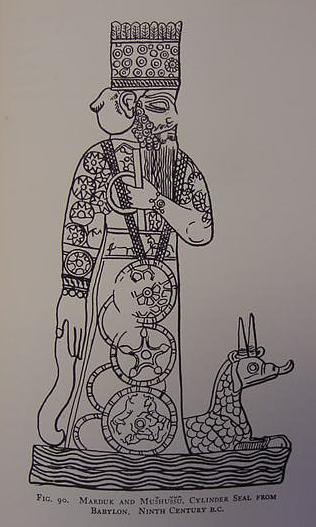
Anu "plays the part of the serpent" in that he urges man (Adapa) to eat food forbidden him by his god (Ea). According to Black and Green some myths have Tiamat being an ancestress of An/Anu (p. 177 "Tiamat." 1992) and she is portrayed in the Enuma Elish as taking on the form of a serpent-dragon who is slain by Marduk, the son of Enki/Ea. So, although An/Anu has no direct serpent-dragon association, he not bearing the epithet ushumgal, he is mythically "descended" from a serpent-dragon ancestress and some of his descendants like Enki and Enlil bear serpent-dragon epithets. According to Langdon Anu fathered 7 sons who were dragons, which to my mind associates him with dragons indirectly:
"One text refers to seven Asakku dragons, sons of Anu, who were defeated by Ninurta."
(p. 321. Stephen Herbert Langdon. The Mythology of All Races, Semitic. Vol. 5. Boston. Marshall Jones Co. Archaeological Institute of America. 1931)
Ningishzida and Dumuzi, who are identified as alternate forms of each other, are Eden's serpent according to Professor Stephen Herbert Langdon in 1931 (They, like Anu, urge Adapa to eat food forbidden him by his god Ea, and thus "play the part" of the Edenic Serpent).
Enki (Ea) (1959) and Ningizzida (1964) are understood to be Eden's serpent according to Professor Joseph Campbell.
The Gilgamesh serpent has been recast as the Edenic serpent according to Professors Bernard F. Batto (1992) and Richard J. Clifford (1994) in that it consumes the food which would have renewed youthful vigor for Gilgamesh.
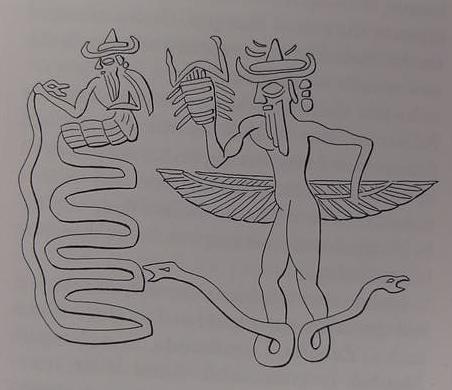
Below two gods who's bodies are half-human and serpent. Nirah is identified as a snake god of the city of Der, and associated with the e-kur temple at Nippur of the Akkadian god Ellil (Sumerian: Enlil), where he was regarded as "a protective deity of the temple and a protective presence." (cf. pp. 166-167 for commentary and drawings figure 137. "Snake gods." Jeremy Black & Anthony Green. Gods, Demons and Symbols of Ancient Mesopotamia, An Illustrated Dictionary. Austin, Texas. University of Austin Press. Published in co-operation with the British Museum Press of London, England. 1992)
The Sumerian god Enlil (Akkadian: Ellil) is identified as the principal instigator of the universal Flood sent to destroy mankind. He also is associated with the creation of mankind at Nippur, to replace the Igigi gods who object to the hard toil in his city-garden, making and clearing its irrigation canals and ditches. In Genesis it is Yahweh-Elohim who makes man, places him in his garden in Eden, to till it and later attempts man's demise with a Flood. To the degree that Enlil "plays the part of Yahweh" in creating man, placing him in his garden and later seeks man's demise in a Flood, the presence of Nirah the serpent-god at Enlil's e-kur ("mountain-house") temple is perhaps being recalled in Genesis' serpent?
Enki's punting pole by which he propels his boat in the marshes about Eridu is called Nirah, so this snake-god was not only associated with Enlil but Enki too. Interestingly, Moses' staff becomes a serpent in his confrontation with Pharaoh's magicians, and Enki was famed for his magic. So Enki's punting pole, like Moses' staff is likened to having the power to transform itself into a serpent.
Black:
"...Enki...His punting pole is Nirah; his oars are the small reeds...The ship departs...he leaves the temple of Eridug..." (p. 332. lines 83-92. "Enki's journey to Nibru." Jeremy Black, Graham Cunningham, Eleanor Robson, and Gabor Zolyomi.
The Literature of Ancient Sumer. New York & Oxford. Oxford University Press. 2004, 2006)
That is to say the below images, if they are of of Nirah, are yet again another "prototype" of Eden's Serpent.
Another "possible" prototype for the serpent in Eden's garden is Enki (Akkadian: Ea) himself. A hymn describes him as
A GREAT DRAGON that "stands" in Eridu. Acording to myth, Eridu was the first city and was created by Enki. He also planted a Mes-tree in the city's garden as well as fruit trees. In myths Enki is credited at times with creating man to work in his garden at Eridu, as well as Enlil's garden at Nippur. For the Mesopotamians Creation began at Eridu, so it is a prototype of Eden. Please click here for all the details.
Professor Bottero (emphasis mine):
"The Sublime lord of heaven and earth...
Father Enki, whom a bull has begotten...
O king, who planted the mes-tree in the Absu...
THE GREAT DRAGON, WHO STANDS IN ERIDU,
whose shadow covers heaven and earth,
An orchard full of fruit trees stretched over the Land,
Enki, lord of prosperity, (lord) of the Anunna gods..."
(p. 31. "To Enki." Jean Bottero. Religion In Ancient Mesopotamia. Chicago & London. The University of Chicago Press. 2001. ISBN 0-226-06717-3. Translated from French by Teresa Lavender Fagan. Originally published as La plus vielle religion: En Mesoptamie. Editions Gallimard. 1998)
Professor Kramer on Enki's fruit tree garden at Eridu (note: this is an "alternate" rendering of Bottero's above translation of the same verse) and that Enki is described as WALKING, TALKING, GREAT USHUMGAL "_SEPENT/DRAGON_," WHO IS _CUNNING AND WISE_ AND ASSOCIATED WITH PLANTING A GARDEN OF FRUIT-TREES AT ERIDU WHERE LIVES ADAPA. Eden's serpent could walk and talk and was associated with a garden full of fruit trees planted on the earth by _a_ god and famed for his "cunning" and "wisdom" (cf. Matthew 10:16 "...be ye therefore WISE AS A SERPENT..."). Perhaps the mes-tree planted by the CUNNING and WISE GREAT USHUMGAL has been transformed by the Hebrews into the "Tree of Knowledge of Good and Evil"? Please NOTE: Scholars render Sumerian ushumgal as "great dragon" or "dragon." Because this creature is described as partially serpentine in form, I prefer to render instead of great dragon, "serpent-dragon."
"Lord WHO WALKS nobly ON heaven and EARTH, self-reliant,
father Enki, engendered by a bull,
begotten by a wild bull...king, who turned out the mes-tree in the Abzu,
raised it up over all the lands,
GREAT USHUMGAL,
who planted it in Eridu-
its shade spreading over heaven and earth-
A GROVE OF FRUIT TREES stretching over the land...
Enki...lord of wisdom...you have given the people a place to live...you have looked after them..."
Enki, king of the Abzu, celebrates his own magnificance-
as is right...
I AM CUNNING AND WISE IN THE LANDS...
I am lord, I am the one whose word endures.
I am eternal...
(pp. 39-41. "Enki and Inanna: The Organization of the Earth and Its Cultural Processes." Samuel Noah Kramer and John Maier. Myths of Enki, the Crafty God. New York & Oxford. Oxford University Press. 1989)
Enki (Ea) is famed as a 'trickster' god whose words often have 'double-meanings' that can confuse and entrap his audience, be they gods or man. In the below excerpt his words are likened to the poison of a deadly VIPER or SERPENT, which seems to go along with the above verse describing him as a "standing or walking serpent-dragon" or ushmugal in a god's city-garden of fruit-trees at Eridu. In other myths it is Enki who creates man to work in his fruit-tree garden at Eridu to replace the Igigi gods who tire of their labor building irrigation canals; in another myth Enki warns the Mesopotamian Noah (variously called Ziusudra, Atrahasis, Utnapishtim) of the Flood that will seek to destroy all mankind, and has him build a great boat to "save the seed" of animals and man, just like Yahweh. That is to say, Enki (Ea) is not only one of several prototypes of Eden's Serpent he is one of several prototypes of Eden's God. In other words, Christianity's Satan as the Serpent in the Garden of Eden, as well as Yahweh-Elohim, are descendants -in part- of Enki (Ea) "the crafty god."
Kramer and Maier (emphasis mine):
"Hail the Abzu!...
Hail Eridu...
Ah! The Master cast the nets,Enki cast the nets,
He cast the first spell [?]...
His word is a floodwave...
that breeds fear....
THE WORD OF ENKI is a floodwave...
You are true with those who are true.
You are not true with those who are not true.
YOU ARE THE VENOM OF A VIPER SET AGAINST HUMANKIND.
HIS WORD IS THE VENOM of a lion that does not come out
for the sake of humans..."
(p. 79. "Enki and His Word: A Chant to the Rider of the Waves." Samuel Noah Kramer & John Maier. Myths of Enki, The Crafty God. New York & Oxford. Oxford University Press. 1989. ISBN 0-19-505502-0)
Professor Skinner (1910) noted the parallels between Adapa and the Southwind myth (said myth appearing in E. Schrader, editor. Keilinschriftliche Bibliothek, a series begun in 1889-, no. vi. I, 92-101) and Genesis' Adam losing out on a chance for immortality and observed that Ea's bestowal of knowledge to Adapa appeared to be mirrored in the Edenic serpent's bestowal of knowledge to Adam (Emphasis mine in CAPITALS):
"Far more illustrative affinities with the inner motive of the story of the Fall are found in the myth of Adapa and the South-wind, discovered amongst the Tell-Amarna Tablets, and therefore known in Palestine in the 15th century BC...Adapa, the son of the god Ea, is endowed by him with the fulness of divine wisdom, but denied the gift of immortality (emphasis mine):
' Wisdom I gave him, immortality I gave him not.'
"This looks like a travesty of the leading ideas of Genesis 3; yet the common features are very striking. In both we have the idea that wisdom and immortality combined constitute equality with deity; in both we have a man securing the first and missing the second; and in both the man is counseled in opposite directions by supernatural voices, and acts on that advice which is contrary to his interest. There is, of course, the vital difference that while Yahweh forbids wisdom and immortality to man, EA CONFERS THE FIRST (AND THUS PLAYS THE PART OF THE BIBLICAL SERPENT) but witholds the second, and Anu is ready to bestow both. Still, it is not too much to expect that a story like this will throw light on the mythological antecedents of the Genesis narrative, if not directly on that narrative itself." (pp. 91-92 "The Paradise Legend." John Skinner. A Critical and Exegetical Commentary on Genesis. Edinburgh, Scotland. T & T Clark. 1910, second edition 1930. Reprint of 1994. ISBN 0-567-05001-7. Note: Skinner was Principal and Professor of Old Testament Language and Literature at Westminster College, Cambridge, England)
I have identified Genesis' Adam and Eve as later Hebrew recasts of Enkidu and Shamhat, as well as Dumuzi and Inanna (and Adapa). All four are associated with a location in Sumerian myths called the edin, rendered variously by different scholars as wildernesss, plain, or steppe (the uncultivated semi-arid land through which courses the Tigris and Euphrates rivers, which in the Bible are associated with a place called Eden).
No protagonist identified specifically as a serpent appears in the Adapa and the Southwind myth to tempt Adapa (an Adam prototype). No woman (Eve) tempts Adapa (Adam) to disobey his god's warning not to eat.
Enkidu (another Adam prototype) is not conned into eating forbidden food by a serpent or woman. However,
Shamhat (Eve) and Enkidu (Adam) stop at a shepherd's camp enroute to Uruk and a meal is presented to them as a courtesy to one's guests. Enkidu balks at eating the bread and alcoholic drink presented him by the shepherds. He has eaten only grass and drunk water with his animal companions, the gazelles. Shamhat steps in and tells Enkidu to consume the food and drink for it is the custom of the land. He obeys her and consumes the items, whereupon he is declared to be "a human" (and a beast or wild animal no more). He is given a change of clothes by the shepherds. Shepherds grazed their animals in the uncultivated land contiguous to or adjoining the city-gardens or fields. This uncultivated land was called in Sumerian the edin. So, Enkidu (Adam) was urged by Shamhat (Eve) to consume food and drink he initially balked at eating, in a shepherd's camp in the edin. After consuming this food he is clothed with new garments like Adam and Eve were. That is to say, I understand Eve's urging Adam to eat forbidden food is a recasting of Shamhat urging Enkidu to eat food he balked at. Motifs from the Epic of Gilgamesh have been fused with motifs from the Adapa and the Southwind myth. Whereas Enkidu after eating is declared to be "human," Genesis has the Serpent telling Eve, after you eat you will become LIKE A GOD, KNOWING GOOD AND EVIL.
Before eating the "human-prepared-food" (bread) Enkidu was a beast or wild animal, after eating human-prepared-food, he is a beast no longer HE IS A HUMAN. The Hebrews probably objected to this portrayal of primeval man as a beast, so they changed the story-line. Yes, Adam was naked like Enkidu and unaware it was wrong to be naked, but he wasn't a beast, he was made in God's image which bestowed a certain dignity upon him. Adam's "eating" gave him knowledge of good and evil, the realization it was wrong to be naked. In the Mesopotamian myths, primeval man (initially abandoned by the gods and forgotten by them) at first roamed the edin naked, wild animals were his companions (not gods), he ate grass and drank at watering holes in the edin. The gods knew it was wrong to be naked, they wore clothes, yet they left man in this state. When naked animal-man dons clothing his existence as a beast ends and _he becomes like a god_for only the gods wore clothing in the beginning_, all other lifeforms, beasts and primeval man, went about naked without any shame. We are _not told_ that Enkidu became human because he acquired clothing, it is because he has eaten bread and consumed alcoholic drink, something animals do not do, only civilized city-dwelling humans and the gods are clothed, eat bread and drink alcoholic beverages!
Please click here for pictures of Adam as a naked agricultural servant of the gods, presenting the harvest to them in a state of nakedness, tilling their fields in a state of nakedness, pouring out drink offerings in a state of nakedness to fullly clothed gods and goddeses. Please click here for pictures of Enkidu and Shamat as well as Dumuzi and Inanna (additional prototypes of Adam and Eve).
I understand Adam is a fusion of several protagonists, Enkidu, Adapa and Dumuzi. Eve is a fusion of Shamhat and Inanna. Dumuzi bore the Sumerian epithet mulu-edin-na "lord of edin", his wife Inanna was called in Sumerian Inanna-edin-na "Inanna of edin" and nin-edin-na "lady of edin", and she was at times likened to being a serpent-dragon of the edin (and Eve, a lady of Eden is associated with a walking, talking serpent).
Foster on a hymn addressing the Akkadian goddess Ishtar (Sumerian Inanna) as a "great dragon," hoping she will cure the Assyrian king of his illness:
"I am Assurnasirpal, your ailing servant...
who unfailingly supplies your food offerings...
Who provides generously the beer that you want and enjoy...
it was you, Ishtar, TERRIFYING DRAGON OF THE GODS,
That appointed me by your desire
and wished that I should rule..."
(pp. 274-275. "Assurnasirpal I, on Occasion of Illness." Benjamin R. Foster. From Distant Days, Myths, Tales, and Poetry of Ancient Mesopotamia. Bethesda, Maryland. CDL Press. 1995)
How does one account for the Hebrews' having knowledge of The Epic of Gilgamesh and the Adapa and the Southwind myth to be able to recast them into Genesis' Adam and Eve and the Garden _in_ Eden? That is to say what is the "mechanism" whereby hoary Mesopotamian compositions and their motifs and concepts came to be "known and recast" by Israel? One possible answer is Abraham who lived circa 2100 BCE at Ur of the Chaldees, modern Tell el Muqayyar south of Babylon. However another avenue of transmission is the Iron Age I (1260-1100 BCE) "Canaanite forefathers" of Iron Age II Israel (1100-587 BCE).
Some scholars have noted that the watering hole in the "steppe" that the naked Enkidu is "undone at" by a naked Shamhat is rendered seru in Akkadian. What some people are unaware of however is that the Akkadian scribes were trained in the writing of Sumerian as well and that the Sumerian word for "steppe" is edin. I have been able to confirm that The Epic of Gilgamesh (which is written in Akkadian) at times "uses" the Sumerian LOGOGRAM (EDIN) in place of the word seru. The logogram is being employed by the scribe as a form of "shorthand." That is to say while (EDIN) is the actual word found in some passages in The Epic of Gilgamesh tablets for "steppe," it is equated in the Akkadian reader's mind as seru. In other words down through the centuries via the Sumerian LOGOGRAM (EDIN), Enkidu the naked man of the Akkadian seru was associated with the earlier Sumerian edin.
Heidel renders a passage from The Epic of Gilgamesh identifying Enkidu as a savage of the "steppe" or seru, but (EDIN) is the actual word on the clay tablet, not seru (note: I have added [Enkidu] in brackets to clarify who "he" is in the below quotation; by the way (GURUS) is "another" Sumerian logogram for Akkadian itlu):
"...while on Tablet I. 4:7, he [Enkidu] is called itlu (GURUS) sag-ga-sa-a sa-qa-bal-ti seri (EDIN):
"The savage man from the midst of the seru."
(cf. p. 233. Alexander Heidel. "A Special Usage of the Akkadian Term Sadu." pp. 233-235.
Journal of Near Eastern Studies. Vol. 8. No. 3. July 1949)
(My thanks to Robert Whiting, PhD, of Helsinki, Finland, a trained Assyriologist, for explaining to me the use of Sumerian logograms in Akkadian texts as substitutes for Akkadian words _is quite common_, and the presence of the logogram (EDIN) in the Epic of Gilgamesh as a substitute for Akkadian seru meaning "steppe")
Scholars who have studied the pre-Akkadian evolution of The Epic of Gilgamesh have determined that it existed earlier in various Sumerian short stories about Enkidu and Gilgamesh, and that later the Akkadians fused these accounts together and recast them into a new story. The Sumerian short-story "originals" use at times the word edin when speaking of the "steppe" wandered by Gilgamesh and Enkidu.
Some conservative Bible scholars have argued that Israel conquered Canaan circa 1406 B.C. on the basis of 1 Kings 6:1 chronology. The "days of the Judges" for these scholars extends from circa 1406 to 1020 B.C. when Saul becomes king. Of interest here is that the Bible states that Israel eventually intermarried with the Canaanites and worshipped their gods (Judges 3:5-6). One of the Canaanite peoples Israel intermarried with was the Jebusites of Jerusalem.
Judges 3:5-7 (RSV)
"So the people of Israel dwelt among the Canaanites, the Hittites, the Amorites, the Perizzites, the Hivites, and THE JEBUSITES, and they took their daughters to themselves for wives, and their own daughters they gave to their sons; and they served their gods. And the people of Israel did what was evil in the sight of the Lord their God, and served the Baals and the Asheroth."
Archaeologists unearthed at Tell el Amarna in Egypt clay tablets from Canaanite kings or princes addressed to Pharaoh Akhenaten who reigned circa 1350-1334 B.C., in "the days of the Judges" (some conservative Bible scholars' 1406-1020 BCE). Found among these tablets were reports from the Canaanite ruler of Jerusalem, Abdu-Heba, alerting Pharaoh that Canaan is under attack by malcontents who he calls 'apiru or 'habiru and these tablets are written in Akkadian cuneiform, betraying a Canaanite vernacular. In antiquity scribes "learned" not only Akkadian but Sumerian in order to use properly Sumerian logograms for shorthand. They also studied Sumerian literary texts as well as Akkadian literary texts as part of their training. At Megiddo archaeologists found on a clay tablet written in Akkadian a passage from the The Epic of Gilgamesh (of the Amarna era 1350-1334 B.C.).
All this is to say that the Jebusites of Jerusalem in the "days of the Judges" were trained in cuneiform and knew Akkadian and Sumerian and probably also had read The Epic of Gilgamesh and its story of a naked Enkidu being separated from his wild animal companions by a naked woman (Shamhat) at the steppe's (EDIN) watering hole. I suspect that the Israelite "descendants" of the intermarriages at Jerusalem came to know via their Canaanite forefathers (the Jebusites) the story of a place called edin where a naked man was undone and separated from his animal companions by a naked woman, and by Iron Age II times (ca. 1200-587 B.C.) had recast this as Adam and Eve in the Garden in Eden. Also found at Pharaoh Akhenaten's Tell el-Amarna was a clay tablet with the story of Adapa and the Southwind myth inscribed upon its surface, suggesting this story was still circulating as late as the "days of the Judges," for scribes to study as part of their training in Akkadian and Sumerian.
The Bible is generally understood to have been crafted at Jerusalem by priests, some of whom in turn were probably the descendants of the Late Bronze Age Jebusites if Judges 3:5-6 is to be believed. King David (who reigned ca. 1000-961 B.C.) is credited with capturing Jerusalem and he bought of Arunah the Jebusite a threshing floor which under his son Solomon, would become the site of the Temple of Solomon, a location where under King Josiah (who reigned circa 640-609 B.C.) the Torah or Law of Moses would be "found" by the high priest Hilkiah (cf. 2 Kings 22:8-20).
How is it possible that the archaic Sumerian logogram (EDIN) used for Akkadian seru survived into Iron Age I-II times in Canaan (Jerusalem) to become transformed into Genesis' eden (Hebrew: `eden)?
I submit the following from Moran who remarks about archaic relics of language and scribal practices surviving in Canaan, long forgotten of in the motherland:
"Language and writing. The Amarna letters are manifestations of the 'cuneiform culture' that was shared in the 14th century BC throughout the ancient Near East...By the middle of the 3rd millennium B.C. not only had cuneiform writing been introduced into Syria, but already at that early date...it was being used in a breadth of application and with a sophistication rivaling those of the great centers in Sumer and Akkad. By the first quarter of the 2d millennium B.C. knowledge of cuneiform writing had spread far and wide, and Babylonian had become the principal language of a cosmopolitan culture. It was the language of international relations, but often, too, of local affairs, both legal and administrative. It was also a language of learning...the language of the Amarna letters is Babylonian, but for the most part it is a Babylonian profoundly different from that of the previous international age. It reflects many of the developments that one finds in the 'good' Middle Babylonian language of the letters from Babylonia itself. But if the cuneiform culture of the provinces was to some extent up-to-date, it was not infrequently, as is usually the way with the provinces, also behind the times. This is true of the writing: a logogram that had been replaced by another logogram centuries before in the scribal schools of Babylonia survives in the provincial culture; an exercise once part of the scribal training but long abandoned in Babylonia is still part of the provincial curriculum; old orthographies are retained, sometimes mixed together with modern ones; and so on. In the language, too, one finds a similar quaint and archaic quality. The provincial scribes, perhaps at times because of analogues in their own native language, may use old common or dialectal forms that had otherwise disappeared centuries before. Their lexicon is full of words that by the 14th century B.C. had either disappeared completely from the Babylonian language or lived on only in the elevated language reserved for the solemnities of myth, epic, hymns and prayers. It is this combination of the old and the new that is so typically provincial and so distinctive of the Amarna letters." (pp.xix-xx. "Introduction." William L. Moran. The Amarna Letters. Baltimore. The Johns Hopkins University Press. 1987)
Please click here for a greater, in-depth article on the Edenic Serpent's pre-biblical protagonists and their associations not only with snakes, walking dragons, man's lost chance at immortality, but also their association with fruit-trees planted in the gods' gardens of Sumer, man according to the myths being created to care for these gardens.
Professor Batto (1992) on the Hebrews recasting of earlier Mesopotamian myths and motifs in the Hebrew Bible:
"...I want to emphasize that this new mythmaking process is a conscious, reflected application of older myths and mythic elements to new situations...In so far as one admits the presence of myth in ancient Babylonian and Canaanite culture, then one must also admit the presence of myth in the Bible...This book, then, is a series of case studies of mythmaking in ancient Israel, or to be more exact, in the biblical tradition." (pp. 13-14. "Introduction." Bernard F. Batto. Slaying the Dragon, Mythmaking in the Biblical Tradition. Louisville, Kentucky. Westminster/John Knox Press. 1992)
"Now the Yahwist's primeval narrative is itself a marvelous example of mythmaking based upon prior Mesopotamian myths, notably Atrahasis and Gilgamesh. Interestingly, the reappropriation of mythic traditions and intertextual borrowing posited for biblical writers was already present within ancient Babylonia, and illustrates that biblical writers must be understood within the larger ancient Near Eastern literary and theological tradition." (p. 14. "Introduction." Bernard F. Batto. Slaying the Dragon, Mythmaking in the Biblical Tradition. Louisville, Kentucky. Westminster/John Knox Press. 1992)
"The theme of this volume...is, of myth and mythmaking speculation within the Hebrew Bible...biblical writers employed much the same techniques and even the same mythic motifs as their ancient Near Eastern neighbors...Israel...drew heavily upon the Babylonian myth of Atrahasis, supplementing with motifs from Gilgamesh and other traditional myths, to create a specifically Israelite primeval myth...Like their ancient Near Eastern counterparts, Israel's theologians were concerned with the place of humankind -and particularly of their own people- within the realm of being." (pp. 168-169. "Conclusion." Bernard F. Batto. Slaying the Dragon, Mythmaking in the Biblical Tradition. Louisville, Kentucky. Westminster/John Knox Press. 1992)
"The focus of this volume has been the various ways in which biblical writers throughout the history of the composition of the Hebrew Bible have used and reused myth...to undergird their religious and/or sociopolitical agenda. My purpose...has been only to show through representative examples how biblical authors actually went about using mythic motifs in their writing and how they consciously manipulated these to serve their specific purposes." (pp. 171-172. "Conclusion." Bernard F. Batto. Slaying the Dragon, Mythmaking in the Biblical Tradition. Louisville, Kentucky. Westminster/John Knox Press. 1992)
All of the gods involved in the Adapa and the Southwind myth which is understood by some scholars to have been recast as Adam's lost chance to obtain immortality, were in myths married.
Anu's wife was Antum (p. 5. "Anu." Leick); Ea/Enki's wife was Damkina (p. 41. "Enki." Leick); Ningishzida's wife was Geshtianna sister of Dumuzi (p. 131. "Ningishzida." Leick); Dumuzi's wife was Inanna/Ishtar (p. 32. "Dumuzi." Leick). Adapa is not portrayed as married nor is Enkidu (both being prototypes of Adam according to some scholars).
From the contradicting Mesopotamian myths regarding the creation of man, his lost chance at obtaining immortality for himself and his demise being sought in a universal flood it is clear that the gods were viewed as both benefactors and enemies of mankind. The gods did not have to behave in an ethical manner, they could and were capricious at times in regards to man.
The Serpent in the Garden of Eden presented itself as man's benefactor, warning Eve that God was lying, God's concern was not that she and Adam would die, rather God's concern was that they would become "like him, knowing good and evil." Genesis' narrator has God repeating back the serpent's words, confirming the serpent's shrewd and penetrating analysis which unmasked God's duplicity:
Genesis 3:4-5, 22 RSV
"But the serpent said to the woman, "You will not die. For God knows that when you eat of it your eyes will be opened and you will be like God, knowing good and evil...Then the Lord God said, "Behold, the man has become like one of us, knowing good and evil..."
In the Adapa and the Southwind myth, Ea, who is credited with creating mankind and placing him in his fruit-tree garden at Eridu to work it and thus end the toil of the Igigi gods, lies to Adapa, telling him not to eat or drink anything for it is the food and water of death. In other words, Ea portrays Anu, Ningishzida and Dumuzi falsely as man's enemy, seeking his death, when in fact they sought man's welfare in offering him a chance at becoming like a god and possessing immortality. Ea succeeded, his will "trumphs" the will of Anu who sought immortality for man. That is to say man's creator and benefactor, Ea (Enki) was also man's nemesis, lying to him because he did not want man to have immortality.
Foster (Professor of Assyriology at Yale University) on Ea's tricking man out of immortality, Ea apparently fearing the loss of man as his servant if made a god (emphasis mine):
"When Adapa declined the food and drink, which would have made him a god and released him from Ea's service, Anu was vastly amused by Ea's cleverness and his sage's stupidity, and so sent the swindled mortal back home." (p. 97. "How Adapa Lost Immortality." Benjamin R. Foster. From Distant Days, Myths, Tales, and Poetry of Ancient Mesopotamia. Bethesda, Maryland. CDL Press. 1995)
"They brought him food of life, he did not eat,
They brought him waters of life, he did not drink...
Anu stared and burst out laughing at him,
"Come now, Adapa, why did you not eat or drink?
"Won't you live? Are not people to be im[mor]tal?"
Ea my lord told me,
'You must not eat, you must not drink...
Anu laughed uproariously at what Ea had done,
"Who else, of all the gods of heaven and netherworld,
could d[o] something like this?
"Who else could make his command outweigh Anu's?"
"That is, by thwarting Anu's good intentions to give Adapa eternal life."
(p. 101. "How Adapa Lost Immortality." Benjamin R. Foster. From Distant Days, Myths, Tales, and Poetry of Ancient Mesopotamia. Bethesda, Maryland. CDL Press. 1995)
In the Hebrew Bible (Christianity's Old Testament) Satan is not portrayed as the serpent in Eden's garden, according to Jewish thinking (Please click here for my article on the pre-biblical origins of Satan and his Demons). It is Christianity that has identified Eden's serpent with Satan (Revelation 20:1-3). Motifs from the Adapa and the Southwind myth have been identified by several scholars as being recast as Adam and Eve's lost chance to obtain immortality by disobeying their creator's command NOT TO EAT. Ea (Enki) issued this command to Adapa and Adapa OBEYED, thereby losing a chance to obtain immortality for himself and mankind. Anu realizing Ea has given Adapa forbidden knowledge (spells to overpower the Southwind deity) offers Adapa immortality. The Hebrews have "reversed" the storyline, instead of immortality being offered by a god because man has forbidden knowledge, it is denied.
Anu, Ea (Enki) and Enlil in other myths are associated with man's creation. In other myths it is Anu and Enlil who instigated the Flood, while Ea (Enki) warns one man to build a boat and "save the seed of man and animals" for a new beginning. In other words, Anu and Ea (Enki) in other myths are credited with man's creation, both are involved in the universal Flood, and both are involved in the Adapa and the Southwind myth regarding man's lost chance at immortality via the eating or non-eating of a food item. So Genesis' Yahweh-Elohim who is associated with creating man, denying him knowledge and immortality, and seeking later man's demise in a Flood, is a later recast of Anu (An), Enlil (Ellil) and Enki (Ea).
Anu (An), Enlil (Ellil), Enki (Ea) and Ninhursag (a goddess) are credited with creating mankind (note: "plain" in Sumerian is edin so the creatures of the plain are the "creatures of edin"):
"After Anu, Enlil, Enki, and Ninhursag
Had fashioned the black-headed (people),
Vegetation luxuriated from the earth,
Animals, four-legged (creatures) of the plain, were
brought artfully into existence..."
(p. 28. "The Deluge. A Sumerian Myth." James B. Pritchard. Editor. The Ancient Near East, An Anthology of Texts and Pictures. Princeton, New Jersey. Princeton University Press.1958)
For the most part, what you have read here dear reader is unknown to mankind at large, although it has been published and in the scholarly literature for over 100 years, it is known only by professional scholars who are "well-read" in the Mesopotamian texts (Sumerian and Akkadian). Millions who are alive today, Jews, Christians, and Moslems are _unaware_ of the knowledge on this page and will probably remain in such a state of ignorance until their dying day. Sadly, the blood shed in the past over their religious "differences" will most probably continue to be shed for hundreds of years into the future.
Professor Barton (1916) on some scholars having suggested the Adapa Myth was behind Genesis' motif of Adam's Fall:
"An increasing number of modern scholars regard the Babylonian story as an earlier form of a narrative which the Hebrew writer took and purified...In the Babylonian myth, the gods Ea and Anu, are divided and work at cross purposes; Ea tells a falsehood to accomplish his end."
(p. 261. George A. Barton. Archaeology and the Bible. Philadelphia. American Sunday-School Union. 1916. Note: George Aaron Barton (1859-1942) was a Professor of Biblical Literature and Semitic Languages at Bryn Mawr College)
I have identified Ea of the Adapa and the Southwind myth as being one of several prototypes of Eden's serpent. He gives Adapa "forbidden knowledge" (curses to over power the wind-god, said knowledge in man's possession upsetting the god Anu), but denies him immortality. Genesis' serpent is credited with inspiring Eve and consequently, Adam to obtain forbidden knowledge, said act resulting in their not obtaining immortality via Yahweh's intervention. The Akkadian Ea in his earlier role as the Sumerian Enki bore the Sumerian epithet ushumgal, "great serpent dragon," and his cunning double-meaning words in hymns were likened to a viper's venom entrapping and undoing sinners. In his human form Ea/Enki can walk and talk to man, whom he is credited with making at Eridu to work in his fruit-tree garden at Eridu in Sumer to replace the rebelling Igigi gods who object to the toil. Later, Ea/Enki changes the one language of mankind into a babel of tongues to spite his brother-god Enlil of Nippur. In another myth, Enlil seeks the demise of mankind via a flood. Ea/Enki defies his brother and warns one man, Ziusudra of Shuruppak, to build a boat to save the seed of animals and mankind for a new beginning. That is to say, I understand that Yahweh who sent the flood and warned Noah to build a boat, and who later at the tower of Babel changed man's one language into many is a fusion in part of Enlil/Ellil and Enki/Ea.
In the Adapa and the Southwind myth Ea (Enki) warns his servant Adapa not to consume the "bread of death" or "water of death" which Anu will offer him. Adapa OBEYS his lying god and refuses these items proferred by Ningishzida and Dumuzi on Anu's behalf. To the degree that Anu, Ningishzida, and Dumuzi encouraged Adapa to consume the "bread and water of life" CONTRA Ea's admonition, they "play the part" of Eden's serpent. Thus, all four gods are playing the part of Eden's serpent: Ea, Anu, Ningishzida, and Dumuzi (Ea "playing the serpent's part" in giving _forbidden knowledge_ to Adapa against Anu's wishes).
Three gods have "serpent associations" via epithets they bear: Ea in his earlier role as Enki is called ushumgal "great serpent-dragon," Dumuzi is called in Sumerian ama-ushumgal-an-na "the mother is a great serpent-dragon of heaven," and Ningishzida is able to assume a serpent-dragon form. Anu is "peripherally" related as he is credited as being the father of the gods some of whom are associated with serpent epithets. However, there exists NO rendering in art of Ea, Anu, or Dumuzi in a serpent's form. Their "serpent associations" are primarily via their serpent-dragon epithets (Sumerian:ushumgal). The one exception is _if_ the serpents modeled in clay and placed under the altar at Enki/Ea's temple in Eridu are intended to represent him as an ushumgal or "great serpent-dragon." That is to say, I understand that Eden's Serpent who could "walk and talk" is a later Hebrew recast of the gods who in human form interacted with Adapa (Adam), but because they bore the Sumerian epithet ushumgal meaning "great-serpent-dragon" they came to be fused together into one protagonist in the form of a serpent or snake who would loose his legs. In other words Professor Skinner back in 1910 was "right":
"It is more probable that behind the sober description of the serpent as a mere creature of Yahwe, there was an earlier form of the legend in which he figured as a god or a demon." (pp. 71-72. John Skinner. A Critical and Exegetical Commentary on Genesis. Edinburgh, Scotland. T &T Clark. 1910. Revised edition 1930. Reprint 1994)
Skinner was also "right" in identifying Ea as playing the part of Eden's serpent in conferring forbidden knowledge on man in the form of Adapa (emphasis mine):
"There is, of course, the vital difference that while Yahweh forbids wisdom and immortality to man, EA CONFERS THE FIRST (AND THUS PLAYS THE PART OF THE BIBLICAL SERPENT) but witholds the second, and Anu is ready to bestow both." (pp. 91-92 "The Paradise Legend." John Skinner. A Critical and Exegetical Commentary on Genesis. Edinburgh, Scotland. T & T Clark. 1910, second edition 1930. Reprint of 1994)
Below, a picture of Ea (Enki) who not only played the part of Eden's Serpent, but also the part of Eden's God, Yahweh-Elohim in that in other myths he is credited with creating man at Eridu and Nippur, denying him immortality, changing the one language of mankind into a babel of tongues, and warning one man to save the "seed of man and animals" from the universal Flood by building a great boat (for the below photograph of the cylinder seal described as Akkadian circa 2334-2154 BC, cf. figure 428, p. 30. "The Surena Collection of Ancient Near Eastern Cylinder Seals." Christies Auction Catalogue. New York City. Sale of 11 June 2001).
Below, a picture (drawing) of a Babylonian Serpent-dragon from the Ishtar Gate at Babylon. In Babylonian myths the supreme god of Babylon, Marduk (biblical Merodach) overcame the dragons of the salty sea under Tiamat's command, assuring his preiminance among the gods who dwelt on the earth. This dragon was of glazed brick and colored red, the background being blue (for the below drawing cf. p. 316. figure 6. "The Mushussu-dragon." Stephanie Dalley. Myths From Mesopotamia, Creation, The Flood, Gilgamesh And Others. Oxford & New York. Oxford University Press. 1989, 1991)
Black and Green:
"The snake-dragon (with horns, snake's body and neck, lion's forelegs and bird's hindlegs) is represented from the Akkadian Period down to the Hellenistic Period as a symbol of various gods...The mushussu...became associated with Ninazu's son Ningish-zida...the creature was transferred to the new Babylonian national god, Marduk, and later to Nabu. The conquest of Babylon by the Assyrian king Sennacherib (reigned 704-681 BC) brought the motif to Assyria, normally as the beast of the state god Asshur. On Sennacherib's rock-reliefs at Maltai, however, the creature accompanies three different gods, Asshur, Ellil (Enlil) and another god, most likely Nabu." (cf. p. 166. figure 138. for commentary and drawing. "Snake-dragon." Jeremy Black & Anthony Green. Gods, Demons and Symbols of Ancient Mesopotamia, An Illustrated Dictionary. Austin, Texas. University of Austin Press. Published in co-operation with the British Museum Press of London, England. 1992)
To the degree that Assyrian rockcut bas-reliefs at Maltai associate the serpent-dragon with the Sumerian god Enlil (Akkadian: Ellil) and this god in myths is associated with man's creation at Nippur and later seeking man's demise in a universal flood, we have "another" prototype of Eden's Serpent. The Maltai reliefs show the god Enlil/Ellil standing upon the back of this creature.
Below, a picture or drawing (1992) from Gudaea's cylinder seal showing King Gudea of Lagash, Ningishzida and a seated god identified as Enki according to Black and Green, but possibly Gudea's god Ningirsu of Lagash (?).(cf. p. 139. figure 115. "Ningishzida." Jeremy Black & Anthony Green. Gods , Demons and Symbols of Ancient Mesopotamia, An Illustrated Dictionary. Austin, Texas. University of Texas Press. Published in co-operation with the British Museum Press, London. 1992). A "mystery" exists regarding Ningishzida's name. Nin is usually translated as "lady," whereas En is "lord." For various scholarly suggestions as to the meaning of the name Ningishzida please click here.
Ningishzida and Dumuzi who brought Adapa of Eridu before Anu were brothers-in-law. Ningishzida's wife was Geshtinanna, the sister of Dumuzi. Professor Langdon noted a hymn calling Dumuzi "Damu the child Ningishzida," apparently identifying Dumuzi with Ningishzida. To the degree Geshtinanna means "heavenly grapevine" does Nin-gish-zida mean "faithul/true lady of the grapevine"?
Black and Green on Ningishzida as the star constellation, Hydra:
"The symbol and beast of Ningishzida was the horned snake or dragon basmu (see Snakes) and astrologically Ningishzida was associated with the constellation we know as Hydra...See Damu; Snake-dragon; Snake gods."
(p. 140. "Ningishzida." Jeremy Black & Anthony Green. Gods , Demons and Symbols of Ancient Mesopotamia, An Illustrated Dictionary. Austin, Texas. University of Texas Press. Published in co-operation with the British Museum Press, London. 1992)
Below a picture of Ningishzida as the star constellation Hydra (a mythological being with serpent heads for hair in Greek myths). Ningishzida/Hydra is portrayed as serpent-dragon with the forepaws of a lion, but no hind legs, the example is from a clay tablet of the Persian period according to Langdon (1931) but Black and Green (1992) date it to the Greek Seleucid period, the successors of Alexander the Great. The Lion represents the constellation Leo (cf. pp. 286/305 figures 89 & 91 for my combining of the two drawings. Stephen Herbert Langdon. The Mythology of All Races: Semitic. Volume 5. Boston. Archaeological Institute of America. Marshall Jones Company. 1931 and p.190. figure 159. Jeremy Black & Anthony Green. Gods , Demons and Symbols of Ancient Mesopotamia, An Illustrated Dictionary. Austin, Texas. University of Texas Press. Published in co-operation with the British Museum Press, London. 1992).
Below, images of Ningishzida as an erect serpent-dragon from the Gudea vase, the cuneiform inscription being omitted by the artist (cf. p. 285. Figure 88. "The Dragon Mushussu. Stone Vase of Gudea." Stephen Herbert Langdon. The Mythology of All Races: Semitic. Volume 5. Boston. Archaeological Institute of America. Marshall Jones Company. 1931).
Black on Ningishzida being a god who loves justice:
"...Ningishzida, who brings together giant snakes and dragons!...who directs speech aright, and who hates wickedness! Mighty power, whom no one dare stops when he spreads confusion!...The merciful king [Enki] entrusted you from your birth...He let you have life and creation...Who can rival you in the highest heaven?...you who carry out commands in the great Underworld..." (pp. 250-252. " A balbale to Ningishzida." Jeremy Black, Graham Cunningham, Eleanor Robson & Gabor Zolyomi. The Literature of Ancient Sumer. Oxford University Press. 2004 hardback edition, 2006 paperback edition with corrections) My note: The above verse acclaims Ningishzida's powers in Heaven, the Earth and the Underworld, recalling somewhat Satan "that old serpent and dragon" who's powers and activities ranged over Heaven, the Earth and the Underworld in the book of Revelation (Rev 12:1-17; 20:1-3)
Marduk (biblical Merodach) the chief god of Babylon is given credit for creating mankind to be a slave of the gods, relieveing them of toil for life's necessitities, food, shelter and clothing, upon the earth (rather like Enki/Ea of Eridu and Enlil/Ellil of Nippur). At Marduk's feet sits a serpent-dragon with two horns. Below them waves perhaps represnt the primordial salty sea personified as Tiamat, mother of the gods who was slain by Marduk. She had fashioned serpent-dragons to attack the gods who had rebelled against her. In defeating Tiamat Marduk appropriated the serpent-dragon as his symbolic beast, and Babylon's as well (for the below picture cf. p. 301. figure 90. From a cylinder seal of the 9th cetury B.C. found at Babylon. Stephen Herbert Langdon. The Mythology of All Races: Semitic. Volume 5. Boston. Archaeological Institute of America. Marshall Jones Company. 1931). In hymns Marduk also bore the Sumerian epithet ushumgal meaning "great serpent dragon."
Below, a close-up of the above stela showing Lagash's King Gudea/Gudaea (his face hacked away apparently by a non-admirer) being grasped by the hand by the god Ningishzida and led to a seated god (?) who dispenses life-giving freshwater needed for Lagash's crops. Ningishzida has serpent-dragon heads erupting from his shoulders. The god standing before Ningishzida is unidentified, but he "might be" Dumuzi, who, with Ningishzida in the Adapa and the Southwind Myth brought man (Adapa) before Anu to receive the "water of life" (for the photo cf. figure 189. Anton Moortgat. Die Kunst des Alten Mesopotamien, Die klassische Kunst Vorderasiens. Darmstadt. Wissenschaftliche Buchgesellschaft. 1967. Verlag M. DuMont Schauberg. Koln). Gudea holds a palm frond in his hand, perhaps from a date palm? Date palm plantations existed in antiquity in Mesopotamia and were an important food source. The Bible suggests for some scholars the "Tree of Life" planted in the Garden of Eden may have been a Date palm as Solomon's Temple is described as having Cherubim and Palmtrees lining its walls (1 Kings 6:32) and God stations the Cherubim to deny man access to the "Tree of Life" in Eden's Garden (Genesis 3:24).
Below, a line drawing of the above stone stela from Girsu (cf. p. 251. figure 30. "Ningishzida, who brings together giant snakes and dragons!" Jeremy Black, Graham Cunningham, Eleanor Robson & Gabor Zolyomi. The Literature of Ancient Sumer. Oxford University Press. 2004, 2006 paperback edition). This scene reminds me of Adapa being presented to Anu by Gishzida (Ningishzida) and Dumuzid (Tammuz) to receive the "water of life" and "bread of life" conferring immortality on man if consumed. The above photo shows a stream of water on the viewer's far right side, perhaps it is "the water of life" being dispensed by a seated god with which Gudaea can grow date palms for the god's table and nourishment (Gudaea holding a palm branch, probably indicating he oversees the caring for the god's fruit-tree garden in the edin).
Black on the Sumerian god Enlil being called a "dragon of the earth" (However Enlil or Akkadian El-lil does not appear in the Adapa and the Southwind myth):
"Enlil, faithful shepherd of the teeming multitudes, herdsman, leader of all living creatures...He alone is the prince of heaven, THE DRAGON OF THE EARTH. The lofty god of the Anuna himself determines the fates."
(p. 323. "Enlil in the E-kur." Jeremy Black, Graham Cunningham, Eleanor Robson & Gabor Zolyomi.
The Literature of Ancient Sumer. Oxford University Press. 2004 hardcover, 2006 paperback with corrections)
Enlil is credited with being responsible for the creation of man at Nippur (Sumerian: Nibru) to replace the rebelling Igigi gods who tire of building canals and irrigation ditches for his city-garden. Man will plant seed, hoe weeds and harvest the garden produce to feed Enlil, the Anunnaki and Igigi gods, giving these gods rest from earthly toil for-ever-more. In other myths Enlil is singled out as instigating a worldwide flood to destroy mankind because their noise disturbs his rest and sleep. I suspect that Enlil, THE DRAGON OF THE EARTH, who made mankind and who sought his destruction in a universal world-wide Flood, has been recast by the Hebrews into Yahweh-Elohim who made man (Adam) and placed him in his Garden of Eden, and later sought man's demise with a Flood. The Sumerian god Enki of Eridu who bore the epithet ushumgal, "GREAT SERPENT-DRAGON," warned one man of the coming Flood having him build a boat to save the seed of man and animals. Yahweh-Elohim of the Garden of Eden is then a fusion of two Sumerian gods who both bore serpent-dragon epithets and who were both credited with making man and who were both involved in a flood to destroy mankind, En-lil and En-ki (Akkadian Ea of the Adapa and the Southwind myth). That is to say, a god (En-lil) who bore a serpent epithet "dragon of the earth" sought man's DESTRUCTION in a Flood, and another god (En-Ki) who bore a serpent epithet "great serpent-dragon" lied to man about not eating the bread of life which would have given him immortality. These two gods, En-Ki and En-Lil (who had man created in order to work in their city garden at Eridu and Nippur both bore serpent epithets) were not only man's creator they denied him immortality and sought his demise. Eden's srepent is portrayed as responsible for denying man immortality and seeking his demise; I understand that Genesis' Serpent is a recast of several Sumerian gods who were associated with man's creation, his losing a chance at immortality, and his demise in a Flood, who bore serpent-dragon epithets.
Genesis' portrayal of Eden's Serpent as being "crafty" or "wily" or "subtle" seems to mirror Professor Kramer's portrayal of Enki:
Genesis 3:1 (NIV)
"Now the serpent was MORE _CRAFTY_than any of the wild animals the LORD God had made."
(The Holy Bible, New International Version. Grand Rapids, Michigan. Zondervan Publishers. International Bible Society. 1984)
I note that Professor Kramer's book on the Sumerian god Enki (en=lord, ki=earth) who created man and denied him immortality bore the Sumerian epithet ushumgal meaning "great serpent-dragon" (ushum= serpent, gal= great) and he is famed for his "craftiness" or subtle words that confuse and ensnare gods and men. The book is titled Myths of Enki, the Crafty God (New York & Oxford. Oxford University Press. 1989. Co-authored with John Maier).
According to Professor Kramer the Sumerian god Enki by circa 2500 B.C. (Kramer. 1989:3) had been assimilated and transformed by the Akkadians into Ea. Kramer does not offer a meaning for Ea (Kramer. 1989:3) but other scholars have suggested it might mean "House of Water" (e=house, a=water).
Enki of Eridug, now recast as Ea of Eridu, is portrayed denying immortality to man in the form of his dutiful servant Adapa at Eridu in Sumer by _craftily_ conning him, telling him not to eat or drink the "bread of death" or the "water of death" to be offered him by the god Anu (Sumerian: An, meaning "heaven") or he will surely die. Adapa _obeys_ his god's warning or command and thus forfeits for himself and mankind, immortality. So man (Adapa) was denied immortality by his creator Ea who bore the epithet ushumgal, "great serpent-dragon" in his earlier form of Enki who was famed for his _craftiness_ like Eden's _crafty_ serpent that caused man to lose out on a chance to obtain immortality through subtle, conning words.
Kramer explains why he chose to portray Enki as a "crafty" as well as a "cunning" trickster god:
"Enki is regularly given the epithet "lord of wisdom." Because the concept of wisdom was already complex very early in the ancient world and had dimensions other than the extremes found in the biblical tradition...we have chosen to avoid "wisdom" when the Enki stories seem to demand shrewdness or cunning, the assets of the Trickster...Perhaps "crafty" is a better term to use for the problem-solving Enki...the more familiar sense, that craft means "showing skill or cleverness," artful and wily, captures something of the "wisdom" of Enki."
(p. 5. "Introduction." Samuel Noah Kramer & John Maier. Myths of Enki, the Crafty God. New York & Oxford. Oxford University Press. 1989)
Other translations of Genesis 3:1 and Eden's Serpent as cunning, subtil (subtle), wiser, clever (characteristics attributed to Enki the ushumgal who as Ea, conned man out of a chance to obtain immortality):
(NKJV) Genesis 3:1 Now the serpent was more cunning than any beast of the field which the LORD God had made.
(KJV) Genesis 3:1 Now the serpent was more subtil than any beast of the field which the LORD God had made.
(RSV) Genesis 3:1 Now the serpent was more subtle than any other wild creature that the Lord God had made.
(BBE) Genesis 3:1 Now the snake was wiser than any beast of the field which the Lord God had made.
(GodsWord) Genesis 3:1 "The snake was more clever than all the wild animals the LORD God had made.
Christianity understands that Eden's Serpent did not want man to have immortality so it urged man (Eve and Adam representing mankind) into eating forbidden fruit contra Yahweh's command by conning Eve. In the Mesopotamian myths two deities bear the Sumerian epithet ushumgal meaning "great serpent-dragon": Enki and Dumuzi. Enki was recast later into Ea who conned man (Adapa) out of chance to obtain immortality while Dumuzi the ushumgal offered man (Adapa) forbidden food (bread of life) that Ea had said was the food of death. Apparently two dieties, Ea and Dumuzi, working at cross purposes to each other in regards to man's destiny (both bearing the epithet "great serpent-dragon") have been fused together and recast as Eden's serpent who offers forbidden food (Dumuzi) and who employs cunning in its use of subtle words (Ea), misleading man (Adapa, Adam and Eve) into a situation which will deny man immortality. In some myths Dumuzi is described as being "the son of nudimmud," a title of Enki's meaning "creator." I find it interesting that father and son (Enki and Dumuzi) both bore the epithet ushumgal, "great serpent-dragon" and while the father Enki (later recast as Ea) sought to deny man immortality, his son, Dumuzi (Tammuz), offered man immortality _contra is father's wishes_, rather like God the father denying Adam immortality but God's only begotten son Christ offering man immortality with the right to eat of the tree of life in Eden's garden at Jerusalem.
Please click herefor Part Twoof this article which includes Conclusions and Bibliography.
Please click here for a picture of several fabulous beasts which might be Cherubim guarding date palms from a wall mural found at ancient Mari on the Euphrates river ca. the 18th century B.C.
Please click here for additional pictures of Enki/Ea as he appears on various Cylinder Seals.
Please click here for additional pictures of Mesopotamian Serpent-gods on Cylinder Seals.
The below drawing (1928) from a cylinder seal of King Gudea of Lagash, ca. 2100 B.C. shows Ningishzida as a human with serpent-dragon heads erupting from shoulders and as a fourlegged beast with horns and wings (cf. p. 57 for the below illustration in Sir Charles Leonard Woolley. Vor 5000 Jahren. Ausgrabungen von Ur. Stuttgart, Deutschland. Franckh'sche Verlagshandlung. 1928. [A German translation of his English edition of 1928 titled The Sumerians. The drawing appearing on p. 89, figure 21A. Oxford, England. The Clarendon Press. 1929 reprint]).
Note: In Sumerian myths Ningishzida (Langdon's Mushussu/Mushhushshu) is associated with the Underworld as well as being a guardian of Anu's heavenly abode. So this serpent-dragon who offered man (Adapa) immortality is at home in both worlds, Heaven and Hell, rather like Satan, the great serpent-dragon of the Book of Revelation is associated with Heaven and Hell, and dwelling upon the earth as Eden's Serpent. Ningishzida dwells upon the earth too, leading Lagash's king to the god Enki at Eridu or Ningirsu at Lagash to obtain the water of life needed for the gods' gardens at Lagash. Interestingly Ningishzida in one myth is portrayed as a human being bound by a demon and put on a boat to enter the underworld against his will, he tells his sister not to come on board the boat, she seeks a substitute for her brother in the underworld. All this is to say, according to various myths, Ningishzida began life as a human being who lived on the earth, who was bound by a demon and carried off to the underworld over his sister's protests. He dwells for a time in the underworld as a minor functionary, but eventually via a resurrection of some type he becomes a gate guard with Dumuzi (another human who dwelt on the earth in a steppe called in Sumerian the edin and carried off to Hell against his will like Ningishzida by demons) at Anu's heavenly abode with Dumuzi, and takes on the role as a benefactor of man (Adapa) seeking to obtain immortality for mankind via the "bread of life" and "water of life." Nin-gish-zida is understood by some scholars to mean "lord of the good tree," (cf. p. 138. "Ningishzida." Jeremy Black & Anthony Green. Gods , Demons and Symbols of Ancient Mesopotamia, An Illustrated Dictionary. Austin, Texas. University of Texas Press. Published in co-operation with the British Museum Press, London. 1992) and Eden's serpent was associated with a tree. For all the details please click here. According to Black and Green Ningishzida was an underworld deity and is the son of Ninazu who's name means "lord healer" he was also called 'lord of the underworld' (pp. 128-129. Ninazu."Leick), who's divine beast was the serpent-dragon called mushussu (p. 137. Black & Green). Ningishzida's wife was Geshtinanna "lady of the grape-vine," Dumuzi's sister who has a sheep stall in the steppe or edin and she is Dumuzi's surrogate in Hell for six months of the year allowing his return to the earth as the life-force in plants. She bore the Sumerian epithet Nin Edin "the lady of Edin," rendered in Akkadian as Belit Seri "Lady of the Steppe." cf. p. 67. "Geshtinanna." p. 131. "Ningishzida." Leick).
I have identified Enkidu of the Epic of Gilgamesh as _one of several prototypes_ of Adam. His patron god was Utu the sun-god (Akkadian Shamash). When faced with death he blames Shamhat the harlot and asks Utu to carry out a curse on her, subjecting her to abuse by men in her role as a temple prostitute, for her having sex with him caused his animal companions to sever their companionship with him, causing him to leave edin/seru the steppe with her, both clothing their nakedness before going to Uruk to meet Gilgamesh.
Utu/Shamash REFUSES to honor Enkidu's curse, telling him the harlot has done him good, giving him food and drink fit for a god, a fine garment to cover his nakedness, and introduced him to Gilgamesh who becomes his best friend. That is to say in the original pre-biblical story of Adam and Eve (Enkidu and Shamhat) it was NOT a god who cursed the naked woman of edin's wateringhole for introducing naked man (Enkidu) to the knowledge it was wrong to be naked. It was the "ingrate" man who did the cursing! The Hebrews have given a new twist or "spin" to the story, having a God (Yahweh) do the cursing instead of a man!
Shamhat's goddess whom she serves is Sumerian Inanna (Akkadian Ishtar) of Uruk. She is the patron-goddess of whores and temple prostitutes. She bears the Sumerian epithet Inanna-edin-na "Inanna of edin" and her bridegroom is Dumuzi the shepherd who pastures his flock in the Sumerian edin (the uncultivated steppe lands surrounding the cities of Sumer and their city-gardens of the gods). Like her husband, the mulu-edin-na, "lord of edin," she too bears the Sumerian epithet ama-ushumgal-an-na, "the mother is a great serpent-dragon of heaven." I thus understand that Adam and Eve's association with a serpent in the Garden _in_ Eden is an oblique allusion to the gods who bore serpent-dragon epithets: Inanna (Eve), Dumuzi (Adam), Ea in his earlier role as Enki the ushumgal of Eridu, Ningishzida in his serpent-dragon form with four legs and human form whereby he could speak to Adapa (Adam), and Anu who offered forbidden food to man which would give him immortality
We have a "problem" regarding the translation into English of the Sumerian word Nin-gish-zida. Nin usually means "lady" while En means "lord." So Nin-gish-zida can alternately be translated "Lady of the good tree" instead of the usual "Lord of the Good Tree" as rendered by the late Professor Jacobsen, an Assyriologist of Yale University (cf. p. 7. Thorkild Jacobsen. The Treasures of Darkness, A History of Mesopotamian Religion. New Haven & London. Yale University Press. 1976). Is it possible that Adapa (a pre-biblical prototype of Adam) was offered the "bread of life" conferring immortality by the "LADY of the good tree" (Nin-gish-zida) and via this confusion, the "lady" was morphed into Eve offering a forbidden tree fruit to Adapa/Adam? Leick on the "confusion":
"Several male gods have names composed with the feminine nin, originally 'Lady', such as Ninurta, Ningirsu, Ningishzida etc., which may go back to female deities, although or maybe because, their masculine qualities (warrior gods!) are usually emphasized."
(pp. 120-121. "Mother-goddess/Great Goddess." Gwendolyn Leick. A Dictionary of Ancient Near Eastern Mythology. London & New York. Routledge. 1998)
Below, a stela showing Gudaea of Lagash (ca. 2275-2260 BC) being grasped by his patron-god Ningishzida and presented to a seated god, a stream of water flows from in front of the god. Behind the lion-throne another god stands in attendance (cf. p. 63. John Gray. Near Eastern Mythology, Mesopotamia, Syria and Palestine. London. The Hamlyn Publishing Group Ltd. 1969).