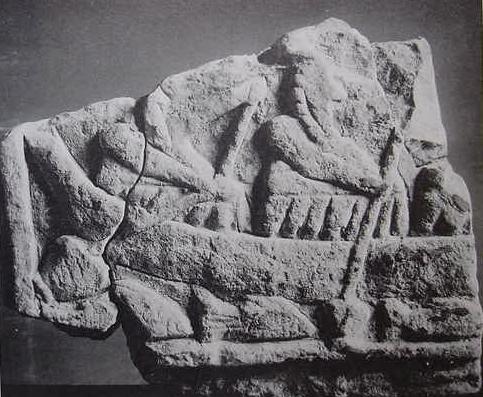
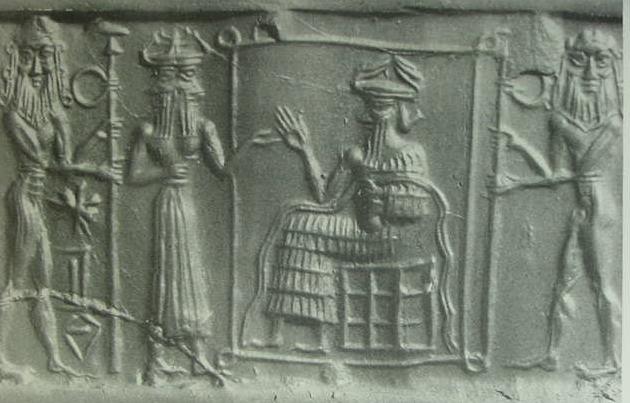
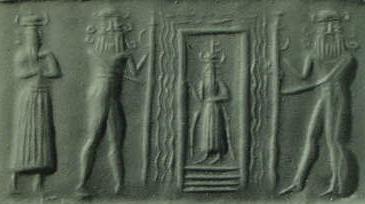
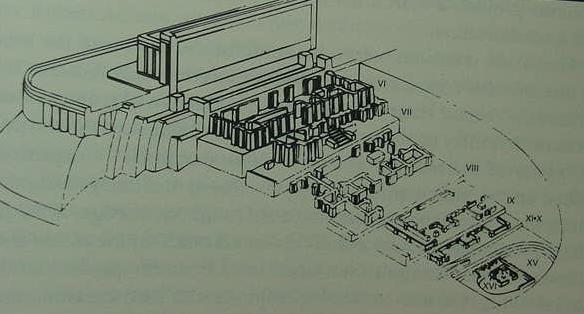
As noted earlier, above, I understand that Noah's Flood is a later Hebrew reinterpretation and transformation of various motifs appearing in Mesopotamian flood myths, the event being recalled is the Shuruppak flood of ca. 2900 BC. Of interest are some "more" Mesopotamian motifs which appear in the Genesis Flood account:
In the Bible, we are told that the Flood commenced in the 600th year of Noah, I note that the Atrahasis myth suggests that the Flood occured at the end of a 600 year interval too. It appears _to me_ that the Hebrews have preserved Atrahasis' 600 year interval of time elapsing before a Flood commences and reformatted this motif as occurring in Noah's 600th year. Perhaps the Flood's commencement in the 600th year of Noah's life is a reformatting of the "catchline" or "repeating refrain" of the Atrahasis Epic that implies for 600 years the gods have endured man's noise and now seek his demise? In the epic, every 600 years (at last 3 or 4 times) Atrahasis receives advisement about the god's efforts to decimate mankind.
Genesis 7:11-12 RSV
"In the six hundredth year of Noah's life, in the second month, on the seventeenth day of the month, on that day all the fountains of the great deep burst forth, and the windows of the heavens were opened. And rain fell upon the earth forty days and forty nights."
Dalley:
"600 years, less than 600, passed and the country became too wide, the people too numerous. The country was as noisy as a bellowing bull. The god grew restless at their clamor, Ellil had to listen to their noise. He addressed the great gods, "The noise of mankind has become too much. I am losing sleep over their racket." (p. 18. "Atrahasis." pp.1-38. Stephanie Dalley. Myths From Mesopotamia: Creation, the Flood, Gilgamesh and Others. New York. Oxford University Press. 1989, 1991. ISBN 0-19-281789-2. paperback)
Disease decimates the populaton (p.18. Dalley)
(Catchline):
"600 years, less 600 passed (p. 20. Dalley)
"Tablet II:
600 years, less than 600, passed and the country became too wide, the people too numerous. The country was as noisy as a bellowing bull. The god grew restless at their clamor, Ellil had to listen to their noise. He addressed the great gods, "The noise of mankind has become too much. I am losing sleep over their racket." (p.20. Dalley)
3 year famine attempted (pp.20-22. Dalley)
"[600 years, less than 600, passed and the country became too wide, the people too numerous...He grew restless at their noise. Sleep could not overtake him because of their racket." (p.23. Dalley)
Dalley on the repeating 600 year refrain:
"Six hundred years is a round number in the sexagesimal system used by the ancient Mesopotamians. as a numerical unit, 600 was the simple noun neru in Akkadian. Repetition of a number seems to occur as a literary device..(Note 22. p. 37. "Atrahasis Notes." Dalley)
"Note the literary strategem which defies literal chronology by featuring Atrahasis as the same mortal in recurrent crises 600 years apart." (note 32. p. 38. "Atrahasis Notes." Stephanie Dalley. Myths From Mesopotamia: Creation, the Flood, Gilgamesh and Others. New York. Oxford University Press. 1989, 1991. ISBN 0-19-281789-2. paperback)
Biography on Dalley:
"Stephanie Dalley has worked on various excavations in the Middle East and has published cuneiform tablets found there by the British Archaeological Expedition to Iraq as well as a book for the general reader about those discoveries. Mari and Karan (1984). She taught Akkadian at the Universities of Edinburgh and Oxford and is now Shillito Fellow in Assyriology at the Oriental Institute, Oxford, and a Senior Research Fellow of Somerville College. She is editor and main author of The Legacy of Mesopotamia (Oxford University Press). (cf. inner flyleaf of Myths from Mesopotamia)
The Sumerian Flood account has the rain-storm lasting 7 days and nights, the later Babylonian account has the rains ending on the 7th day as well. I wonder if perhaps these "motifs" have been preserved in the Genesis account as an "INVERSION"? God is portrayed as announcing that in 7 days time the rains will begin and continue for 40 days. In other words, following a period of 7 days of NO RAIN, the Flood will begin. I would argue, then, that the 7 days of rain in the Sumerian and Babylonian accounts were INVERTED into 7 days of NO rain in the later Hebrew account; that is to say, the rains _ending_ on the 7th day have been transformed into rains _beginning_ on the 7th day. Also of interest is that both the Bible and Atrahasis have the Flood hero being given a SEVEN DAY advance warning of the coming flood.
Genesis 7:4 RSV
"For in SEVEN DAYS I will send rain upon the earth forty days and forty nights..."
Millard and Lambert noted that Atra-Khasis (alternately rendered Atra-Hasis) had 7 days notice for the Flood's commencement (emphasis mine, Update of 07 April 2005):
"...in Atra-khasis Enki gives the hero ONLY SEVEN DAYS in which to prepare for the onset of the flood..." (p. 12. "Introduction." W. G. Lambert & A. R. Millard. Atra-Hasis, The Babylonian Story of the Flood. Oxford University Press. 1969. Reprint, 1999 by Eisenbrauns, Winona Lake. Indiana)
To date, archaeologists have failed to find evidence of world wide flood in the 5th-3rd millenniums B.C. in Mesopotamia, Syria or Canaan. They date some settlements in Sumer to the Ubaid period of circa 4900 B.C., specifically the ancient city of Eridu (modern Abu Shahrein near Ur of the Chaldees), which in Mesopotamian myths was the very first city built by the god Enki. This myth has the world covered in water, then a freshwater stream eurpts from the depths of the ocean, land forms about it and Enki builds the first city Eridu. Of course in the Bible the first city is built by Cain and called Enoch after his son (Ge 4:17). So, it is clear that Genesis' author understands at least _one city_ built by Cain sometime in the course of the 4th millennium was engulfed by Noah's 3rd millennium B.C. flood, but the archaeological evidence does not support this notion.
Millard and Lambert have noted that in antiquity plagiarism was common, texts were copied without acknowledgement and sometimes very freely recast or rewritten to tell a new story. I suspect just such happened with the biblical story of Noah's Flood, it too was plagiarized and recast from earlier Mesopotamian accounts:
"...the ancient world had no proper titles, no sense of literary rights, and no aversion to what we call plagiarism. Succeeding ages often rewrote old texts to suit new language forms and tastes."
(p. 5. "Introduction." W.G. Lambert & A.R. Millard. Atra-Hasis, the Babylonian Story of the Flood. Oxford University. 1969, reprinted 1999 by Eisenbrauns, Winona Lake, Indiana)
An example of such a rewrite is the Sumerian version versus the Babylonian or Akkadian account:
"The Sumerian epic...comes closest to Atrahasis...Despite the similarity in content, the size is quite different (some 300 Sumerian as opposed to 1,245 Akkadian lines), and wording nowhere agrees."
(p. 14. W.G. Lambert & A.R. Millard. Atra-Hasis, the Babylonian Story of the Flood. Oxford University. 1969, reprinted 1999 by Eisenbrauns, Winona Lake, Indiana)
Professor Bright (1942) on a world encompassing flood's absence in the 3rd millennium B.C.:
"Has Archaeology Found Traces of the Flood?"
"...For excavations in Palestine and Syria the answer is an unqualified "No." In these two countries some of the oldest towns in the world have been excavated. We know now that Jericho was founded near the beginning of the Late Stone Age. While we cannot be certain that the town was first settled in such an early period, we can be sure that the town was first settled between about 5000 and 4500 B.C. This city and others in Palestine established after it show no evidence whatever of a flood...
1. The evidence from Ur...At Ur Wooley found a continuous occupation from the Early Dynastic back to the Obeid Period. In the middle of the Obeid level he found a stratum of river mud or deposit some ten feet thick -conclusive proof that a deluge had interrupted the occupation of the place, at least temporarily, during the fourth millennium. Wooley is confident that he has here the evidence of Noah's flood (see, for example, his Ur of the Chaldees [1929] p. 29) and his assurance is enthusiastically shared by most popular handbooks which deal with the subject.
2. The evidence from Kish. The excavations conducted at this site between 1923 and 1932 also yielded evidence of inundation. But the flood level here lies well within the Early Dynastic Period l that is, considerably later than 3000 BC and many centuries after the Ur flood deposit, The two cannot refer, therefore, to the same catastrophe (see Watelin and Langdon, Excavations at Kish, Vol, IV, pp. 40 ff.).
3. The evidence from Fara [ancient Shuruppak]. During the excavations at this site in 1931 a sterile, alluvial layer some two feet thick was found between the Jemdet Nasr and Early Dynastic layers -thus indicating an inundation at the site which was earlier than the one at Kish and yet much later than the one at Ur (see Schmidt, Museum Journal, XXII, 193 ff.). (pp. 34-35. John Bright. "Has Archaeology Found Any Evidence of the Flood?" pp. 32-40. G. Ernest Wright & David Noel Freedman, editors. The Biblical Archaeologist Reader. Chicago. Quadrangle Books. 1961. Reprinted from The Biblical Archaeologist. Vol. 5. pp. 55-62. 1942)
"This concludes the actual archaeological evidence bearing on the flood...Archaeology has given us no trace of it..." (p. 37. John Bright. "Has Archaeology Found Any Evidence of the Flood?" pp. 32-40. G. Ernest Wright & David Noel Freedman, editors. The Biblical Archaeologist Reader. Chicago. Quadrangle Books. 1961)
Noah's Flood is a myth, as determined over the past 100 years by Geologists and Archaeologists and is most probably a later reworking of the Shuruppak flood occurring in the 3rd millennium B.C., the same millennium the Bible (Jewish Massoretic Text) dates the event too.
I have suggested that the local Shuruppak flood of ca. 2900 B.C. caused by a swollen Euphrates river was transformed into a flood covering the world's mountains due to an error, the word KUR, meaning land, underworld, country, (temples were called Kur too) and mountain, perhaps, is "the mechanism" by which a flooded KUR-land, or KUR-temple became a flooded KUR-mountain which would imply all the world's mountains were flooded.
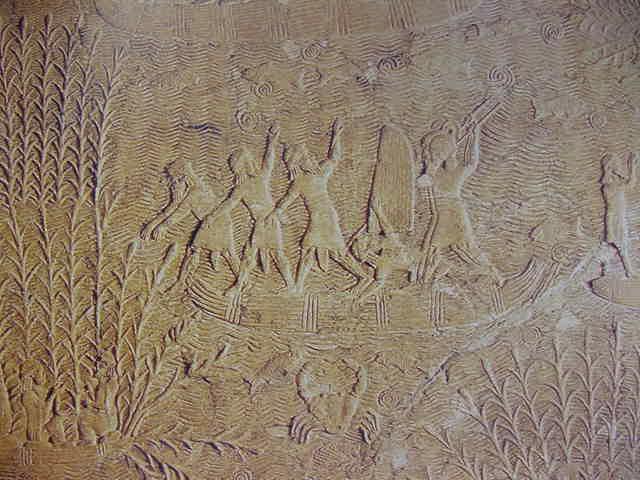
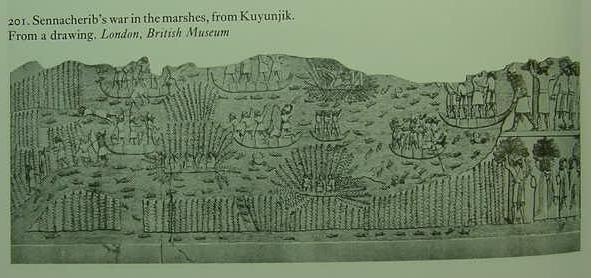
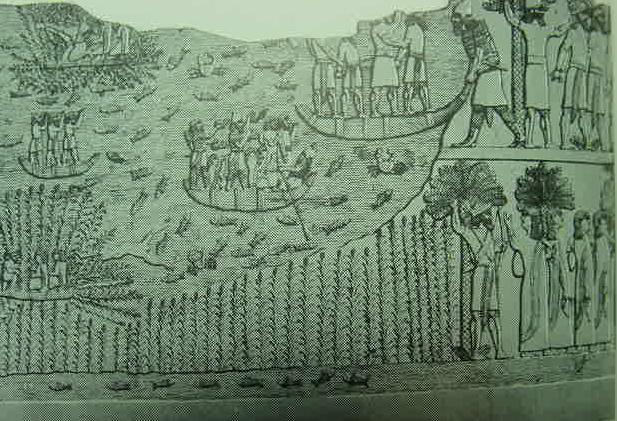
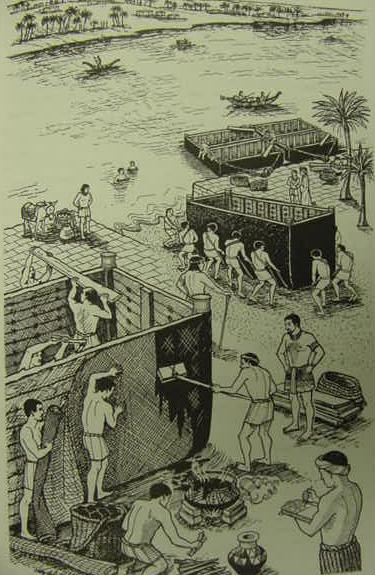
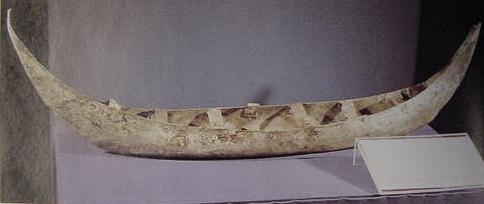
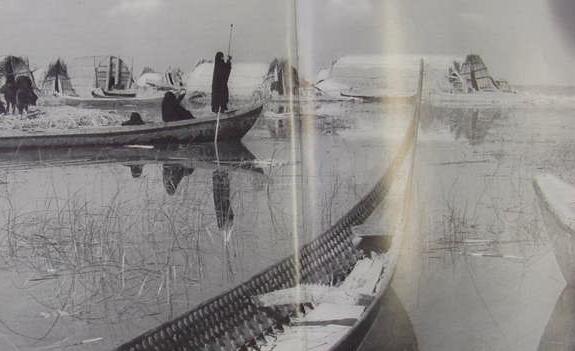
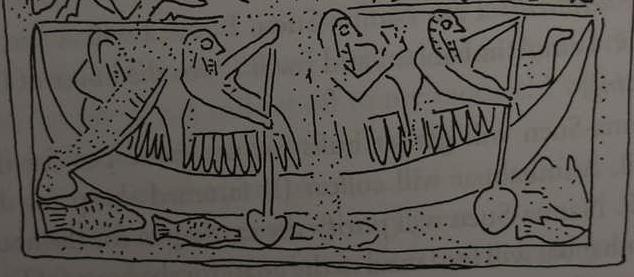
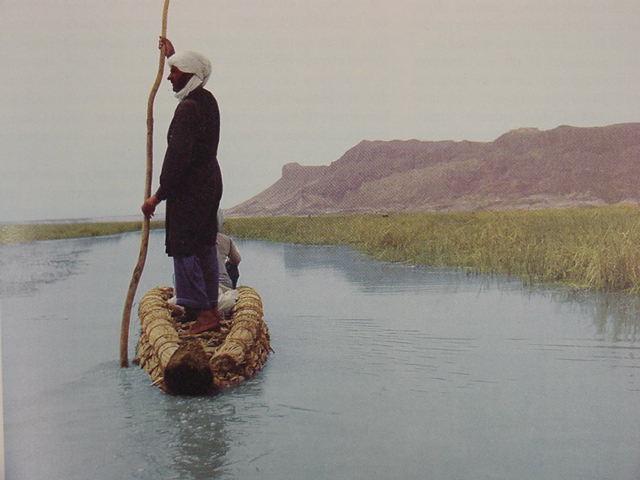
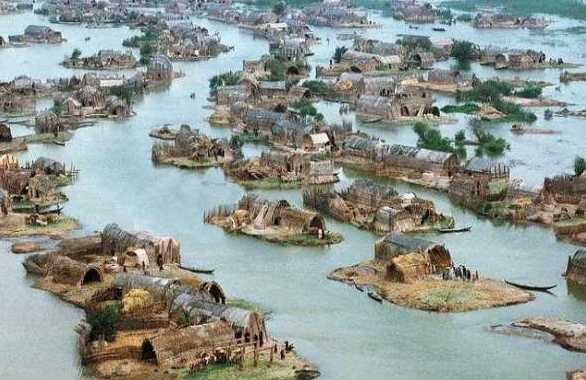
"_If_" the above Shuruppak bas-relief is of Ziusudra's boat, it was most likely a small shallow craft of wood like present-day marsh boats. The SMALL REED BOATS shown in the Neo-Assyrian bas-reliefs of Sennacherib ARE PROBABLY what Ziusudra's REED BOAT WAS ENVISIONED AS IN THE ATRA-KHASIS and GILGAMESH EPICS, BECAUSE THEY ARE SMALL ENOUGH TO BE CRAFTED FROM A SMALL REED HUT. It is of course preposterous that a gigantic seven story cube-like boat is constructed of a small reed hut, but this was probably a "signal" from the storyteller to his audience that this was a "fable or tall-tale" and NOT to be considered a real event. I seriously doubt anyone tore down their house or temple to build a huge "multiple-storied" boat, be it of marsh reeds from a reed hut, temple or a wooden house. No god warned a man 7 days in advance of a flood, this too is myth. Ergo, the more likely reality is that a small wooden craft as portrayed in the bas-relief was either already built and "at hand" for the family to board upon their realizing that the unusually prolonged heavy rains striking the area, were precipitating a swollen, flooding Euphrates river. At most, only "a few" domesticated animals, male and female to assure replenishment of breeding stock lost to the flood waters of the Euphrates got into the boat with Ziusudra's family.
The strange description of the Shuruppak craft as being "roofed over like the Apsu," and of the dimensions of a huge cube, suggest to me that either Enki/Ea's Apsu house in the midst of the abyss is being envisoned by the storyteller as a model for this unusual craft, or Enki's reed-built shrine at Shuruppak is the model for the "Mesopotamian Noah's" Ark.
Finally, I understand that Enki/Ea later was transformed by the Hebrews into Yahweh-Elohim of Genesis. Both gods share similar motifs: 1) Both are responsible for man's creation; 2) Both make man to work in their garden which possesses fruit trees; 3) Both Deny man immortality; 4) Both permit man to acquire wisdom like a god; 5) Both confound the one language of the world in a babel of tongues; 6) Both initially deny man the knowledge it is wrong to be naked. (7) Both warn a man of a flood intended to destroy all of mankind, telling him to build a craft to save himself, family and animals. I also understand that Enlil who is portrayed as the prime instigator of the Flood and who blesses the Flood survivor after the event, has been combined with Enki to become Yahweh-Elohim.
Contradicting Flood Chronologies from Contradicting Bible Recensions and Scholars:
Professor Steibing on three different and _CONTRADICTING_ dates for God's creation of the world found in the book of Genesis as calculated by Jewish, Catholic and Protestant scholars:
"Most scholars agreed that the world was only about six thousand years old, though there was considerable disagreement over the exact date of the creation. Jewish rabbinical calculations from the Hebrew Massoretic Text showed that the world began 3,740 years before the Christian Era. Roman Catholic tradition, based on the Latin Vulgate translation of the Bible, placed the creation in 5199 B.C. And most English-speaking Protestants accepted the seventeenth-century Archbishop James Ussher's calculation of the time of creation, 4004 B.C. Ussher's dates were placed in the margins of early eighteenth-century editions of the King James version of the Bible, making them seem even more authoritive." (p. 32. "The Discovery of Prehistory." William H. Steibing Jr. Uncovering the Past. New York & Oxford. Oxford University Press. 1994 [1993 Prometheus Books])
A search of the internet using Google for various Creation and Flood Dates turned up a number of "surprises": there is NO consensus or agreement on when Creation occurred and therefore the date of the Flood varies with the various contradicting Creation dates. In addition, for any given manuscript, scholars disagree among themselves on the procedures to be employed in the counting of years to establish Creation and Flood dates.
One of the "problems" in an attempt to "fix a date" for the biblical Flood is that several different recensions exist of the Bible who's "ages" assigned to the Patriarchs (pre-flood and post-flood) in Genesis DISAGREE with each other, such as the Samaritan Pentateuch, the Septuaginta, the Latin Vulgate Bible, the King James Bible, and the Jewish Massoretic Text called the TANAKH and the Jewish Seder Olam Rabbah.
For an example of the "wildly differing ages" of Genesis' pre and post-flood patriarchs between the Septuaginta, the Bible of the early Christians and the modern Revised Standard Edition (Oxford University Press. 1977) please click here. For tables showing different Flood dates abstracted from various Bibles like the Septuaginta (Alexandrian and Vaticanus), Samaritan Pentateuch, Massoretic Text please click here.
Circa 3402 BC.............Date of the Flood from the Alexandrian Septuaginta. (Chart C).
Circa 3350 BC The "earliest date" for the beginning of the Jemdat Nasr Period/Era
according to Maisels (cf. below)
Circa 3342 BC.............Date of the Flood from the Alexandrian Septuaginta. (Chart B).
Circa 3302 BC.............Date of the Flood from the Vaticanus Septuaginta. (Chart C).
Circa 3242 BC.............Date of the Flood from the Alexandrian Septuaginta. (Chart B).
Circa 3213 BC.............Date of the Flood acording to Flavius Josephus, Jewish Historian.
Circa 3171 BC.............Date of the Flood from the Samaritan Pentateuch. (Chart C).
Circa 3112 BC.............Date of the Flood from Samaritan Pentateuch. (Chart B).
Circa 3000 BC............Date of the Flood (David Livingston Ph.D., of Associates for Biblical Reseach).
Circa 2960 BC............Maisels' "end" of Jamdet Nasr period (The Shuruppak Flood occuring in this Era).
Circa 2958 BC............Date of the Flood according to Eusebius' calculation (4th century AD) from the Greek Septuaginta
noted by in the 5th century AD Jerome (Roman Catholic Latin Vulgate Bible).
Circa 2950 BC...........Date of the Shuruppak Flood (cf. MacDonald, who allows anywhere from 2950-2850 BC)
Circa 2903 BC............Date of the Flood from the Samaritan Bible
(cf. below The on-line Catholic New Advent Bible Encyclopedia "Deluge" article).
Circa 2900 BC............Date of the Shuruppak Flood according to archaeological findings
(cf. below, Professor H.W.F. Saggs circa 2900 BC for the Shuruppak Flood).
Circa 2800 BC............The "latest date" for the "end" of the Jemdat Nasr Period or Era.
Circa 2750 BC The Shuruppak Flood is dated ca. 2750 BC _in_ the Early Dynastic I Period
by Trevor Palmer, Nottingham Trent University, United Kingdom (cf. below)
Circa 2700 BC............Gilgamesh believed to have been a king of Uruk. In the Gilgamesh Epic
he seeks out the Flood's survivor, Utnapishtim (the Mesopotamian Noah),
formerly a king at Shuruppak where he was warned by his god to build a
boat to save self, family and animals against a flood to be sent by the gods
to destroy all mankind.
Circa 2600 BC.............Shuruppak limestone bas-relief showing men paddling a boat which might be the
"original" boat behind the later "embellished" myths of reed-boats, reed-chests
and the biblical Noah's "Ark."
Circa 2588 BC.............Dean Coombs.
Circa 2522 BC.............Flood Date Massoretic Text (Jewish). (Chart C).
Circa 2518 BC.............Dean Coombs.
Circa 2462 BC.............Flood Date Massoretic Text (Chart B).
Circa 2458 BC.............Dean Coombs.
Circa 2433 BC.............Dean Coombs.
Circa 2373 BC.............Dean Coombs.
Circa 2348 BC............Noah's Flood occurs according to Archbishop James Ussher (17th century AD)
in margins of many 18-19th century AD King James Version Bibles.
Circa 2345 BC........... Noah's Flood date according to Charles E. Sellier and David W. Balsinger (1995. cf. below)
Circa 2304 (+/- 11 yrs)...Date of the Flood according to J. Osgood Ph.D.
Circa 2303 BC.............Dean Coombs.
Circa 2243 BC.............Dean Combs.
Circa 2105 BC ...........Date of the Flood according to the Jewish Medieval sage Rashi's calculation from the Jewish Bible.
Circa 2100 BC............3rd Dynasty of Ur (of the Chaldees) kings claim descent from Gilgamesh, idolizing him in poems.
Circa 2100 BC............Abraham and Terah at Ur of the Chaldees (according to Ussher), and later migrate to
Haran in northern Mesopotamia.
Circa 2100 BC............Earliest "adventures" of Gilgamesh appear in Sumerian poems (p. xii. Foster)
Circa 1700 BC............Earliest Akkadian/Babylonian versions of Epic of Gilgamesh appear,
reworking earlier Sumerian "adventures" of Gilgamesh (p. xiii. Foster)
Circa 1600 BC............Sumerian Atrahasis Flood account from Nippur, Flood hero is Ziusudra,
a large boat is mentioned but nothing is said of how, when it was constructed
or whether it was made of reeds or wood (p. 14.Lambert & Millard. 1969, 1999).
Circa 1500-1000 BC...."Middle Babylonian" versions of Epic of Gilgamesh. Shuruppak boat made of reed-hut.
Circa 1446-1406 BC....Moses writes the "Flood account" according to some Conservative Protestant scholars.
Circa 669-626 BC.......Epic of Gilgamesh version found in Assyrian king Asshurbanipal's library
at Nineveh.
Circa 612 BC.............Fall of Nineveh to Medes and Chaldeans.
Circa 612-539 BC.....Rise and Fall of the Neo-Babylonian Empire and fall of Assyria (612 BC)
Circa 560 BC..............Genesis-2Kings is composed in the Babylonian Exile (587-539 B.C.) by one author according to
some scholars (cf. Whybray).
Circa 275 BC..............Berossos' Flood account appears in a History of Chaldea written in Greek.
Xisuthros is Flood hero.
Professor Finegan has extracted from Jerome, Biblical Chronologies compiled from Eusebius:
From Adam to the flood the number of years is 2,242 (cf. p. 191. "Cumulative Summary Figures in the Introduction of the Chronicle of Eusebius. Table 98. Early Chroniclers and Chronographers." Jack Finegan. Handbook of Biblical Chronology, Principles of Time Reckoning in the Ancient World and Problems of Chronology in the Bible. Revised Edition. Peabody, Massachusetts. Hendrickson Publishers. 1964, 1998).
Adam's creation is given as 5200 B.C. (p. 190. "Summary of the Chronicle of Eusebius in the Latin Version of Jerome. Table 97. Early Chroniclers and Chronographers." Jack Finegan. Handbook of Biblical Chronology, Principles of Time Reckoning in the Ancient World and Problems of Chronology in the Bible. Revised Edition. Peabody, Massachusetts. Hendrickson Publishers. 1964, 1998).
My note: subtract 2,242 years from 5200 B.C. and the Flood is dated according to Jerome (using Eusebius) to circa 2958 B.C. This date also appears in the Greek written Septuaginta Bible.
MacDonald (Ph.D. in Ancient History, a teacher at the University of Minnesota) dates the Shuruppak Flood anywhere from circa 2950 to 2850 B.C. I note that a 2950 B.C. Flood is only 8 years off from the Greek Septuaginta's 2958 B.C. Flood date:
"...excavations of a third Mesopotamian site, Shuruppak, also uncovered a flood stratum (Schmidt, 1931)...This flood level separated late Protoliterate and Early Dynastic I remains and dates from around 2950 to 2850 B.C...the deposit at Shuruppak is about fifteen inches..."
(David MacDonald. "The Flood: Mesopotamian Archaeological Evidence." 1988)
However, some scholars have dated the Shuruppak flood deposit to as late as 2750 B.C. and the Early Dynastic Period:
"On the other hand, at the nearby city of Shuruppak (the modern Fara), there was evidence of a flood during
the Early Dynastic Period, around 2750 B.C., and an alluvial deposit dating from around the same time was found at another Sumerian site, the city of Kish."
(Trevor Palmer, Nottingham Trent University, UK. Catastrophes: The Diluvial Evidence. Paper presented at the SIS Silver Jubilee conference at Easthamstead Park, 19 September 1999)
For many Conservative scholars (Protestants), Arch-Bishop Ussher's 17th century A.D. chronology of the Bible gives Adam's creation as 4004 B.C. and the Flood as circa 2345 B.C. Apparently Eusebius and Jerome came up with different sums from Ussher. Why? The Catholic Bible is in part a recension of the 3rd century BC Septuaginta which preserves _different ages_ for the pre-flood patriarchs, giving a Creation date of ca. 5200 B.C. and Flood of 2958 B.C.
The Jewish TANAKH 1985 (Philadelphia, PA. The Jewish Publication Society) or Anno Mundi 5758, suggests creation was circa 3763 B.C. If 1656 years are subtracted from Adam to the Flood, it occured ca. 2107 B.C.
Professor Bailey noted that the Greek text (the Septuaginta) differed from the Hebrew text (the Massoretic text) on the years elpasing bewteen Creation and Noah's Flood:
"Whereas the traditional Hebrew Text (Massoretic Text) of Genesis 5 reports a total of 1656 years from the creation of the first human being to the coming of the great flood in Noah's time, the traditional Greek text (Septuaginta) gives a total of 2242 years..." (p. 186. "Elapsed Time from Adam to the Flood According to the Greek Bible (LXX)." Lloyd R. Bailey. Genesis, Creation and Creationism. New York & Mahwah, New Jersey. Paulist Press. 1993)
5586 BC........The Septuaginta (a 3rd century BC bible written in Greek for Jews at Alexandria,
Egypt, used by early Christians and quoted from in the New Testament.
5555 BC........Flavius Josephus, a Jewish Historian of the 1st century AD who wrote a history of
the Jews, paraphrasing the Bible.
5508 BC........ Eastern Orthodox Church
5493 BC.........Ethiopian Church
5490 BC.........Syrian Christians
5481 BC.........Flavius Josephus' 2nd date for creation
5199 BC.........Pope Gregory XIII (1580)
4004 BC.........Arch-bishop James Ussher of Armagh, Ireland (17th century AD) appears in King
James Version of the Bible.
3761 BC.......Creation date from the Massoretic Text as found in the Jewish Seder Olam Rabbah.
I note that this year, 2006 A.D. (or C.E., "Common Era") is rendered by some Jewish authorities as 5766 from the Creation. For some Protestants, using Ussher's calculations this year would be 6010 from the Creation. For Catholics, using Eusebius' calculations, this year would be 7206 since the Creation.
One Jewish site, using the Medieval Jewish Sage Rashi's calculations, understood the Flood was ca. 2105 B.C.
Professor Skinner on the elapsed years between the Creation and Flood noted for the Flood 1656 years in the Massoretic Text, 1307 years in the Samaritan Text, and 2242 years in the Septuaginta (cf. "Chronology Table," on p. 134. John Skinner. A Critical and Exegetical Commentary on Genesis. Edinburgh, Scotland. T & T Clark. 1910, 1930 revised edition, reprinted 1994).
Of all the above "many" proposals for the Creation of the World and the Flood, the one which most closely "aligns" with the Shuruppak Flood of circa 2900 B.C. _which I understand is the event being recalled in Noah's Flood_ is the Samartian Bible's 2903 B.C. Flood date appearing on the internet under the Catholic on-line New Advent Bible Encyclopedia and its article titled "The Deluge" (cf. below for details). The second closest date to the 2900 B.C. Shuruppak Flood date is "Roman Catholic" Flood date of circa 2958 B.C. (this date is derived from the Greek Septuaginta), as worked out by the 4th century A.D. Christian scholar Eusebius and preserved by Jerome in the 5th century A.D.
All this is to say, that the chronological schema for a Flood is BEST PRESERVED by the Samaritan and Septuaginta Bibles.
Below is what I regard as a "typical" Christian Apologist refutation that the Bible has "borrowed" from Mesopotamian Flood myths Noah's Flood:
"A popular theory, proposed by liberal "scholars," said that the Hebrews "borrowed" from the Babylonians, but no conclusive proof has ever been offered. The differences, including religious, ethical, and sheer quantity of details, make it unlikely that the Biblical account was dependent on any extant source from the Sumerian traditions. This still does not stop these liberal and secular scholars from advocating such a theory. The most accepted theory among evangelicals is that both have one common source, predating all the Sumerian forms. The divine inspiration of the Bible would demand that the Genesis account is the correct version. Indeed the Hebrews were known for handing down their records and tradition. The Book of Genesis is viewed for the most part as an historical work, even by many liberal scholars, while the Epic of Gilgamesh is viewed as mythological. The One-source Theory must, therefore, lead back to the historical event of the Flood and Noah's Ark. To those who believe in the inspiration and infallibility of the Bible, it should not be a surprise that God would preserve the true account of the Flood in the traditions of His people. The Genesis account was kept pure and accurate throughout the centuries by the providence of God until it was finally compiled, edited, and written down by Moses. The Epic of Gilgamesh, then, contains the corrupted account as preserved and embellished by peoples who did not follow the God of the Hebrews." (Frank Lorey, M.A. "The Flood of Noah and the Flood of Gilgamesh." Please click on the following url for Lorey's article in its entirety http://www.icr.org/index.php?module=articles&action=view&ID=414 )
The problem in the above assertions? The biblical account does not tell us "where" Noah was at when God allegedly warned him to build the Ark. The Mesopotamian account furnishes the missing information, the Flood hero is residing at Shuruppak in Lower Mesopotamia. Shuruppak has been identified and excavated (1931) and it had only _one_ flood layer, dated to circa 2900 B.C. The Shuruppak Flood did not extend over all of Lower Mesopotamia, it was very local, of a flooding Euphrates and its canal serving Shuruppak. It would appear that the Mesopotamian account has been VINDICATED by archaeological findings at Tell Fara (ancient Shuruppak) and the Samaritan Bible's flood account is "somewhat" VINDICATED to the degree that its 2903 B.C. Flood date is very close to the 2900 B.C. Shuruppak Flood. As noted earlier, archaeology has documented villages back to the 12th millennium B.C. in the Ancient near East, and no-where does there exist the evidence of a universal Flood sediment. Quite simply the Bible is wrong. It is not the word of God.
As noted above by Lorey, at least "some" Evangelical Scholars are willing to accept the notion that the Mesopotamian and Biblical accounts are recalling THE SAME EVENT, when differences arise in details the Bible "must always" trump the Pagan account. The COMMON EVENT IS THE SHURUPPAK FLOOD of 2900 B.C.
Lorey's Chrisitian Apologetic _assumes_ that a Holy Spirit really exists and that it is responsible for the Bible's creation. The claim is made that this Holy Spirit is still alive and well today, guiding the pious and preserving God's Holy Word from the machinations of Satan. The Holy Spirit is also envisoned as guiding the pious in correct doctrines and dogmas. All of these assertions are of course nonsense. What is the proof they are nonsense?
The proofs there is no HOLY SPIRIT:
1. As noted by Professor Steibing we have three Bibles, Jewish, Catholic and Protestant, each _contradicting_ the other on when the world was created and consequently when the Flood occurred. If there was a "real" Holy Spirit, it would be able to keep God's Holy Word from being corrupted into contradicting chronologies with different ages for the Pre and Post Flood patriarchs. The faithful's response is that ONLY the original writings were without error, they are now lost and consequent copies introduced man-made errors. This "favorite" excuse or "Apologetic" though _really is AN AFFRONT to the Holy Spirit_ because it implies the Holy Spirit is impotent and unable to preserve God's Holy Word from man-made errors. Satan has then TRIUMPHED over God and the Holy Spirit by corrupting with man-made errors ALL the Holy Texts ("Recensions"). Consequently the churches founded on these error-riddled texts are possibly erecting their dogmas and doctrines on error. No one today can say which Bible is the real "error-free" text. We are asked to believe that the error-riddled texts should be accepted as evidence of God's "inerrant" Holy Word and that a Holy Spirit is alive and well today and unconcerned about the errors.
2. If the Holy Spirit was real and still alive today, it would NOT permit the various Christian faiths to contradict each other as to what constitutes correct doctrines. Christianity has fragmented into hundreds of denominations, each accusing the other as being under Satan's power and embracing false dogmas. In past ages Christians slaughtered each other over doctrinal differences, claiming others were under Satan's power, teaching the doctrines of men for God's Holy Word (The 16th century A.D. Protestant vs. Catholic wars of the Reformation which decimated hundreds of thousands of men, women and children). In this age Christians tortured Christians to confess to heresy, then they were burned alive at the stake in public spectacles called Auto-da-fe's. Supposedly the Holy Spirit had told Christians to "turn the other cheek and pray for their abusers," NOT torture and burn alive their enemies. I have no doubts or illusions that these "pious" Christians believed that the Holy Spirit was directing them to treat their Christan opponents in such a barbaric manner.
3. As noted elsewhere on this website, the Bible contains numerous failed prophecies. God allegedly warned his people NOT TO BELIEVE a prophet UNTIL the prophecy was fufilled (De 18:20-22). CONTRA God's instructions, ALL of the above faiths, Christian and Jewish, tell their congregations to IGNORE GOD, the "failed prophecies" will be fufilled in some future age. If there was a real Holy Spirit, it would not tolerate this nonsense being preached. The Holy Spirit was quite adamant that the only way to know if a prophet was false or not was to WAIT for the prophecy to be fulfilled, which NULLIFES Christianity's and Judaism's claims the prophecies are for a future age. All (Christian and Jew) are guilty of teaching that the prophets should be believed despite the failure of _ALL_ the prophecies to materialize. Please click here for my article on "Christianity's Flawed Methodologies Regarding Claims to Fulfilled Prophecies."
4. Had the Holy Spirit been "real", Geologists and Archaeologists would have found the remains of Noah's world-wide Flood in the context of a 3rd millennium B.C. world as Genesis' chronology suggests a 3rd millennium B.C. Flood. They did not. What they found was the evidence of the Shuruppak Flood of circa 2900 B.C., which was a flooding Euphrates river and canal. Some 17 paralllels exist between the Bible's Flood and the Shuruppak Flood, leading some scholars to concede both accounts, pagan and biblical are recalling the same historical event. The Mesopotamian myths state that Shuruppak was destroyed by the flood, and a two foot alluvial clay deposit exits at Shuruppak (Tell Fara) dating circa 2900 B.C. Archaeology has vindicated the Shuruppak flood tradition, the last of the Antediuvian cities in Mesopotamian tradition. For an in depth article on the non-existence of a Holy Spirit please click here for my article titled "The Reception of God's Holy Spirit: How the Hebrew Prophets _contradict_ Christianity's Teachings."
Because Christians believe in a Holy Spirit, and its Bible, some fundamentalists reject the findings of Archaeology and Geology and make "silly claims" that the world of the Dinosaurs is Noah's Flood because the Bible dates the creation of the earth and universe to 4004 B.C. in some King James Version Bibles.
Two Christian scholars Sellier and Balsinger understand Noah's Flood destroyed the dinosaurs ca. 2345 B.C:
"Imagine a world of huge dinosaurs, gigantic flying birds, and enormous plants and you probably have a good picture of what the earth was like in Noah's time." (p. 58. Charles E. Sellier & David W. Balsinger. The Incredible Discovery of Noah's Ark. New York. Dell Books. 1995)
"...based on Noah's records found in the Genesis account, and astronomical computer analysis, we determined that he began building the ark in 2465 B.C., with the first rains falling in 2345 B.C..."
(p. 14. Charles E. Sellier & David W. Balsinger. The Incredible Discovery of Noah's Ark. New York. Dell Books. 1995)
Walton identifies himself as a bible-believing evangelical scholar:
"I believe in the authority of the Old Testament as the Word of God and would categorize myself as an evangelical." (p. 16. "Introduction." John H. Walton. Ancient Israelite Literature In Its Cultural Context. A Survey of Parallels Between Biblical and Ancient Near Eastern Texts. Grand Rapids, Michigan. Zondervan Publishing House.1989, 1990 Revised edition)
Walton on the biblical Flood account noting some Conservative bible-believing scholars will not accept the notion it is borrowed from Mesopotamian myths (Emphasis mine):
"While most scholars are content to assume that the Mesopotamian account is the ultimate source of flood traditions which are reflected in the Genesis account (readily acknowledging the complexity of attempting to reconstruct the exact path of transfer) there is a minority of scholars who finds this assumption unacceptable. FOR THEOLOGICALLY CONSERVATIVE SCHOLARS, IT IS UNACCEPTABLE TO UNDERSTAND THE GENESIS ACCOUNTS AS VARIATIONS OF BABYLONIAN MYTHS. THE AUTHORITY OF THE BIBLE IS A PRESUPPOSITION THAT NEEDS TO BE DEFENDED AND IS THREATENED BY THEORIES THAT SUGGEST THAT THE NARRATIVES OF GENESIS ARE DEMYTHOLOGIZATIONS RATHER THAN REVEALED TRUTH. THERE IS THEN A VESTED INTEREST OF FAITH that must be considered when examining the relationship of the respective literatures of Israel and Babylon." (p. 39. "Cosmology." John H. Walton. Ancient Israelite Literature In Its Cultural Context. A Survey of Parallels Between Biblical and Ancient Near Eastern Texts. Grand Rapids, Michigan. Zondervan Publishing House.1989, 1990 Revised edition)
Professor Millard (being quoted by Professor Walton; brackets [ ] and Emphasis are mine):
"The two accounts [Babylonian and Hebrew] UNDOUBTEDLY DESCRIBE THE SAME FLOOD, the two schemes relate the same sequence of events." (p. 40. "Cosmology." John H. Walton. Ancient Israelite Literature In Its Cultural Context. A Survey of Parallels Between Biblical and Ancient Near Eastern Texts. Grand Rapids, Michigan. Zondervan Publishing House.1989, 1990 Revised edition).
For my part, I have NEVER encountered an Apologist who "connected _all_the dots" for his readership showing that the Shuruppak flood dated to the 3rd millennium B.C. is the very SAME MILLENNIUM the Samaritan, Catholic and Protestant Bibles date the Flood to. Nor do these Apologists bother noting for their readership that there is geologically NO EVIDENCE of a 3rd millennium B.C. Flood anywhere in the Ancient near East. How do they handle this information which has been around since 1931? Easy, they just turn a blind eye to it and ignore it (what their congregations don't know won't hurt them)!
Professor William H. Shea, a devout 7th Day Adventist scholar, has written an article challenging the notion that Noah's Flood is recalling a "local" flood in Mesopotamia. The problem? I find his "methodologies" and "arguments" seriously flawed. His conclusion is that this notion is preposterous because the Bible says Noah's flood covered the whole world. In other words, because of his "faith committment" he cannot accept archaeological and geological findings that there was never a universal flood. Let us look at Shea's arguments and take them apart and show why they are flawed.
Shea:
"The local flood theory raises many problems, which may be examined from three different perspectives: archaeology, linguistics, and literary traditions. Such an examination will determine whether the biblical flood story ultimately goes back to the story of a local river flood in Mesopotamia or to the Bible as a historical record of a universal deluge."
Shea notes that under "Archaeology" Lower Mesopotamia was subjected to repeated floods in antiquity and archaeologists have dated them to different eras at different sites. There is no era where all the sites were engulfed simultaneously.
Shea notes under "Linguistics" that the Akkadian word for the flood is abubu and suggests Hebrew mabbul is related and describing the same flood event.
Shea notes under "Literary Traditions" that both the Mesopotamian and biblical accounts suggest a unversal flood occurred wiping out _all_ of mankind except those on the boat.
Shea's conclusion on the above "three tests: Archaeology, Linguistics and Literary Comparsion":
"The biblical flood story comes close...but makes a moral distinction that the Mesopotamian version does not. God was disgusted with the wickedness of humankind, but he decided to rescue the few righteous in the world through the use of Noah's ark (Genesis 6:4-8). One cannot do this on either the Biblical or the Babylonian scale with only a local river valley flood. A universal deluge that virtually wipes out humankind is required."
Shea then follows up noting the universality of flood traditions in cultures from all over the world as support for the universal flood. He also notes fossils in mountains suggesting the flood covered them.
The problems?
Archaeology: While Shea does note that Shuruppak was excavated in 1931 and found to have flood sediment from a flooding Euphrates canal circa 2900 B.C. and that the Mesopotamian flood hero was from this city HE NEGLECTS TO MENTION that the Samaritan Bible dates the Flood to 2903 B.C. a scant 3 years off from the 2900 B.C. Shuruppak Flood while the Roman Catholic Bible dates Noah's Flood to 2958 B.C., a scant 58 years from the 2900 B.C. Shuruppak flood. He also NEGLECTS TO MENTION that Geologists and Archaeologists have found _no_ evidence of a universal flood ANYWHERE in the ancient Near East (Egypt, Sinai, Canaan, Phoenicia, Syria, Mesopotamia, Turkey, Iran) for the 3rd millennium B.C. when the Bible dates this event (Protestant Bibles dating Noah's flood ca 2348 B.C.). He also NEGLECTS TO MENTION that archaeologists have dated villages in Turkey, Syria and Iraq to as early as the 12th millennium B.C. and that they have found no evidence of a universal flood sediment from that time frame up to the modern day.
He also NEGLECTS TO MENTION that when the flood traditions from all over the world were compared with the findings of trained Anthroplogists, Archaeologists and Geologists that they were found not to be all from the same moment in time, nor alike in details, nor were they in the 3rd millennium B.C. when Genesis dates the flood.
He NEGLECTS TO MENTION under his "geological flood proofs" of fossils that Geologists date these fossil-bearing strata which appear all over the world to different eras MILLIONS OF YEARS AGO _NOT_ THE 3rd MILLENNIUM B.C.
The "best" he can come up with from his Christian Apologist point of view is that a local flooding canal of the Euphrates at Shuruppak is impossible as being behind Noah's flood because this disagrees with the Mesopotamian and Biblical accounts of a universal flood destroying all of mankind except those on the boat. In other words, for Shea, two "literary compositions" mentioning a universal flood, Mesopotamian and Biblical, "trump" the findings of Archaeology, Anthropology and Geology. Please click here to read Shea's article. He therefore rejects Secular Humanists' and Liberal scholars' declaration that the Shuruppak flood of ca. 2900 B.C. is what is behind the Mesopotamian and Biblical traditions.
Professor Hoerth (1998) on there being _no_ evidence of Noah's Flood in Mesopotamia and devout Christians ("flood geologists") refusal to accept the findings of Geologists:
"Evidence of the biblical flood has not been found in the silt layers of Mesopotamia. "Flood geologists" claim that the greatest event of all time was the Noachian flood, which laid down many if not all of the rock strata in the earth's crust. To them, evidence of the flood can be seen in geology. On the other hand, geologists claim that no one trained in their discipline accepts such a theory."
(pp. 190-191. "The Flood." Alfred J. Hoerth. Archaeology and the Old Testament. Grand Rapids, Michigan. Baker Books. 1998)
Professor Hoerth lists 14 parallels shared by Noah's Flood and the Shuruppak Flood in the Epic of Gilgamesh:
1. The flood was divinely planned.
2. The flood was connected with the defection of the human race from God/the gods.
3. A divine revelation to the hero of the deluge tells of an imminent disaster that no one else knows about.
4. A ship is built, pitched inside and out.
5. The family of the hero is saved.
6. The living creatures that are to be saved are put abroad.
7. A storm brings on the flood.
8. Everyone not on the ship is destroyed.
9. The duration of the flood is specified.
10. The ship lands on a mountain.
11. Birds are sent out to see whether the water has receded.
12. Sacrifice is offered to and accepted by the deity.
13. The hero receives a special blessing.
14. There is reference to the possibility of no future flood.
(pp. 195-196. "The Flood." Alfred J. Hoerth. Archaeology and the Old Testament. Grand Rapids, Michigan. Baker Books. 1998)
My personal investigations into the "pre-biblical origins" of the Sabbath have identified the Mesopotamian Flood myth found in the Epic of Gilgamesh and Atrahasis as THE SOURCE of the Bible's Sabbath (Hebrew Shabbat). The methodology employed was quite simple, I asked myself, "Does there exist in _any_ Mesopotamian myth, a statement about gods resting on a seventh day?" The answer was yes, ALL THE GODS RESTED ON THE SEVENTH DAY after destroying mankind who's noise prevented them from resting by day and sleeping by night. I understand that the six days and nights that the gods destroyed the earth and all that dwelt on it with their flood, was transformed by the Hebrews via a reversal/inversion into a God creating the earth and populating it, then setting aside the seventh day for his rest. Please click here for all the details.
My research on the "pre-biblical origins" of who Japheth "_really was_" who appears on Noah's Ark, has determined that he is the Greek Titan called Iapetos (Japethus). Iapetos' descendants survive a flood in Greek myths called the flood of Deucalion, in Greece. For the story of how Deucalion's flood came to be "erroneously" assimilated and merged by the Jews in the 7th/6th century BC with their traditions of Noah's Flood (based on the Shuruppak Flood of 2900 B.C.) please click here.
As noted above, George Smith in 1872 discovered the Mesopotamian Flood Account on clay tablets brought to the British Museum in London for study and originally found in the Library of the 7th century B.C. Assyrian king Ashurbanipal at Nineveh. Smith noted that the Flood hero lived at Shuruppak which he rendered "Surippak". Eventually this city was identified and excavated by Eric Schmidt (1930-1931) on behalf the the Pennsylvania Museum and the University of Pennsylvania. He established that the Mesopotamian Flood myths were "partially correct" - a Flood had left its two-foot layer of sediment at the site ca. 2900 B.C. However, the flood layer was very local, and did not include all of Lower Mesopotamia. It was concluded on the basis of the archaeological evidence that the Mesopotamian Flood Account was an "embellished tall-tale."
It has been over 75 years now since Schmidt's excavations and the conclusions reached by many so-called "Liberal Bible Scholars" is that since Noah's Flood shares so many parallels with the Shuruppak Flood, the former is derived from the latter.
However, since that time (1931), Conservative Bible scholars are still in defiant "denial" of the irrefutable evidence. They have a lot to loose if they accept the Shuruppak Flood as being what's behind Noah's Flood (Ge 6:17-11:10): the claim that the Bible is God's inerrant word will be "compromised", so too the claims in the New Testament alluding to Noah's Flood (cf. Matthew 24:37-39; Luke 17:26-27; 2 Peter 2:5); not only Christendom "has its back up against the wall," so too does Judaism and Islam, for these faiths also accept Noah's Flood as a real event.
I have yet to read a "convincing" argument from the Apologists, be they Christian, Jewish or Moslem as to why the Shuruppak Flood is _not_ what is behind Noah's Flood. It shares many of the same details, it is located in the 3rd milllennium B.C. which is the same millennium the Bible dates the event to. Archaeology and Geology have found no evidence of a 3rd millennium B.C. universal flood in the Ancient Near Eastern world be it Egypt, Israel, Syria or Mesopotamia.
I doubt the day will ever come that the Apologists will admit they are wrong, and concede that Noah's Flood is based on an "embellished" and exaggerated account of a local river flood at Shuruppak. The Mesopotamian account has the Flood lasting only 7 days. The Bible grossly expanded the 7days to 40 days of flooding (Ge 7:17). I have noted that the possible "mechanism" behind the Flood covering "mountains" in the Mesopotamian accounts is the word kur meaning mountain, country, land, underworld and even temple. Via either a _mistake, or playful "tongue-in-cheek" punning_ by an ancient author with a wry sense of humor, a flooded land (kur) about Shuruppak became a flooded mountain (kur) implying for "later" readers that all the world's mountains were inundated.
Kramer and Maier noted that Enki was famed as a "trickster" god, his statements often having "double-meanings" which ensnare and confuse the unsuspecting audience. He told his servant Adapa not to eat the "bread of death" or drink the "water of death" when presented by Anu. When Anu presented Adapa "bread of life" and "water of life" Adapa refused to eat or drink, thereby losing a chance to obtain immortality for himself and mankind. When the Mesopotamian Noah asked Enki what he was to say to folk about the gigantic boat he was building so to to not alert them of a pending flood he was told to repeat a phrase that had double-meanings, tricking the audience into not being aware of an immanent flood:
"The advice...is given Atrahasis, called Utnapishtim in Gilgamesh and identified here as the "man" of the city of Shuruppak...The ironic lines are clever, for they are to convince the residents of the city to help build the boat -without their knowing the terrible events to follow. Ea's [Enki's] advice just skirts the lie..."
(cf. p. 132. Samuel Noah Kramer & John Maier. Myths of Enki, The Crafty God. New York. Oxford University Press. 1989).
I am sure that if the ancient Mesopotamian author could be brought back to life, he would be amazed that his tongue-in-cheek farcial "Tall-Tale" or "Yarn" came to accepted as "Gospel Truth" by later generations, and that three great monolithic faiths would arise using his nonsense: Judaism, Christianity and Islam.
What are "the clues" or "signals" utilized by the Mesopotamian author to "alert" his audience that the Shuruppak Flood is "nonsense" and only to be regarded as a "Tall-Tale" or "Yarn"?
(1) A _SMALL_ REED HUT is to be torn down and A _GIGANTIC_ BOAT, seven stories in height is made in only 7 days to hold "the seed of all living things" and punting poles will navigate this monstrosity!
(2) In only 7 days time the seed of _all_ living things, meaning animals domestic and wild, will assemble at one location, Shuruppak, to board the reed boat upon its completion on the 7th day.
(3) The Flood lasting only 7 days generates enough water to cover the tops of all the world's mountains.
(4) The Flood drains from the earth in only 7 days' time, whereupon all the living exit the boat.
(5) Shuruppak's excavation in 1931 revealed the Flood was a caused by the Euphrates river ca. 2900 B.C. and the two foot alluvial sediment which was deposited did NOT cover any kur (mountains), the only kur it covered was a kur (land) in the vicinity of the city. This deposit screams loud and clear that the Mesopotamain notion that the Shuruppak flood covered the world's mountains is nonsense.
Any rational thinking individual should have no problem spotting the above four "signals" from the Mesopotamian author as an "alert" that the story is to be regarded as a Tall-Tale or "Yarn." Sadly, these signals came to be overlooked with the passage of time and later generations came to foolishly believe this farcial "Myth" or "Tall-Tale" and even embellish it by extending the length of time of the Flood from 7 days to 40 days (Genesis 7:17), and extending the recession of the Floodwaters from 7 days to 150 days (Genesis 8:3) in order _to make the Flood MORE BELIEVEABLE_, after all, 7 days is really too hard to swallow as Gospel Truth, for a Flood to cover the world's mountain tops! Please click here for an in-depth presentation of various objections raised by Scientists to Noah's Flood being a real event.
As for the "silly" claims of some Conservative Bible scholars that Noah's Flood was the world of the dinosaurs, and that the dinosaurs were destroyed in Noah's Flood in the 3rd millennium BC (based on the biblical chronology), the records of Mesopotamia _BELIE_ this nonsense. As noted earlier by Lambert and Millard, there is NO appearance of a "Flood Tradition" in the 3rd millennium B.C. records of Mesopotamia, the "Flood Tradition" makes its FIRST APPEARANCE in the early 2d millennium B.C., _AFTER_ the Shuruppak Flood of circa 2900 B.C., that is to say the "Flood Tradition" arises _after_ an interval of almost 1000 years, which is "plenty of time" for the Shuruppak event to become garbled and embellished into a "Worldwide Flood". Shuruppak has _no_ dinosaur fossils in its flood layer, nor do any of the "other pre-flood cities" mentioned in the Mesopotamian texts and excavated by archaeologists (some texts enumerating 8, others 10 pre-flood cities in Mesopotamia).
Lambert and Millard on the "absence" of any mention of a "Great Flood" in Mesopotamian texts of the 3rd millennium but its appearance in texts of the 2d millennium B.C.:
"All the material in list form just described is from the first half of the second millennium B.C. So far there is no evidence for this tradition of a great flood among the Sumerians of the third millennium." (p. 16. "Introduction." W. G. Lambert & A. R. Millard.
Atra-Hasis, The Babylonian Story of the Flood. Winona Lake, Indiana. Eisenbrauns. 1969 Oxford University Press. Reprint 1999 by Eisenbrauns)
Maisels (PhD. in Anthropology, University of Edinburgh, Scotland) dated the Jemdet Nasr period as circa 3350 to 2960 B.C. and Early Dynastic I as circa 2960 to 2760 B.C. (cf. p. 133. fig. 5.1 "Periodization of Mesopotamian History." Charles Keith Maisels.
The Emergence of Civilization From hunting and gathering to agriculture, cities, and the state in the Near East. London & New York. Routledge. 1990, 1993. Note: Maisels has a PhD in Anthropology from the University of Edinburgh, Scotland)
David R. Harris, the Director of the Institute for Archaeology, London made the following endorsement of Maisels' book:
"The strength of Maisels' approach to his grand theme lies precisely in its breadth...it is generously illustrated with diagrams, maps and graphs...both scholarly and accessible to non-specialists; indeed it is a tour de force."
The Flood Layer at Shuruppak (Tel Fara) brought to an end the Jemdet Nasr era at that location. The city was rebuilt but not directly over the flooded site in the Early Dynastic I period. The Roman Catholic Bible, as noted earlier (above) dated Noah's Flood to circa 2958 B.C. on the basis of the chronology worked out by Eusebius in the 4th century A.D. and preserved by Jerome in the 5th century A.D. Maisels dated the end of Jemdet Nasr as ca. 2960 B.C. The Roman Catholic Flood date of 2958 B.C. is then _only two years_ off the mark for the circa 2960 B.C. Shuruppak Flood event. I find this "near-alignment" of Flood dates quite amazing! I do, however, realize that the Shuruppak Flood is dated by various scholars anywhere from circa 3000 to 2800 B.C. Yet Maisel's 2960 B.C. "end date" for Jemdet Nasr and the Shuruppak Flood ending Jemdet Nasr at Tell Fara and the Catholic Flood date of 2958 B.C. are "worth noting" in my view. In any event, the below 3200-2800 B.C. "range of dates" for the Jemdet Nasr period _BRACKETS_ the Roman Catholic Bible's 2958 B.C. date for Noah's Flood:
The dating for the Jemdet Nasr Period varies among scholars: 3350-2960 B.C.; 3200-3000 B.C.; 3100-2900 B.C.; 3000-2900 B.C.; 3000-2800 B.C.:
Maisels suggests 3350-2960 B.C. for the Jemdat Nasr Period (cf. p. 133. fig. 5.1 "Periodization of Mesopotamian History." Charles Keith Maisels. The Emergence of Civilization From hunting and gathering to agriculture, cities, and the state in the Near East. London & New York. Routledge. 1990, 1993. ISBN 0-415-096596. paperback. Note: Maisels has a PhD in Anthropology from the University of Edinburgh, Scotland).
Gwendolyn Leick. p. 278, 3200-3000 B.C. Jemdet Nasr period (Mesopotamia, the Invention of the City. London. Penguin Books. 2001).
Michael Roaf. p. 68 "...Jemdet Nasr period (about 3100-2900 B.C.)..." Cultural Atlas of Mesopotamia and the Ancient Near East. New York. Facts on File. 1990.
"...our understanding of Mesopotamian society during a short period, lasting about one century, around 3000-2900 B.C.E. This time-span, named Jemdet Nasr after the site..." (British School of Archaeology, Iraq. "Jemdet Nasr: a place and a period.")
"Important Sumer City States"
"The Jemdet Nasr Period lasted from 3200 to 2900 B.C."
"The urban revolution or the building of the first cities took place in 3100 - 2900 B.C. in the transition from prehistory to history." (John Heise. "The First Cities: Jemdet Nasr Period")
Jemdet Nasr ca. 2,800 B.C. (A seal is being described and dated)
Diyala Project. The Oriental Institute of Chicago.
Saggs (Professor Emeritus of Semitic Languages at University College, Cardiff, Wales) on the date of the Flood associated with Shuruppak as being circa 2900 B.C. (Note: SKL is an abbreviation for The Sumerian King List which mentions kings who reigned before and after "the Flood"; ED is an abbreviation for Early Dynastic Period) (emphasis mine):
"The biblical story of the Flood has its counterpart (and perhaps its origin) in Mesopotamian tradition. Since major floods have always been a threat to south Mesopotamia the question arises: was the Mesopotamian tradition simply a mythological expression of a constant anxiety, or was it based on the memory of some particular flood of unparalleled magnitude? If the latter, what was the date of the Flood?
Mesopotamian records offer some clues on when the Flood was believed to have occurred. According to the Epic of Gilgamesh, Gilgamesh went to consult Uta-napishtim, the sole survivor from the Flood, to discover how he obtained eternal life (see pp. 111-112). Behind the Gilgamesh traditions was a real person, who lived at about 2700 B.C., and the epic represents Uta-napishtim's exploits as remote in time from Gilgamesh, implying an interval of at least two centuries. This makes 2900 B.C. the latest date for Uta-napishtim's Flood. SKL places the Flood before the First Dynasty of Kish, which would be compatible with this.
At several south Mesopotamian sites excavators came upon layers of apparently water-laid silt, prima facie indicating a major flood. One such, found by Sir Leonard Wooley at Ur in 1928-29, lay immediately above the final phase of the Ubaid level, indicating a date not later than 3500 B.C., too early to fit the Gilgamesh tradition; it has been suggested that this layer was not water-laid but wind-blown sand, but this has not been substaniated. At Kish three or four different flood layers were identified, the earliest from the beginning of the ED period, at about 2900 B.C. There is also evidence from Fara, the site of Shuruppak, the city with which the Epic of Gilgamesh links Uta-napishtim. Here there was a layer of alluvial sterile clay and sand, datable to the beginning of the ED period, which could correspond with the earliest flood stratum at Kish.
On balance, the archaeological evidence seems to point to a flood of particular severity at about 2900 B.C., which might be the basis of literary themes about a world-wide Flood, attested first in Mesopotamia and then in other parts of the ancient Near East."
(pp. 38-39. "The Flood: archaeological and literary data." H. W. F. Saggs. Babylonians. [Peoples of the Past Series]. Berkeley & Los Angeles. University of California Press. 2000. Also published in the United Kingdom under the Trustees of the British Museum at the Bath Press. Bath, England. 2000)
What was "the moral" in crafting the Shuruppak Flood for the Mesopotamian audience? The Mesopotamians portrayed their gods as being very human, like humans they possessed unflattering personalities and shortcomings. Enlil "lord wind" (Akkadian Ellil) who instigated the Flood is portrayed as somewhat rash, not thinking through the future implications of the demise of all mankind vis-a-vis the gods to achieve his rest from mans' constant noise. He fails to consider that with man gone the gods will have to return to their earthly gardens and hoe them themselves, onerous work which they hated, thus the reason why they made man to work in their gardens. They will also have to feed themselves, man will not be around as their slave or servant to pour out drink offerings and make food offerings in the temples.
The Flood taught the gods a valuable lesson. THEY NEEDED MAN, they could not afford to act rashly again and seek the demise of all mankind with another Flood. Genesis _DENIES_ this portrayal of WHY man was made to work in Yahweh's garden and WHY Yahweh decided to destroy mankind in a Flood.
The Mesopotamian Flood myth then did NOT understand that the Flood was sent because Man was a terribly evil SINNER and was shedding the blood of his fellow men, it was "his noise" that disturbed Enlil's rest by day and sleep by night that brought on the Flood.
Where then did Genesis get the notion of a Flood sent to destroy an "evil" or SINFUL mankind? I suspect the answer lies in Enki's (Akkadian Ea) plea to Enlil not to send another Flood to destroy man. Enki tells Enlil in the future, take only the SINNER'S LIFE, not the lives of _all_ mankind (implying Enlil has acted ignobly in destroying innocent people along with sinners). I understand Genesis has expanded this motif making all of mankind "sinners" (only evil-hearted from their youth and violent Ge 6:5,13, 8:21) in the pre-Flood world and thus deserving of the destruction wrought on them by Yahweh. Surprisingly the Mesopotamian Flood stories (Atrahasis and the Epic of Gilgamesh) portray the gods terrified and in remorseful tears as they witness mankind's destruction by the Flood. Ishtar (Sumerian Inanna) cries out like a woman in travail that she is ashamed of herself for voting in the council of the gods for man's destruction, for she "gave birth to mankind" as a mother-goddess. Only Enlil who instigated the Flood is without remorse and sheds no tears, he is infuriated any humans have survived. Yahweh-Elohim's lack of remorse in destroying man seems best mirrored in Enlil (Akkadian Ellil). Of interest here is that in other myths Enlil at Nippur had man created to serve in his city-garden to end the mutiny of the Igigi gods who objected to the back-breaking toil. Man's purpose in life will be to work in a god's city-garden forevermore, planting the crops, weeding, and presenting food to the gods that they may be at ease from toil upon the earth.
In the Mesopotamian myths both Enlil and Enki are credited with making man to work in their city gardens at Nippur and Eridu. Enlil sends a Flood to destroy his creation, man. Enki defies Enlil and warns one man, Ziusudra to make a boat and save self, family and animals. After the Flood Enki beseeches Enlil to never send another Flood. Enlil assents and then gives his blessing to the survivors. In the Bible Yahweh instigates the Flood, warns Noah to build an ark and save self, family and animals, and Yahweh blesses Noah after the Flood. I understand that Enlil and Enki have been fused together and recast as Yahweh while Ziusudra has become Noah.
How did the Mesopotamian Flood hero whose name is variously rendered Ziusudra, Utnapishtim, or Atra-khasis come to obtain the Hebrew name of Noah?
The Hebrew scholar Rabbi Cassuto on an "anomaly" regarding the meaning of Noah's name:
Genesis 5:28-29 RSV
"When Lamech had lived a hundred and eighty-two years, he became the father of a son, and he called his name Noah, saying, "Out of the ground which the Lord has cursed this one shall bring us relief [niham] from our work and from the toil of our hands." (Hebrew niham: "to comfort")
"This one shall bring us comfort-" This etymology does not fit the root nuah. As far back as Rabbinic times
(Bereshith Rabba xxv2) it was observed that 'the explanation does not correspond to the name nor the name to the explanation. The text should have either, Noah- this one will give us rest; or Nachman- this one will bring us comfort [yenahmenu]." (p. 288. Umberto Cassuto. A Commentary on the Book of Genesis, From Adam to Noah. Jerusalem. Magness Press. The Hebrew University. 1944 [in Hebrew]. 1989 English edition)
Cassuto noted that the root nuah pronounced nuach/nuakh means "rest." I understand that in the Mesopotamian myths ONLY ONE MAN ATTAINS IMMORTALITY, Ziusudra. We are told he is given life eternal like a god and settled in Dilmun, in the east where the sun rises. When Gilgamesh finds him he is _lying about on his back_ "like a god," that is to say he does not have to toil in the gods' gardens like the rest of mankind. The gods enjoy an eternal REST from toil, for they have made man to toil in the gods' gardens on their behalf and present the harvest to them in food offerings. Thus, because the Flood hero enjoys a REST FROM TOIL like the gods, I suspect he got the epithet NUACH or NUAH (English Noah). That is to say He is the one that enjoys a REST FROM TOIL in the gods' gardens.
Regarding the motif of Noah's getting drunk on wine, this may be a reworking of the Atrahasis and Gilgamesh Flood myths. The Mesopotamian Noah is the "provider of the wine" for his workers. In the Bible Noah is credited as being the "provider of wine" for mankind via the planting of the "first" vinyard.
"Bullocks I slaughtered for [the people];
Sheep I killed every day.
Must, red wine, oil, and white wine,
[I gave] the workman [to drink] as if it were river water,
[So that] they made a feast as on New Year's Day."
(p. 83. Alexander Heidel. The Gilgamesh Epic and Old Testament Parallels. Chicago. University of Chicago Press. 1946, 1949, reprint 1993)
"I poured out a libation on the peak of the mountain...
The gods smelled the savor...
gathered like flies over the sacrificer..."
(p. 87. Heidel)
The Mesopotamian Noah, Atrahasis, is the one who "who went in and out" (of the Ark or great boat?) while the workers, outside the boat were feasting upon its completion. He is nervous, knowing they will be destroyed in the coming Flood, and that he has agreed to keep secret from them their pending doom.
"While one was eating and another was drinking.
He went in and out; he could not sit, could not kneel,
For his heart was broken, he was retching gall."
(p. 72. "Story of the Flood." Benjamin R. Foster. From Distant Days, Myths, Tales, and Poetry of Ancient Mesopotamia. Bethseda. Maryland. CDL Press. 1995)
Perhaps "the going in and out" was transformed into Ham going into and out of Noah's tent, seeing him asleep in a naked drunken stupor, picking up on the motif of wine being consumed like water with the boat's construction?
Leick on Ea/Enki's reason for saving mankind from a flood, he realizing the gods need man to be their servants:
"In the later mythological tradition, Enlil's relationship with mankind is always problematic: he is easily roused to anger and impulsively gives in to his urge towards destruction. The flood myths describe how, when the noise generated by the masses of humans drives him to distraction, he immediately decides to wipe them off the face of the earth. In contrast, Enki/Ea realizes in his wisdom that the gods depend on mankind and finds ways to foil Enlil's plans for annihilation." (p. 153. "Enlil." Gwendolyn Leick. Mesopotamia, the Invention of the City. London. Penguin Books. 2001)
If Leick is correct then Ea/Enki did not save man (Utnapishtim/Atrahasis/Ziusudra) from the Flood because he cared about man's well-being, he did it out of self-interest. The Gods had made man to replace the Igigi gods as laborers. Who would build the canals and irrigation ditches, grow, harvest and prepare food for the gods if man was no more? The gods would have to do this. So, Ea/Enki, being a god of "wisdom" foresaw what would happen from Enlil's rash act and thus warned Utnapishtim to save the "seed" of mankind and creatures for a new beginning.
Clifford views Enki more favorably than Leick:
"Genesis 2-11 moves in a different direction than the creation-flood genre of Mesopotamian literature...Atrahasis is a critique of the gods; their assembly is bumbling and fragmented; their leader is the bullying and cowardly Enlil. This unflattering picture is relieved only by the introduction of the wise and compassionate Enki and Nintu. Fault lies with the gods rather than with human beings. The gods' miscalculations lead to the annihilation of the race, and their needs to its restoration...Both Atrahasis and Genesis were written with a sense of confidence. Atrahasis shows confidence in the human race; people are necessary because the gods are generally lazy, shortsighted, and impetuous. Confidence in Genesis is founded on God's justice and mercy, and the reliability of the created world." (p. 149. "Genesis 1-11." Richard J. Clifford. Creation Accounts in the Ancient Near East and in the Bible. Washington, D. C. The Catholic Biblical Quarterly Monograph Series 26. The Catholic Biblical Association of America. 1994)
Apparently as late as the 8th century B.C. the Assyians understood that the Flood did NOT cover all the world and its mountain tops for the god of Babylon, Marduk, is made to say that the city of Sippar, which lies on the flood-plain of Iraq was NOT overwhelmed by the Flood waters (As noted earlier, above, Archaeologists excavated Shuruppak the city of the Mesopotamian Noah and confirmed that Sippar was NOT overwhelmed by the 2900 B.C. Shuruppak Flood):
"Even Sippar, the eternal city, which the Lord of
Lands did not allow the Flood to overwhelm, because it was so dear to him..."
(p. 305. "Erra and Ishum IV." Stephanie Dalley. Myths From Mesopotamia: Creation, the Flood, Gilgamesh and Others. Oxford & New York. Oxford University Press. 1989, 1991)
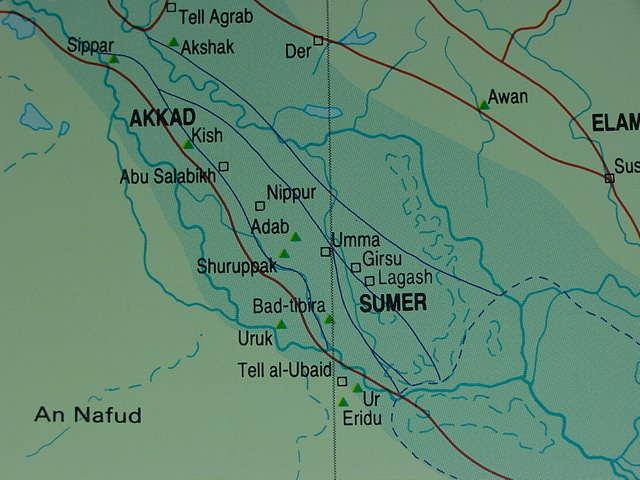
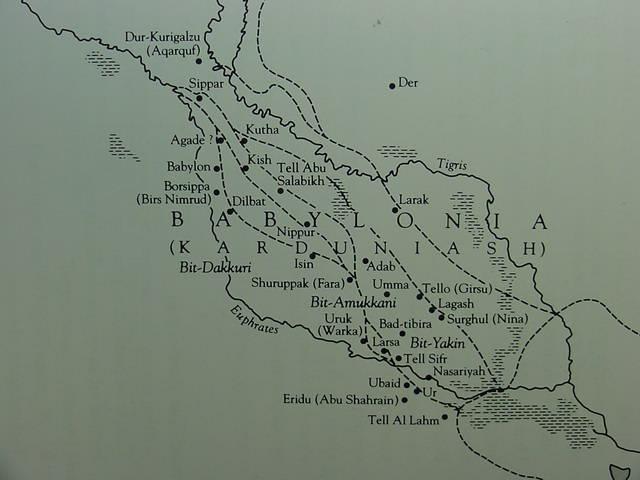
The Bible suggests that Noah's ark landed somewhere in the mountains of Ararat (not on a mountain called Ararat). The Assyrians knew a mountainous country to their north called Urartu and some scholars have suggested the biblical Ararat is Urartu. The excavations at Shuruppak revealed the Flood was a very local affair it did not even cover all of Sumer in Lower Mesopotamia. According to the Epic of Gilgamesh the boat landed on kur Nisir, translated mount Nisir. I note that kur can also mean "land" or "country." Downstream from Shuruppak lies modern-day An Nasiriyeh, could kur Nisir be the "land of Nisir" or Nasiriyeh, downstream from Shuruppak? That is to say as the local flooding of the Euphrates river at Shuruppak began to subside, the river resumed its normal flow southeastward toward An Nasiriyeh (kur Nisir?), where it came to be beached. After the boat's beaching the Flood hero is placed by the gods Anu and Enlil in kur Dilmun (alternately rendered kur Tilmun/Telmun) in the east. Perhaps kur Dilmun is modern-day Tel el Lahm just east of Nasiriyeh, Ur and Eridu? In antiquity the shore of the sea was said to be near Ur and Eridu, making Tell el Lahm in the midst of this sea an island (today there is no sea surrounding the site). Please click here for additional information on Tell el Lahm possibly being the island Dilmun.
Langdon (1931):
"The boat touched upon mount Nisir.
Mount Nisir held it fast and allowed it not to move."
(p. 221. "Legends of the Deluge." Stephen Herbert Langdon. The Mythology of All Races: Semitic. Volume 5. Boston. Marshall Jones Company. Archaeological Institute of America. 1931)
Professor Walton's contrasting the Mesopotamian and Israelitie concepts regarding the status of man in his Creator's eyes (Emphasis mine):
"In the book of Genesis, dignity is conferred on humankind because only humans are in the image of God. All of the cosmos is created for people and with people in mind. In the ancient Near Eastern perspective, humankind is an afterthought and even a bother. There is no dignity to be found in the created status of humanity. HUMANKIND IS CREATED TO BE SLAVES RATHER THAN TO RULE. Dignity in Mesopotamia, for example, is therefore found in the function of humankind -THE GODS NEED THEM TO PROVIDE HOUSING (temples) and FOOD (sacrifices). (p. 232. John H. Walton. Ancient Israelite Literature In Its Cultural Context, A Survey of Parallels Between Biblical amd Ancient Near Eastern Texts. Grand Rapids, Michigan. Zondervan Publishing House. 1989, 1990 Revised Edition)
"What Aristotle later observed about Greek religion was just as true of Mesopotamian religion: "Men imagine not only the forms of the gods, but their ways of life to be like their own." Like human conduct, then, the conduct of the gods lacked consistency and was for the most part unpredictable. There was no absolute morality characteristic of divine conduct and no code to which the gods were bound. The gods were not obliged to be moral, ethical, or even fair, and integrity could never be assumed...since humans were created to do work for the gods, the gods were seen to depend on people to provide for them. This primarily involved two basic elements: the sacrifices provided food for the gods, and the temples provided shelter and housing for the gods." (pp. 238-239. "Summary and Conclusions." Walton. 1990)
Professor Batto (1992) on the Hebrews recasting of earlier Mesopotamian myths and motifs in the Hebrew Bible:
"...I want to emphasize that this new mythmaking process is a conscious, reflected application of older myths and myhic elements to new situations...In so far as one admits the presence of myth in ancient Babylonian and Canaanite culture, then one must also admit the presence of myth in the Bible...This book, then, is a series of case studies of mythmaking in ancient Israel, or to be more exact, in the biblical tradition." (pp. 13-14. "Introduction." Bernard F. Batto. Slaying the Dragon, Mythmaking in the Biblical Tradition. Louisville, Kentucky. Westminster/John Knox Press. 1992)
"Now the Yahwist's primeval narrative is itself a marvelous example of mythmaking based upon prior Mesopotamian myths, notably Atrahasis and Gilgamesh. Interestingly, the reappropriation of mythic traditions and intertextual borrowing posited for biblical writers was already present within ancient Babylonia, and illustrates that biblical writers must be understood within the larger ancient Near Eastern literary and theological tradition." (p. 14. "Introduction." Bernard F. Batto. Slaying the Dragon, Mythmaking in the Biblical Tradition. Louisville, Kentucky. Westminster/John Knox Press. 1992)
"The theme of this volume...is, of myth and mythmaking speculation within the Hebrew Bible...biblical writers employed much the same techniques and even the same mythic motifs as their ancient Near Eastern neighbors...Israel...drew heavily upon the Babylonian myth of Atrahasis, supplementing with motifs from Gilgamesh and other traditional myths, to create a specifically Israelite primeval myth...Like their ancient Near Eastern counterparts, Israel's theologians were concerned with the place of humankind -and particularly of their own people- within the realm of being." (pp. 168-169. "Conclusion." Bernard F. Batto. Slaying the Dragon, Mythmaking in the Biblical Tradition. Louisville, Kentucky. Westminster/John Knox Press. 1992)
Noah's Flood, dated to the 3rd millennium BC by both Roman Catholic and Protestant Christian scholars is a myth. Archaeology and Geology have found no evidence of such an event, some villages being dated to the 12th millennium BC and having no Flood layers _anywhere_ in the Ancient Near East. It has been correctly identified as a Hebrew recast of the circa 2900 BC Shuruppak Flood, a much over-embellished tall-tale of a flooding Euphrates river and its canals at modern Tell Fara south of Babylon.
I understand that the "biblical Flood" is actually _a conflation of two different Flood myths_, probably 8th century B.C. Homeric Greek and 2900 B.C. Sumerian Mesopotamian. Japheth who appears on Noah's ark is most likely the Greek mythical Titan called Iapetos (Iapetus or Japetus). In Greek myths he is the "father of the Greeks" via his son Prometheus and grandson Deucalion. Deucalion builds a great chest or boat to ride out a local flood in Thessaly, Greece. The book of Genesis was most likely written ca. 560 B.C. in the Exile. The Jews' garbled knowledge of Japheth (Iapetos) is probably derived from their pre-exilic exposure (pre- 587 B.C.) to Greek merchants and Greek mercenaries serving in the Saitic pharaohs' armies that overran Judah in the 7th-6th centuries B.C. making it a tributary state of Egypt. In error, the Jews thought the Iapetiade who survived Deucalion's Flood were recalling the Shuruppak Flood of circa 2900 B.C. in the 3rd milllennium B.C. Please click here for more details on how the Greek Iapetos (Japetus) was transformed into Japheth by the Jews.
Below a map showing the location of Shuruppak in relation to modern day Nasariyah (an-Nasiriyeh). Nasariyah lies southeast of Shuruppak and in antiquity the Euphrates flowed to the general vicinity of Nasiriyah which lies just north of ancient Eridu and Ur. I understand that the "_kur_ Nisir " that Utnapishtim's boat landed on is the an-Nasiriyah area. Kur can be rendered mountain, underworld and _land_ (as in a "_REGION_"). I am proposing here that as the flood waters from the Euphrates abated during the Shuruppak flood of ca. 2900 B.C., the narrator apparently understood that the Shuruppak boat coasted downstream to the area of modern day an-Nasiriyah, which might preserve the ancient kur Nisir, "the region of Nisir" (not Mount Nisir). So, via a misunderstanding of the word kur a "region" of Nisir became a "mountain" of Nisir. This explanation _is more in harmony with the geological evidence_ unearthed at Shuruppak (modern Tell Fara) which revealed that the famous Flood of Utnapishtim appearing in the Epic of Gilgamesh was a flooding Euphrates river and adjacent canals (For the below map cf. p. 181. H.W.F. Saggs.
Peoples of the Past: Babylonians. Berkeley & Los Angeles. University of California Press. 2000. Published originally by the British Museum Press in London, England). Note: the dotted lines are ancient courses of the Euphrates as it subdivided into four major streams in the edin (plain) of Lower Mesopotamia in antiquity, the solid lines show the present day course of the Tigris and Euphrates rivers.
Pritchard (Emphasis mine):
"There emerged a REGION (-mountain).
On Mount Nisir the ship came to halt.
Mount Nisir held the ship fast..."
(p. 69. "The Epic of Gilgamesh." James B. Pritchard. Editor. The Ancient Near East, An Anthology of Texts and Pictures. Princeton, New Jersey. Princeton University Press. 1958. Paperback edition)