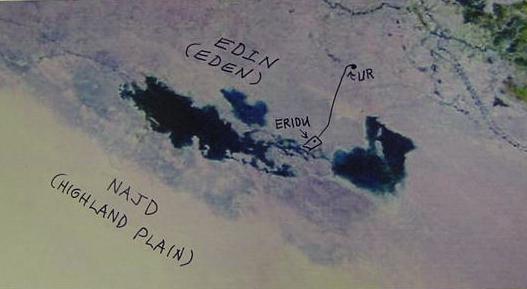
This article in a nutshell: Ancient Sumer's edin (steppe) is identified as the land of Nod (and the land of Eden) while Cain's city of Enoch is a fusion of motifs originally associated with the Sumerian cities of Unug (Uruk) and Eridug (Eridu). The biblical notion that the world's first city is founded by Cain, a wanderer and shedder of blood, is recalling Gilgamesh who lives at Sumerian Unug (Babylonian Uruk), Unug being recast as Enoch. Gilgamesh wanders edin in fear of dying after his friend Enkidu's death, recast as Abel's death. Themes associated with Gilgamesh, his wandering edin and fear of dying of after his "brother" Enkidu's death were recast as a wandering Cain in Nod, Nod meaning "to wander" in Hebrew. That is to say themes associated with the Epic of Gilgamesh have been recast in Genesis' story of Cain and the Land of Nod east of Edin. So biblical Nod meaning "to wander" is an allusion to Gilgamesh's wandering, in fear of dying, in the edin, which was also recast as biblical Edin. The Epic of Gilgamesh uses Unug in place of Uruk (called a logogram by scholars) and Sumerian edin is likewise used in the Epic as a logogram substitute for Akkadian Seru meaning steppe. So both Unug and Edin appear as logograms in the Epic, in versions as late as Neo-Babylonian times.
A "warning" to the viewer (especially if you are a _devout_ Christian, Jew or Moslem):
My research at this website is that of a Secular Humanist. Secular Humanists understand that the Bible is _not_ the word of God (for the reasons why please click here). Secular Humanists seek to explain the Bible's concepts as evolving from within the context of the Ancient Near East and its religious notions regarding the origins of the world, why man was created and what his purpose in life is. If asked to briefly summarize _my_ understanding of the Hebrew God, Yahweh-Elohim, it would be best encapsulated by the Latin Motto now found on the money of the United States of America: e pluribus unum: "From Many, One." That is to say I understand that the Hebrews took the many gods and goddesses of Mesopotamia, Syria, Canaan and Phoenicia, and ascribed their powers, feats, epithets and personas to their God. Whereas many gods and goddesses were responsible for the Shuruppak Flood in the Hebrew transformation and recasting as Noah's Flood it is only one God who is responsible. I understand that many of the Hebrew notions about the relationship between God and Man are deliberate _refutations_and_challenges_ of the beliefs held by the Mesopotamians, said refutations being in the form of a series of 180 degree "inversions" or "reversals" of earlier Mesopotamian concepts.
According to Genesis after the expulsion of Adam and Eve from the Garden in Eden, a son is born called Cain. He slays his brother Abel and his punishment is to be "wanderer on the earth" (Ge 4:12). Cain complains that as a wanderer his life will be peril and he will be slain (Ge 4:13-14). He then dwells in the "land of Nod, east of Eden" (Ge 4:17) and there builds a city calling it Enoch, after his son (Ge 4:17). We are told that one of Cain's descendants is a herdsman of cattle and the "father" of those who dwell in tents (Ge 4:20). One of Cain's descendants boasts of killing a man (Ge 4:23).
For two millennia scholars have sought to identify the "land of Nod" as well as the "land of Eden" and its garden. I understand that Eden and its garden is a Hebrew myth based upon later recastings of motifs and concepts appearing in earlier Mesopotamian myths regarding primal man's origins of the 3rd through 2nd millenniums B.C.
Davila on the land of Nod possibly _not_ being a location's name:
"Nod. The name of the land where Cain went after he had killed his brother Abel...Gen 4:16...locates it "east of Eden." The land of Nod is not mentioned elsewhere in the Bible. It is unlikely that an actual geographic location is meant. The name seems to be derived from the Hebrew root nwd, "to wander"...Thus, rather than denoting a specific place, the land of Nod symbolizes Cain's fate as "a fugitive and a wanderer (nad) on the earth" (Gen 4:12,14)..."East of Eden" simply means outside of the Garden of Eden, and thus banishment from God."
(p. 1133. Vol. 4. James R. Davila. "Nod." David Noel Freedman. Editor. The Anchor Bible Dictionary. New York. Doubleday. 1992)
Englert on Nod possibly being a "play on words":
"Nod [wandering]. A country east of Eden where Cain went and dwelt (Gen 4:16). Possibly the name represents a play on words, a place of wandering for the condemned wanderer. Some have suggested that words "east of Eden" are a gloss added in order to attach the story to the Eden narrative of Genesis 3."
(p. 557. Vol. 3. D. M. C. Englert. "Nod." George A. Buttrick. Editor. The Interpreter's Dictionary of the Bible. Nashville & New York. Abingdon Press. 1962)
The Hebrew word nowd translated into English as nod according to Strong, is a primitive root which can mean "to wander," or "to flee" among other meanings (cf. p. 77. # 5110-5113. "Hebrew and Chaldee Dictionary." James Strong. Strong's Exhaustive Concordance, Complete and Unabridged. Waco, Texas. Word Books. 1977).
Nod or nuwd, various renderings of from Strong's Concordance (Hebrew and Chaldee Dictionary):
5110
nuwd, nood, a primitive root; to waver; figuratively to wander, flee, disappear; also (from shaking the head in sympathy) to console, deplore, or (from tossing the head in scorn) taunt- bemoan, flee, get, make to move, take pity, remove, shake, skip for joy, be sorry, vagabond, way, wandering.
5111
nuwd (Chaldean word), nood; corresponding to 5116; to flee: -get away.
5112
nowd, node or nod, node; from 5110; exile: wandering.
5113
nowd, node; the same as 5112; vagrancy: Nod, the land of Cain: -Nod.
The notion of primal man being a "wanderer" in "fear of his life" is a motif or concept appearing in Mesopotamian myths and I thus draw the conclusion that the Hebrews have recast these notions as Cain being a wanderer in fear of his life in a place called Nod.
The "first" slaying for the Mesopotamian myths is of an Igigi god called We-ila at the Sumerian city of Nibru (Akkadian Nippur). He is classed as a garden-laborer with fellow laborers who rebel against the Anunnaki god of Nippur called Enlil. Enlil (Akkadian Ellil) and Enki (Akkadian Ea of Eridu) determine that the hard labor protested by the Igigi gods in their city-gardens, creating irrigation canals and ditches and planting seed, hoeing weeds and harvesting the produce to feed the Anunnaki gods is not without just cause. To end the revolt of the Igigi at Nippur (and at Eridu) Enki decides to create a new laborer with Enlil's assent to work in the gods' city-gardens, man will bear the work basket of the gods. Man will care for the gods' city-gardens, thus giving the Igigi gods a never-ending rest from physical toil upon the earth as already enjoyed by the Anunnaki gods. That is to say, in the Mesopotamian myths the "shedding of blood by man" is an activity of the gods _before_ man's creation! The god Abzu (Apsu) was slain by his son Enki (Ea) the god of Eridu; Marduk the god of Babylon slew the goddess Tiamat (spouse of Abzu/Apsu) and later her replacement companion the god Kingu; Enki slew the Igigi god We-ila at Nippur to animate the clay that became man with this god's blood and flesh. Genesis _denies_ that God is "a shedder of the blood" of fellow gods, there is only _one_ God! In the Hebrew recasting of the Mesopotamian creation myths it is man who becomes "the shedder of much blood," instead of gods viciously slaughtering each other! In other words, in the Mesopotamian myths man is made in the image of the gods who shed each other's blood thus man is a shedder of human blood too, he can be no different from the gods in whose image he was made. The Hebrews deny this Mesopotamian concept, that man sheds his fellow-man's blood because he was made in the image the gods who shed each others blood. The Hebrew God is portrayed as being outraged that man sheds his fellow man's blood.
Other Mesopotamian myths have man created and abandoned by the gods and left "to wander" the great uncultivated plain through which run the Tigris and Euphrates rivers. He is portrayed as being naked, his companions are wild animals he eats grass with them (gazelles and wild cattle) and he laps water at watering holes in the wilderness with the naked beasts. This uncultivated land that he wanders is not called Nod, its name in Sumerian is _edin_ (alternately rendered_eden_ by some scholars), the uncultivated steppeland or floodplain associated with Mesopotamia. The city-gardens of the gods _created _before_ man_ are never called edin/eden, the edin/eden is contiguous to or abuts their city-gardens. That is to say the city-gardens are _in_ the midst of the uncultivated edin/eden or are _surrounded by_ the uncultivated edin/eden, the gods' city-gardens are _in_ the edin/eden.
"And the Lord God planted a garden _in_ Eden...there he put the man whom he had formed." (Genesis 2:8)
In agreement with earlier scholars I identify Eden with the Sumerian edin, which means "uncultivated steppe or plain," and usually associated with the area today called Mesopotamia. The Mesopotamian myths have the gods in the beginning dwelling upon the earth. They create cities to live in and to provide food for themselves they acquire the arts of animal husbandry and learn to make irrigated city-gardens to raise fruits, vegetables and grain. Tiring of all this toil, the gods decide to create man to be their slave, his duty will be to provide life's necessities (food, clothing and shelter) that the gods may be at ease for the rest of eternity and free from earthly toil. Man will care for their city-gardens, dig irrigation ditches to provide water for the crops, harvest them and present them as food offerings to the gods in the temples.
The gods' city-gardens possess fruit trees, vegetables, and grain (to make bread and beer from), they are "off limits" for foraging by beasts contra Genesis' portrayal of God's Garden in Eden allowing wild animals to feed in it with Adam and Eve.
The Mesopotamian myths contradict themsleves regarding the edin. Some myths claim naked man knows no fear in the edin because no predators exist "yet" to offer man harm as in the below Eridu Genesis myth. However, other accounts reveal that the edin possesses carnivores: lions, leopards, bears, wolves and poisonous snakes as well as tent-dwelling bandits and cut-throats. Edin, contra Eden, is a place of danger for man. If the carnivores of edin don't kill man, he faces the danger of being slain by edin's tent-dwelling nomads, brigands and outcasts from respectable society, said 'respectable society' being characterized as urban city-dwellers!
I thus understand that motifs of primal man's (Cain) facing danger in Genesis is a recasting of motifs associated with the edin. That is to say the Land of Nod or "land of wanderers" is the edin!
The Sumerian god Enki of Eridu is portrayed in myth as ordering the slaughter of the Igigi god We-ila at Nippur and mixing his blood and flesh with Nippur's clay to create man. That is to say the clay that is man has no life until the slain god's flesh and blood is ground into it, animating it. I understand this motif has been recast as Cain slaying Abel his brother, Abel's blood crying out to God from the ground (Ge 4:10-11). The Igigi were gods and Enki is an Anunnaki god, so in a sense a god has slain a "brother-god" causing his blood to enter the earth or clay to thereby animate man. Enki bears the Sumerian epithet Nudimmud which means "creator of man." Is it possible that this title was morphed into Nod where dwells a primal man who slays his brother? Cain, the world's first murderer, is credited with creating the world's first city named after his son Enoch, and in the Sumerian myths it is Enki who is credited with creating the world's first city, Eridu, in Sumer. Was Enki morphed into Enoch? So Enki/Nudimmud shed his brother-god's blood and created the world's first city and Genesis has the world's first city, Enoch, created in the land of NOD by a "wanderer and shedder of human blood."
Professor Frymer-Kensky on the meaning of Nudimmud:
"There had been considerable rivalry between Enki/Ea and the mother-goddess as to who created the first humans, and Ea eventually became considered Nudimmud, the "man-creator." (p. 246. Note 53. Tikva Frymer-Kensky. In the Wake of the Goddesses, Women, Culture and the Biblical Transformation of Pagan Myth. New York. Fawcett Columbine, Ballantine Books, 1993. First edition 1992 The Free Press a division of Macmillan, Inc.)
The "Eridu Genesis Myth" (translated by Professor Thorkild Jacobsen in 1981) speaks of naked man, abandoned, ignored and forgotten by the gods, wandering the "high desert" or "high steppe" (Sumerian: an edin) with wild animals for companions. He knows no fear, because no animals exist "yet" to harm him like lions, hyenas, and snakes. This myth supplies the motif for Genesis' notion that primal naked man (Adam) has no fear of wild animals in Eden (edin). This motif is, of course, "nonsense," as other Mesopotamian accounts reveal that naked man (Enkidu) fears edin's carnivores and Sumerian cylinder seals show a naked man (Enkidu?) embracing gazelles and defending them from lions that roam the edin. Please click here for cylinder seals showing naked man (Enkidu?) protecting gazelles from predators.
Eden's Cain is a "wanderer" who settles down and builds a city. I understand that the motif of primal man wandering the high edin or "high desert" then settling down to build cities has been recast as Cain the wanderer building a city.
Of interest here is that the Sumerian Eridu Genesis account was found at Nippur and at Ur. In other myths we learn that the god of Nippur, Enlil, summons his brother-god Enki of Eridu, to his city to put down the rebellion of the Igigi gods by creating man of clay to replace them as laborers in his city-garden. In yet another myth Enlil of Nippur sends a flood to destroy mankind, but Enki defies him and thwarts his plan by warning one man of the flood, telling him to build a boat and save the seed of man and animalkind for a new beginning. Enki is credited with creating man at not only Nippur but also at Eridu to replace the rebelling Igigi gods as garden laborers. In otherwords, Genesis' Yahweh-Elohim who created man and placed him in his garden, made Cain a wanderer, had him build a city, is nothing more than a Hebrew recast of motifs and concepts associated with Nippur and Eridu whose myths speak of man's creation and his being naked and wandering with animals in the edin. That is to say Eridu and Nippur are pre-biblical prototypes of Genesis' garden _in_ Eden. No texts about primal man have been found at Eridu, but this city and its association with primeval man appear in texts found at Ur (Tell Muqayyar south of Babylon) where Abraham lived.
The Mesopotamian myths understand _before_ man was created that the gods were naked and wandered the edin like wild animals, they knew not the wearing of clothes or eating of bread, they ate plants with their mouths like sheep. Eventually they acquire the arts of husbandry and becomes tillers of the soil creating irrigated city-gardens. That is to say Genesis' notions of primeval man (Cain) at first being a wanderer who later settles down to build a city is apparently a recast of earlier Meopotamian motifs regarding the gods and primeval man.
Professor Kramer on the Anunnaki gods being wandering naked animals in the beginning just like primeval man:
"They (the Anunnaki) knew not the eating of bread,
Knew not the dressing of garments,
Ate plants with their mouths like sheep,
Drank water from the ditch..."
(pp. 220-221. "Literature: The Sumerian Belles-Lettres." Samuel Noah Kramer. The Sumerians, Their History, Culture, and Character. Chicago & London. University of Chicago Press. 1963. Reprint of 1972)
Please note that both Enlil and Enki the gods of Nippur and Eridu, locations where man was created of clay to replace the rebelling Igigi gods, are both classed as being Anunnaki gods. The above verse reveals that once upon a time the Anunnaki were _wanderers_ of the edin, naked beasts, who knew not the eating of bread, eating plants with their mouths like sheep. That is to say, both Nippur and Eridu, portrayed in some myths as having been built and occupied the gods _before_ man's creation were created by "wanderers" of the edin (recalling Cain "the wanderer" creating the city of Enoch).
Jacobsen on naked primal man being a wanderer or "nomadic vagrant" of the an edin or high steppe (note that Jacobsen's portrayal of primeval man being a vagrant or wanderer at first and then later settling down to build cities appears to anticipate Genesis' portrayal of Cain another primeval man who is a wanderer who later settles and builds a city):
"...the goddess of birth, the mother of mankind, Nintur...decided to call mankind home from a nomadic, vagrant existence, to have them build cities and temples, and thus become sedentary and civilized." (pp. 130-131. Thorkild Jacobsen. "The Eridu Genesis." pp. 129-142 in Richard S. Hess & David Toshio Tsumura. Editors. I Studied Inscriptions From Before the Flood, Ancient Near Eastern, Literary, and Linguistic Approaches to Genesis 1-11. Winona Lake, Indiana. Eisenbrauns. 1994)
Jacobsen's translation of the Eridu Genesis (Note: I have not followed Jacobsen's poetic format. Emphasis mine):
"Mankind's trails when forgotten by the gods were in the high (i.e., not subject to flooding) desert. In those days no canals were opened, no dredging was done at dikes and ditches on dike tops. The seeder plow and plowing had not yet been instituted for the knocked under and downed people. Mankind of (those) distant days, since Shakan (the god of flocks) had not (yet) come out of the dry lands, _did not know arraying themselves in prime cloth_, MANKIND WALKED ABOUT NAKED. In those days, there being NO SNAKES, being NO SCORPIONS, being NO LIONS, being NO HYENAS, being NO DOGS, being NO WOLVES, MANKIND HAD NO OPPONENT, FEAR AND TERROR DID NOT EXIST. [The people had as yet no] king. Nintur was paying attention: Let me bethink myself of my mankind, (all) forgotten as they are; and mindful of mine, Nintur's creatures let me bring them back, let me lead the people back from their trails. May they come and build cities and cult-places, that I may cool myself in their shade; may they lay the bricks of the cult-cities in pure spots, and may they found places for divination in pure spots! She gave directions for purification, and cries for quarter, the things that cool (divine) wrath, perfected the divine service and the august offices, and said to the (surrounding) regions: "Let me institute peace there!" When An, Enlil, Enki, and Ninhursag fashioned the darkheaded (people) they had made the small animals (that came up) from (out of) the earth in abundance and had let there be, as befits (it) gazelles, (wild) donkeys, and fourfooted beasts in the desert...he (i.e., the king)...laid the bricks of those cities...The firstling of those cities, Eridu she [Nintur] gave to the leader Nudimmud [Enki/Ea]...[man] dredged the canals, which were blocked with purplish (wind-born) clay, and they carried water. Their [man's] cleaning of the smaller canals established abundant growth." (pp. 160-161. Patrick D. Miller, Jr. "Eridu, Dunnu and Babel: A Study in Comparitive Mythology." pp. 143-168. Richard S. Hess & David Toshio Tsumura. Editors. I Studied Inscriptions From Before the Flood, Ancient Near Eastern, Literary, and Linguistic Approaches to Genesis 1-11. Winona Lake, Indiana. Eisenbrauns. 1994.citing from Professor Thorkild Jacobsen's translation. 1981. "The Eridu Genesis.")
Below, a Sumerian account of Grain's/Wheat's (personified) refuting Sheep's/Ewe's (personified) claim as to who benefits man more:
"Your shepherd on the high plain eyes my produce enviously; when I am standing in the furrow in the field, my farmer chases away your herdsman with his cudgel. Even when they look out for you, from the open country to the hidden places, your fears are not removed from you: fanged (?) snakes and BANDITS, the creatures of the desert, WANT YOUR LIFE on the high plain.
The Sumerian an edin-na (an = high + edin-na =plain) is rendered variously as a "high" desert, steppe, or plain where shepherds graze their sheep and goats; Note that this _edin_ is characterized as being a place of danger, inhabitated by snakes and other predatory creatures of the desert (leopards, lions, and hyenas) which seek a sheep's life, but this can apply just as well to man. Edin is not a pleasant, idyllic place of tranquility where man has no fear its wild animals. The Mesopotamians understood man had been created to care for the gods' city-gardens (at Eridu and Nippur and Babylon) and present them their produce for their sustenance in the Temples. These gardens which produced grain for bread and beer, fruit-trees, and assorted vegetables were surrounded by uncultivated steppeland called the edin where shepherds grazed their flocks (the gardens themselves were never called edin). As noted in these verses, the farmer was vigilant to keep out of his garden-fields of grain, the shepherd of edin and his foraging flocks. Foraging wild animals would be just as _unwelcome_ in the gods' city-gardens. I understand that the Hebrews are denying, challenging and refuting the Mesopotamian notions about the relationship between man, wild animals and the gods' gardens by recasting all of the above as a series of inversions or reversals of Mesopotamian concepts. For the Hebrews there is no danger for man from wild animals in Eden and they are free to feed off the plants in God's garden, which is not a city-garden, but in the midst of a region called Eden.
As regards motifs from Genesis of Cain the wanderer fearing for his life, note the statement that BANDITS SEEK ONE'S LIFE in the an-edin or "high steppe." The motif here of course is of predator's seeking the sheep's life but this motif can apply just as well to man. The Mesopotamian city-dwellers regarded the edin as a place of lawlessness, filled with tent-dwelling nomads and bandits. The wanderers of edin are murderers, no wonder then Cain the "wanderer" fears for his life, he has "murdered" and become a wanderer, and wanderers in Mesopotamian eyes are equated with lawless murderers. The Mesopotamians equate the good-life with cities. Here law prevails, one is safe. The Hebrews deny this notion for they have Cain the wanderer-murderer founder of the world's first city and one of his descendants, Lamech, boasts of killing a man (Ge 4:23-24). Why are the Hebrews portraying a murderer as the founder of the world's first city thereby suggesting cities are full of Cain's muderous descendants? The answer will surprise you. Abraham is portrayed as a shepherd in his wanderings between Ur of the Chaldees, Haran and Canaan. Having been a resident at/near Ur he would be aware that tent-dwelling nomads are feared and despised by the city-dwellers. In defense of his way of life as a tent-dwelling shepherd of edin the steppe he probably inverted the Mesopotamian storyline. Nomadic tent-dwelling herders are not lawless murderers despised by God, the city-dwellers are who God despises (the descendants of a murdering Cain). Abraham is also portrayed as having been originally a polytheist before being "called' by God at Haran. As a practicing polytheist at Ur (originally a Sumerian city-state) he would have, no doubt, been familiar with Sumerian and Mesopotamian myths and their notions that the wanderers of edin are to be equated with murderers. He would also be aware that the gods' heart's delight was to dwell in cities, not the edin. He also would be aware that these city-dwelling gods were portrayed as shedding the blood of their fellow gods in these cities! Thus the reason perhaps that the founder of cities is a murderer. Enki slew Apsu at Eridu. We-ila is slain at Nippur at Enki's behest, with Enlil's assent. Marduk of Babylon slays Tiamat and Kingu. In other words the shedding of blood in Mesopotamian myths is not just a phenomenon associated with the lawless edin and its wanderers but in cities too (man's very creation at Nippur being a result of We-ila's being killed by Enlil and Enki). So the motifs of being a murderer and fearing for one's life associated with Cain the wanderer and city-dweller are nothing more than recast echoes of earlier themes and motifs appearing in the Mesopotamian myths.
The steppe was called in Sumerian eden/edin and at other times arali. In any case it is a place of danger for man:
"Generally, the town-dwelling population of southern Mesopotamia considered the open semi-desert countryside to be a dangerous and lawless place..."
(p. 13. "Arali." Gwendolyn Leick. A Dictionary of Ancient Near Eastern Mythology. London. Routledge. 1991. Reprint 1997)
The motif of Cain the wanderer being fearful of dying is also picked up in the Epic of Gilgamesh. After Enkidu's death Gilgamesh becomes a wanderer of the steppe (Sumerian edin, Akkadian seru) and he is portrayed as fearing death. His wanderings are likened to those a bandit (bandits are to be equated with murderers who have fled to wander the lawless wilderness):
Gilgamesh speaking to an alewife or barmaid:
"Enkidu, whom I love so much,
Experienced all troubles with me.
He suffered the fate of mankind.
Day and night I wept over him...
Since his death I have not found eternal life.
I keep wandering like a bandit in the open
country.
Now that I have found you, alewife,
May I not find the death I dread.'
"Gilgamesh, where do you roam?
You will not find the eternal life you seek.
When the gods created mankind
They appointed death for mankind,
Kept eternal life in their own hands..."
(pp. 149-150. "The Epic of Gilgamesh." Stephanie Dalley. Myths From Mesopotamia: Creation, The Flood, Gilgamesh And Others. Oxford & New York. Oxford University Press. 1989, 1991)
To the degree that I have identified Cain's murder of Abel as a recasting of the slaying of We-ila at the instigation of Enki and Enlil at Nippur and the world's first city founded by Cain in the land of Nod as being a recast of the world's first city founded by Enki at Eridu, the city of Enoch (Ge 4:17) is recalling Eridu in Sumer. Genesis has the land of Nod being "east of Eden" (Ge 4:16) and it is interesting to note that according to the Sumerian myths and annals Eridu was the farthest east location within the edin, the uncultivated steppe which ends here. Eridu, according to ancient hymns lay on the "shore of the sea," or "sea land," which was portrayed as a land of marshes. So I understand that the city of Enoch in the land of Nod east of Eden is recalling ancient Sumerian Eridug (Akkadian: Eridu, Arabic: Tell Abu Shahrain). But the land of Nod, as applied to people who wander in fear of their lives, is a recast of life in the edin, the great uncultivated steppe or plain which extends from Eridu to Haran in Syria. I understand that Nod really is not exclusively Eridu and area, its the whole of Mesopotamia. In other words edin-the-uncultivated-steppeland watered by the Tigris and Euphrates rivers is not only the land of Eden its also the land of Nod!
In agreement with Professors Robert Graves and Raphael Patai (1963) I understand Enkidu and Shamhat of the Epic of Gilgamesh have been recast as Adam and Eve. In the Bible they are expelled from the Garden in Eden and their son Cain settles in the Land of Nod _east_ of Eden. I have identified a watering hole in the wilderness (Sumerian: an edin, "high plain") west-southwest of Uruk as the possible setting for Enkidu's encounter with Shamhat and Eridu the "first city" in Sumerian myth is _east_ of this watering hole! That is to say, the watering hole was morphed by the Hebrews into a God's garden in Eden, and Eridu, _east_ of this location became Cain's city of Enoch. Please click here for a map showing the watering hole where Enkidu (Adam's prototype) met Shamhat (Eve's prototype). In the Sumerian world's "first city" dwells its founder, the Sumerian god Enki who was responsible for slaying a brother-god, We-ila, and who bore the epithet NUDIMMUD, "creator of man."
Note: In agreement with other scholars I understand that Eridu is also _one of several prototypes_ for God's Garden in Eden. Please click here for the details.
Paradoxically, Eridu as the world's first city in Mesopotamian myths becomes _for me_ the pre-biblical prototype of the Bible's first city built in the "land of Nod" by Cain and called Enoch. Of interest is that Enoch's son is Irad which is similar in sound to Eridu (Irad apparently dwells in the world's first city and Eridu is the world's first city in Mesopotamian myth. Did the Hebrews creatively transform Eridu into a person named Irad?).
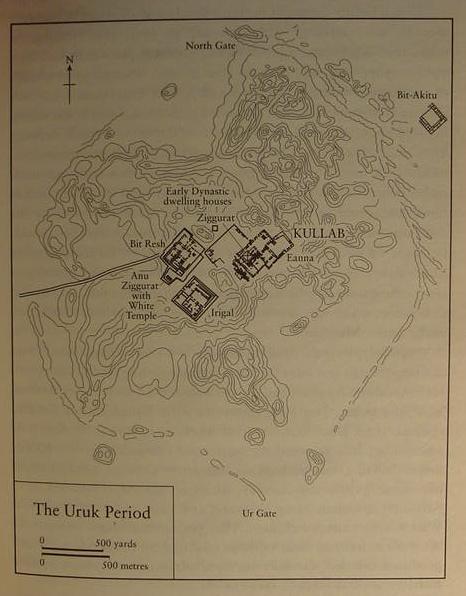
Regarding Enoch as the name of the world's first city in the Bible, it is worth noting that Uruk was a much larger city than Eridu, and its Sumerian name was Unug, which sounds somewhat like Enoch. So we might have a fusion here of two Mesopotamian historical kernels, Eridu as the world's "first" city in Mesopotamian myth and Unug (Arabic: Warka, Akkadian: Uruk, Genesis' Erech in the plain of Shinar) which according to archaeologists was a much larger and more important city.
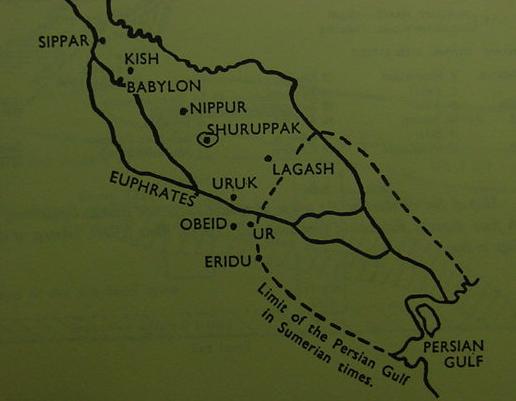
In 1963 Professors Graves and Patai identified Adam and Eve as later recasts of Enkidu and Shamhat of the Epic of Gilgamesh, and my research agrees with their proposal (cf. pp. 78-79 & 81. Robert Graves & Raphael Patai. Hebrew Myths: The Book of Genesis. New York. Doubleday & Company. 1963, 1964. Reprinted 1983 by Greenwich House). Enkidu (Adam) and Shamhat (Eve) leave the watering-hole in edin-the-steppe (recast in Genesis as the "garden in Eden") and come to dwell in the city of Uruk, Sumerian Unug. So, it just might well be that Genesis' city of Enoch is a Hebrew "morphing" of Sumerian Unug! The land of Nod is described as "east" of the garden of Eden and Unug is "east-northeast" of the watering-hole (said watering-hole being about where the letter "b" is in Obeid on the below map. Please click here and scroll down for a more detailed map of the wateringhole)
Please click here for how Enkidu of the watering-hole in edin-the-steppe was recast as Adam.
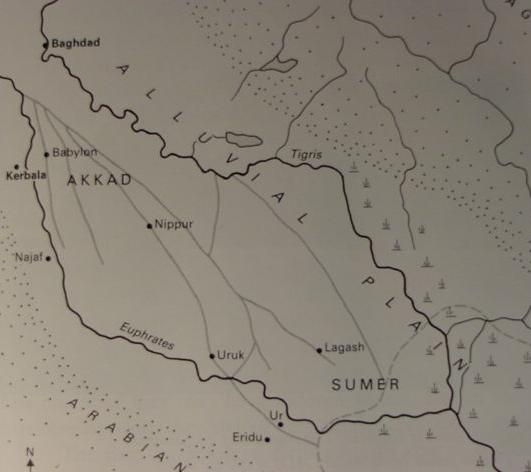
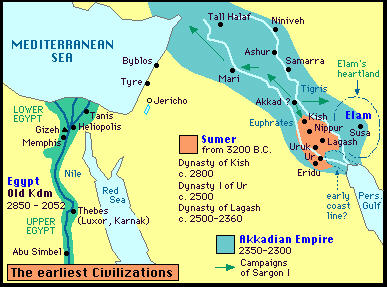
Below, a map showing the location of Nippur and Eridu in the 3rd-2nd millenniums B.C. where, according to ancient Mesopotamian myths man was created to work in the city-gardens of the Sumerian gods Enlil and Enki to relieve the Igigi gods of toil. Note the dotted line showing the shore of Persian Gulf near Eridu and Ur (cf. p. 33. "Map of Mesopotamia." Lloyd R. Bailey. Noah, the Person and the Story in History and Tradition. Columbia, South Carolina. University of South Carolina Press. 1989). In reality, this map errs! The Persian Gulf's shore was _not_ near Ur and Eridu in the land of Sumer. The shoreline was in reality where it has always been, south of Basra!
Sumerian edin which means "uncultivated steppeland or plain" applies to the land of Mesopotamia, and in particular ancient Sumer. The god's city-gardens made before man was created and filled with fruit-trees were never called edin, they were in the midst of the edin or surrounded by the edin. In the edin wandered according to myths naked primal man, who fed on grass and who knew not it was wrong to be naked. He knew no fear from his herbivore companions the gazelles. His and the animal's "heart's delight" according to the Epic of Gilgamesh was the water of the watering-hole in the edin (the notion of primal man's hearts' DELIGHT being water being recast as the Hebrew word `eden meaning DELIGHT, Sumerian edin being morphed into Hebrew `eden). In the edin primal naked man (Enkidu being created of clay and having like Adam no mother or father) meets a naked woman, Shamhat the harlot-priestess from Uruk, who awaits his arrival in order to seduce him and separate him from his animal companions. She succeeds and convinces him to leave edin and dwell with her in Uruk. He learned from her in edin that it is wrong to be naked and both leave the edin with their nakedness clothed just as Adam learned in a place called Eden it was wrong to be naked _after_ his contact with another naked woman, Eve. Genesis' notion that man after being expelled from Eden eventually settles in a land of wanderers, called Nod and comes to live in a city called Enoch is a recast of Enkidu (Adam) and Shamhat (Eve) leaving edin to live at Sumerian Unug, Akkadian Uruk. The notion that it is the world's "first city" preserves Sumerian notions that Eridu was the first city, but Eridu has been fused with Unug to become Enoch. Unug or Uruk was in antiquity a much larger and more important city than Eridu.
Genesis' Garden _in_ Eden, its motifs, concepts and its characters have been identified as later _recasts_ of fictious personages and events appearing in earlier Mesopotamian myths, one of which was the Epic of Gilgamesh.
The Hebrews' intent in recasting the Mesopotamian myths was to deny, refute and challenge their portrayal of the relationship between Man and his Creator. The Mesopotamians saw man as a victim of uncaring capricious gods whereas the Hebrews portrayed their God as the victim of an evil-hearted and unappreciative mankind.
Apparently the honor for the 'earliest" association of Cain's city of Enoch and its land of Nod with Uruk goes to Professor Sayce (1846-1933) of Oxford University in England (Oxford Professor of Assyriology) who by 1887 had identified Cain's (his Kain) city of Enoch with Uruk, which had been earlier called in Sumerian (his Accadian) Unug (his Unu-ki or Unuk) and the city of Eridu preserving the names of Irad and Jerad, other descendants of Cain:
"Its earliest name was the Accadian Unu-ki or Unuk, "the place of the settlement," of which the collateral form Uruk does not seem to have come in vogue before the Semitic period. If I am right in identifying Unuk with the Enoch of Genesis, the city built by Kain in commemoration of his first-born son, Unuk must be regarded as having received its earliest culture from Eridu, since Enoch was the son of Jared, according to Gen. v. 18, and Jared or Irad (Gen. iv. 18) is the same word as Eridu."
(p. 185. "The Gods of Babylonia." Archibald Henry Sayce. The Hibbert Lectures of 1887, Lectures on the Origin and Growth of Religion, as illustrated by the religion of the Ancient Babylonians. London & Oxford. Williams & Norgate. 1897, fourth edition. Reprinted by Kessinger Publishers of Whitefish, Montana in paperback)
Hastings (1894), in agreement, apparently, with Professor Sayce (1887), that Cain's city of Enoch is Sumerian (Akkadian) Unug or Unuk and Genesis' Jared/Irad is Eridug/Eridu:
"...Uruki...a Semiticised from of the older Akkadian name, Unu-ki, Unug, "the city of the land," i.e., metropolis, which, allowing for the guttural pronunciation of the first sign...is an exact equivalent of the Hebrew...Here, then, the first city of Cain is evidently identical with...Unuk...Jared...Irad...is...Eridu...Eri-dugga, "the holy city"..."
(p. 353. Vol. 5. James Hastings. Editor. The Expository Times. Edinburgh. T. & T. Clark. Oct. 1893-Sept. 1894)
Cottrell (1965) on Loftus who excavated at Uruk in the 1850s noted that the native traditions understood it was Abraham's birth place, Ur of the Chaldees:
"Loftus elected to travel by the land route influenced by a twofold object; that of examining the geology of the Chaldean marshes, and that of exploring the ruins of Warka, to which native tradition assigns the birthplace of the patriarch Abraham."
(p. 51. "The Discovery of Erech." Leonard Cottrell. The Quest for Sumer. New York. G. P. Putnam's Sons. 1965)
Please click here for a recently discovered cuneiform text confusingly making Gilgamesh the king of Ur instead of Uruk as noted by Professor Andrew George (2007).
Other scholars like Professor Morris Jastrow Jr. of the University of Pennsylvania had by 1898 noted the parallels between Enkidu and Shamhat of the Epic of Gilgamesh and Adam and Eve and that motifs associated with Adapa of Eridu appeared to be identified with Adam.
I have noted that after leaving the watering hole in the edin Enkidu and Shamhat come to dwell at Uruk, the Sumerian Unug, Sayce's Enoch built by Cain. I understand that the Hebrews are recasting motifs and concepts from several different Mesopotamian myths into a new story. They deny the existence of the Mesopotamian gods and goddesses and their many city-gardens in the midst of the edin (every Mesopotamian city had its god's or goddess' garden that man tilled), there is only _one_ God and only _one_ god's garden in Eden and it is not a city-garden.
We are told that God's garden is watered by a single stream that rises in Eden and that this stream later subdivides into four rivers, the Pishon, Gihon, Tigris (Hebrew Hidekkel) and Euphrates. The land of Nod ("land of wanderers"?) lies _east of_ Eden. Where in Mesopotamia does a single stream become four?
Before we answer that question an important observation needs to be made: Genesis does not name the single stream which arose in Eden to water God's garden. Some commentators understand that _after_ leaving the garden this stream subdivides into four streams. Quite clearly God's garden is _not_ watered by either the Pishon, Gihon, Hidekkel (Tigris) or Euphrates _in denial of_ the Mesopotamian portrayal of the latter two streams being the source of water for the gods' city-gardens of Sumer in Lower Mesopotamia! That is to say the Hebrews are challenging, refuting and denying the Mesopotamian understanding that the Euphrates and Tigris provide water for a God's garden!
According to Archaeologists in antiquity the Euphrates was one stream from Mari to Sippar. From the latter site it eventually subdivided into three streams as it crossed the great floodplain of Lower Meopotamia.
Some Archaeologists have noted on the basis of paleohydrological surveys by Geologists that in the course of the 6th through early 2nd millenniums B.C. the Tigris "apparently" _joined_ the Euphrates in the vicinity of Sippar. For me, this _joining_ of the Tigris to the Euphrates and its three streams became Genesis' river of Eden with four streams. By the 2nd millennium B.C. the Tigris began moving to the east and its present location while the Euphrates migrated to the west, separating from each other. Please click here for maps showing the joining of the Euphrates and Tigris near Sippar.
Thus the most likely location for Genesis' Garden _in_ Eden "fed by one river" that later became four streams would appear to be Mari. This would make the land of Nod "to the east" of the Garden in Eden (that is to say "to the east of" Mari). Uruk, Sumerian Unug (Sayce's Unuk) does _lie to the east_ of Mari. Thus the Garden of Eden, if at Mari, was in Upper Mesopotamia while the Land of Nod to its east was the great floodplain of Lower Mesopotamia, Unug/Unuk/Uruk being Cain's city of Enoch according to Professor Sayce (Eridu, which was the "first" city in Mesopotamian myths lies to the east of Uruk, and to the east of Mari and Sippar too). Please note that in the Mesopotamian myths man at first is a "wanderer" then the gods take him and have him build cities (cf. above, Jacobsens' Eridu Genesis myth). Thus the cities of Sumer were, according to Eridu Genesis myth, built by man the wanderer under a goddesses' direction. Genesis apparently has recast this as Cain the wanderer building a city in the land of Nod, "the land of wanderers," calling it Enoch. That is to say Sumer has been recast into the Land of Nod. Please note that Eridu _in_ Sumer is the "first city" and according to the Eridu Genesis myth it is built by man the wanderer of edin at the goddess Nintur's direction and given to the God Enki. However, Mesopotamian myths frequently contradict each other. Another myth has Enki dwelling at Eridu and being awakened by his mother and he asked to put down the rebellion of the Igigi gods. He decides to create man of the clay from the apsu fountain at Eridu to replace the rebelling Igigi as laborers. So in this myth Eridu was created by the gods _before_ man was created.
Please click here for a wall mural found at Mari showing winged fabulous beasts guarding two trees in a god's garden and dieties holding water pots with four streams erupting from them, perhaps an allusion to the Euphrates leaving Mari to eventually become the four streams of Lower Mesopotamia? At Mari archaeologists found names of people in the area possessing the theophoric _yawi_ understood to be Yahweh who revealed himself to Abraham at Haran in Upper Mesopotamia (Mari lies in Upper Mesopotamia). Please click here for and scroll down to the end of the article for further details on the _yawi_ names found at Mari in Upper Mesopotamia and at Kish in Lower Mesopotamia.
Highly reccomended is Scafi's recent book which covers most of the attempts to locate the Garden of Eden and the land of Nod on a map. He covers proposals from Medieval times to the 21st century. Some maps are in black and white others in full color. Do yourself a favor and buy this book: Alessandro Scafi. Mapping Paradise, A History of Heaven on Earth. Chicago & London. The University of Chicago Press and The British Library. 2006. (Please click here to purchase Scafi's book).
The land of Nod and its city of Enoch, built by Cain is understood to be a later Hebrew recast of much earlier Mesopotamian myths which are ultimately, probably Sumerian, recalling man as a wanderer creating cities for the gods to dwell in, within Sumer in Lower Mesopotamia as per Professor Jacobsens' (cf. above) "Eridu Genesis myth." That is to say Sumer has been transformed by the Hebrews into the Land of Nod, "the land of wanderers." In Sumerian myth the "first city" is Eridu in Sumer. In Hebrew myth the "first city" is Enoch in the Land of Nod. I agree with Sayce that Sumerian Unug/Unuk has been recast as Enoch, but Eridu as the "first city" is also fused and recast with Unug to become Enoch.
Paradoxically however, Sumer is also Eden, and its city-gardens have been recast as a God's Garden in Eden, Eden being derived from the Sumerian edin (the uncultivated steppeland or plain) surrounding Sumer's cities and their city-gardens. So the Sumerian edin is not only Eden it is also the "land of Nod" and in effect ancient Sumer!
My research into the pre-biblical origins of the Garden in Eden and the Land of Nod reveals that several _contradicting_ strands exist which have been fused together and recast by the Hebrews. Although Jacobsen's (above) "Eridu Genesis myth" portrays man the wanderer creating cities for the gods to dwell in, other _contradicting_ myths have the cities of Sumer being created and occupied by the gods alone _before_ man's creation!
If _my_ above suppositions here are correct then truly it can be said that "Sometimes the truth is stranger than fiction!"
I am not the first to place the land of Nod in Lower Mesopotamia. As noted above, Professor Sayce in 1887 identified the city of Enoch with Sumerian Unug, thereby suggesting that the land of Nod was in this area.
Genesis has the world's first city being created by Cain in the land of Nod and this notion that a _man_ is the creator of the world's first city is bolstered or supported somewhat by the Eridu Genesis myth which portrays the goddess Nintur directing man the wanderer to build the world's first city, Eridu, in Sumer, for the god Enki.
Professor Jastrow of the University of Pennsylvania had by 1914 realized that many of Genesis' motifs were ultimately related to and derived from Lower Mesopotamia and Babylonia but obviously modified and transformed. The big question for him was by what processes did the Hebrews come to differ from the Babylonians in their religious beliefs?
Jastrow:
"The problem involved in a comparison between the Hebrew civilisation and the Euphratean culture, as we may briefly designate the Babylonian-Assyrian civilization...is to determine the point of separation between the two that lead to such totally different issues. Why is it -we may properly ask- that with agreement in regard to many traditions, with religious ideas and practices that at one time bore a close resemblance to one another, with a general view of life, of divine government, of the fate of man after death, of practical ethics at the outset not sharply differentiated from one another, the courses taken by Hebrew and Babylonian traditions were so dissimilar. For it is to the different courses taken by this common stock of traditional ideas and practices that the contrast no less striking than the points or resemblance that once existed between the two civilisations...Our comparative study will be directed chiefly towards an elucidation of the ultimate differences that arise between Hebrew and Babylonian points of view despite earlier and very noticeable points of agreement...Gradual growth involves survivals, that is to say, indications of older views and customs carried over into later periods. Evolution means not only transformations through historical processes, but a mixture of old and new. It will therefore be also part of my purpose to trace the process of growth in both Hebrew and Babylonian traditions and to show in how far older views were replaced, how far they survived, and how, combined with new thought, they gave rise to new religious practices."
(pp. 4-5. "Relations between Hebrews and Babylonians." Morris Jastrow, Jr. Hebrew and Babylonian Traditions, The Haskell Lectures delivered at Oberlin College in 1913. New York. Charles Scribner's Sons. 1914)
In answer to Jastrow's question my research suggests that it was Abraham who changed the Lower Mesopotamian concepts. He began life as a polytheist so he would have been intimately familiar with Mesopotamian myths and their motifs. Being an accursed nomadic tent-dwelling shepherd of the edin steppelands, he probably recast the city-dwellers myths via a series of brilliantly orchestrated inversions and reversals. Nomadic tent-dwelling shepherds were not cut-throats and thieves and cursed by God, the city-dwellers were the accursed. They dared to build a tower of Babel (ziggurat) _in their city_ and brought down upon themselves God's anger, he scattering them and changing their language into a babel of tongues. That is to say God's favor was with humble shepherds who dwelt in tents in the edin, not city-dwellers! When the Hebrew God finally agreed to dwell among men, it was in a tent, the Holy Tabernacle among humble tent-dwelling nomadic shepherds at Mount Sinai _not_ in a temple in the midst of a city as in Mesopotamian beliefs. So, I see Genesis' motifs as having been framed by nomadic tent-dwelling shepherds who recast the Lower Mesopotamian city-dweller's origins of man and the gods myths in such a way as to _repudiate, deny and challenge_ the notion that tent-dwellers are the accursed of God, it is the arrogant city-dwellers who are the accursed. The city-dweller's notions about why man was created and why his demise was later sought in a flood are also challenged and denied via a series of inversions and reversals. In essence, the nomadic tent-dwelling shepherds of the edin are challenging point-by-point many of the city-dweller's myths. The shepherds have the "correct" view of why man was made and his end sought in a flood, the city-dwellers have it all wrong!
Crawford on the animosity between nomadic herders and settled urbanites or agriculturalists (Emphasis mine):
"However, in essence the population can be divided into those people in permanent settlements, who relied primarily on agriculture and stock rearing for their subsistence, and those who wandered between settlements with their herds of sheep and goats...conflicts arose between the groups, and THE URBAN DWELLERS TENDED TO DESPISE THE NOMADS AS UNCOUTH BARBARIANS."
(p. 12. "Pastoralists and farmers." Harriet Crawford. Sumer and the Sumerians. Cambridge, United Kingdom. Cambridge University Press. 1991, 2004)
Frymer-Kensky on Israel's religion being indebted to Mesopotamian concepts, and its challenging via "counterpoints" some of its notions (emphasis mine):
"Many Israelite ideas about justice, society, and even religion developed from and IN COUNTERPOINT to Mesopotamian ideas."
(p. 83. Tikva Frymer-Kensky. In the Wake of the Goddesses, Women, Culture and the Biblical Transformation of Pagan Myth. Ballantine Books. 1993. First Edition by Freepress 1992)
I realize that the above may be confusing for the reader:
We are dealing with several issues which are entangled or snarled up in Mesopotamian vs. Hebrew concepts due to the Hebrews' recasting and refuting of the earlier Mesopotamian notions:
(1) The pre-biblical notions of the Mesopotamians regarding the founding of the world's first city and the possibility of its being founded by wanderers and shedders of human blood; (2) The biblical transformation, recasting, and reinterpretation of the earlier Mesopotamian motifs and notions regarding the origin of cities, the first city being founded by Cain, a wanderer and shedder of human blood.
The Mesopotamian myths _contradict_ themselves regarding the founding of the world's first city, Sumerian Eridug (Akkadian: Eridu). Some accounts have the Anunnaki god Enki (Ea) creating the city with the assistance of the Igigi gods. Another account, the so-called Eridu Genesis myth, has the goddess Nintur taking naked man from his wild animal companions and his aimless wandering of animal trails in the edin to build cities for the gods to dwell in. The first city man the wanderer creates is Eridu and it is presented to Enki (Ea).
Other myths reveal the Mesopotamians feared the inhabitants of the lawless edin which surrounded their cities. They regarded these inhabitants as murderers. So two Mesopotamian concepts appear to be fused together: (1) Cities are created by wanderers of the edin where dwell murderers and shedders of human blood; (2) The first city (Eridu) is founded by the Anunnaki god Enki (Ea), who as an Anunnaki was himself once upon a time a naked wanderer of the edin, eating plants with his mouth like a sheep _and_ he is responsible for the slaying of two gods, Apsu at Eridu and We-ila at Nippur. So, the Mesopotamian notion of the first city being created by a wandering murderer appears to be what was recast into Cain the wandering murderer founding the first city.
The Bible suggests Nod is _east of_ Eden. Eden probably is referring to the Garden of Eden whose cherubbim are stationed at its eastern entrance to bar man's return. Here is where the problems begin.
For the Mesopotamians the land of the murdering wanderers is the edin, the uncultivated steppeland or plain and this stretches from Eridu to Haran, embracing both Upper and Lower Mesopotamia. It is while Cain is in Eden that he is told he will be a wanderer, so he apparently began his wandering _in_ Eden and in Mesopotamian myths lawless bandits and murderers wander about _in_ the edin. Bingo! We have a "match-up," Cain the murderer wanders Eden just as murderers in Mesopotamian myths wander an edin.
But Genesis _sets a boundary to Nod_, it is east of the Garden in Eden.
So, to find the Bible's land of Nod, we have to first pinpoint the most likely location for the Bible's Garden in Eden.
For some commentators the Bible suggests that an un-named river rises in Eden, waters God's garden, then later subdivides into four streams.
There is some confusion on how to interpret Genesis' statement regarding the "river of Eden" and its four streams, do the streams divide after leaving the garden or does the division of one river into four streams occur within the garden? What is mean by "THERE"? The land of Eden? or the garden of Eden?
Genesis 2:10, RSV
"A river flowed out of Eden to water the garden, and THERE it divided and became four rivers."
The Jewish scholar Yahuda (1934) thought the splitting of the four rivers occured _after_ leaving the garden of Eden:
"It must first be emphasized that in Genesis 2:10 there is no mention of four rivers flowing through paradise. Quite on the contrary, it is expressly stated that "a river went out of Eden to water the garden," which can only mean one river. The four rivers mentioned immediately afterwards actually have nothing to do with paradise itself. The whole passage (Genesis 2:10-14) does not refer to paradise, but to the relation of the four rivers to that one river of paradise. All that this passage meant to convey was that the one river of paradise gave origin to the four greatest world streams, thus representing paradise as the source of prosperity and fertility for the whole earth...As already stated, the text of the Paradise story does not say a single word which suggests that the four rivers were within the paradise "to water the garden." The Hebrew text of Genesis 2:10 does not mean that the division of the one river into four was effected within the area of paradise. What it means to convey is that those rivers came forth from that one river after it had left the garden."
(pp. 164-165; 168. "The Story of Paradise." Abraham S. Yahuda. The Accuracy of the Bible, the stories of Joseph, the Exodus and Genesis Confirmed and Illustrated by the Egyptian Monuments and Language. London. William Heinemann Ltd. 1934)
The Jewish scholar Cassuto seems to agree with Yahuda (1944):
"...we are told that a river flowed out of Eden to water the garden, and thereafter it divided into four big rivers..."
(p. 77. Umberto Cassuto. A Commentary on the Book of Genesis. Vol. 1. [From Adam to Noah]. Jerusalem. The Hebrew University. 1944-1968 in Hebrew; 1961-1989 in English. ISBN 965-223-480-X)
If the Hebrew Eden is recalling the Sumerian/Akkadian edin-the-steppe, the problem becomes finding a river in "edin-the-steppe" of Mesopotamia that becomes four rivers!
The Bible denies the Mesopotamian notion that there many gods and goddesses, it denies that there exist many city-gardens of the gods in the edin, there is only _one_ God, Yahweh-Elohim, and thus there is only _one_ God's garden in Eden not many gods' and goddesses' gardens in edin.
The Lower Mesopotamian myths understand that the Euphrates and Tigris rivers provide water for the gods' city-gardens via canals and irrigation ditches. Genesis denies this. The Tigris and Euphrates along with the Pishon and Gihon do _not_ water God's garden. They are subdivisions of the un-named stream that watered God's garden. That is to say _after_ the un-named river leaves God's garden (according to Yahuda), it subdivides into the Euphrates and Tigris.
We are told the Garden is watered by one stream that later becomes four streams. Where in Mesopotamia does one river subdivide into four? The answer: The Euphrates is single stream from Mari to the vicinity of Sippar. Upon reaching the latter location the great floodplain of Lower Mesopotamia is encountered and here the single river subdivides into three major streams who are joined by a fourth stream the Tigris, near Sippar. So edin's four streams have been identified.
The Garden in Eden _watered by one stream_ then, is probably Mari and the land of Nod, "east of Eden" (east of the Garden in Eden) becomes the great floodplain of Lower Mesopotamia.
But we have yet another "marker" from Genesis to pinpoint the land of Nod with greater precision, the city of Enoch founded by Cain. It is presented in Genesis as the world's _first city_ and in Mesopotamian myth the _first city_ is Eridu in the land of Sumer. So the "Land of Nod" is ancient Sumer, and it lies _east of_ Mari! The word Enoch appears to preserve Sumerian Unug (Uruk), a larger and more important city, economically speaking, than Eridu . These two sites may have been fused together to become the city of Enoch in the "Land of Nod." Alternately, Enoch might be a morphing of Enki who founded Eridug/Eridu.
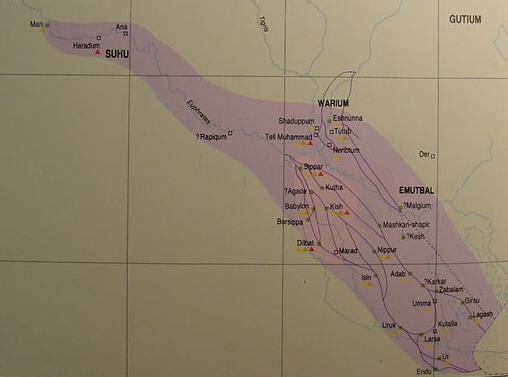
Below, a map showing the kingdom of the Babylonian king Hammurabi (ca. 1792-1750 B.C.) in a light shade of purple. Some scholars have suggested that the king of Shinar, Amraphel (Ge 14:1,9), a contemporary of Abraham, is Hammurabi. This map shows the Euphrates from Mari (viwer's far left), my proposal for the location of the Garden in Eden, to Uruk and Eridu (viewer's far right), my proposals for Enoch in the "land of Nod" I note that this map shows the Euphrates as a single stream from Mari (destroyed by Hammurabi) to Sippar as a single stream. Near Sippar the Euphrates subdivides into four streams: (1) Sippar to Borsippa and Diblat; (2) Sippar to Agade and Diblat; (3) Sippar to Kutha, Adab and Larsa; (4) Sippar to Mashkan-Shapir. I have argued that Abraham of Ur of the Chaldees, originally a practicing polytheist and worshipper of edin's gods and goddesses abandoned polytheism and, transforming the Mesopotamian myths, recognized only one God as associated with the edin, Yahweh-Elohim of the Garden in Eden. If Amraphel is Hammurabi and a contemporary of Abraham then in Abraham's world one river did indeed subdivide into four streams in the edin/Eden (cf. p. 120. map titled "Hammurabi's Kingdom." Michael Roaf. Cultural Atlas of Mesopotamia and the Near East. Oxford, England. An Equinox Book. 1990. Reprinted by Facts on File, New York, 1990).
The importance of the Euphrates to "Southern Mesopotamia" according to Saggs, Professor Emeritus of Semitic Languages, University College, Cardiff, Wales (emphasis mine in bold print and CAPITALS):
"North and south Mesopotamia differ in climate and in natural resources. The north has stone and various minerals, and much of it enjoys rainfall normally sufficient to grow crops of corn [wheat]. Southern Mesopotamia, beginning at about Hit on the Euphrates and north of Baghdad on the Tigris, comprises the delta of the two rivers. Everywhere the soil is alluvial silt, stone is wholly lacking until well out into the western desert, and the rainfall, at less than 150 mm (6 inches) per year, is inadequate to support permanent vegetation cover. However, because of the rivers the region is not totally arid. The river friinges are well watered and productive, with belts of willow and poplar and dense thickets of tall grass, rushes and tamarisk and other undergrowth. Between Nasariyah on the Euphrates and Amara on the Tigris there is a vast region of marsh, with beds of giant reeds, and lakes full of fish and water birds. Wherever canals are cut from the rivers for irrigation, vegetation can be lush. But such luxuriance is the exception, and today the greater part of the region is, unless irrigated, desert except for a brief carpet of verdu from spring storms...The ruins of most of the earliest cities lie in regions which are now markedly arid, and one may wonder how civilization could begin in such adverse conditions. In fact it did not; EVERY CITY OF SOUTH MESOPOTAMIA ORIGINALLY LAY ON A MAJOR CHANNEL OR STREAM OF THE EUPHRATES, which has since shifted...Finds of Paleolithic stone tools in north Iraq proves the existence of humans there from about 100,000 B.C., and small camps or settlements from about 9000 B.C. show the early stages of change from total dependence on hunting and gathering, towards the domestication of animals and exploitation of cereal plants. We do not know when the first humans arrived in south Mesopotamia. Archaeology can trace farming settlements there only from the mid-sixth millennium, but it could have been the haunt of hunters, fishers and nomadic pastoralists many millennia earlier, without their leaving evidence traceable by present archaeological techniques.
Because of the behavior of the Euphrates over the preceding millennia, the first human comers would have found a region much more inviting and less arid than now. Besides several major channels of the Euphrates (THERE WERE STILL AT LEAST THREE IN THE THIRD MILENNIUM), there would have been many more minor streams and ditches, and swamps like the present southern marshlands. Such conditions produced more vegetation than now, so that the region was not only highly favourable for hunting, fishing and cattle rearing, but also offered easy possibilities for any settlers who broght with them a tradition of growing grain crops; they had only to sow their grain on the dry levees of former river-banks, and it would produce crops with minimal further attention until harvest. As population increase called for bigger harvests, the settlers could easily increase the area of cornland [wheat-land] by digging ditches to drain strips of wet land, and using those ditches -primitive canals- to bring water to further strips of land which were otherwise too dry. These were the small beginnings, but they began the process which over the millennia gave the world such great ancient cities, known from the Bible, as Uruk (Erech of Genesis 10:10), Ur of the Chaldees and Babylon." (pp. 8-9. "The Rediscovery of Babylonia." H. W. F. Saggs. Peoples of the Past: Babylonians. Berkeley, California. University of California Press. 2000 [The Trustees of the British Museum, London]. ISBN 0-520-20222-8)
Saggs' description of Southern Mesopotamia as being pretty much an arid region with the exception of the water from the Euphrates, recalls to my mind Genesis' description of the earth as arid and without water until God provided a river to water his garden. Saggs also noted that ancient cities of this region received their water for their gardens of the gods principally from one source, a river, the Euphrates. In Genesis it is a river that waters God's garden. In the temple of Solomon at Jerusalem the walls were decorated with Cherubim and Palm Trees (1 Kings 6:32, 35; 7:36), I note that Date Palm plantations or orchards line the banks of the Euphrates and its streams or channels throughout this region. Date Palms also appear on a wall mural at ancient Mari on the Euphrates guarded by fabulous winged beasts. Archaeologists have found the remnants of the canals and irrigation ditches about Mari which made these Date Palm plantations possible.
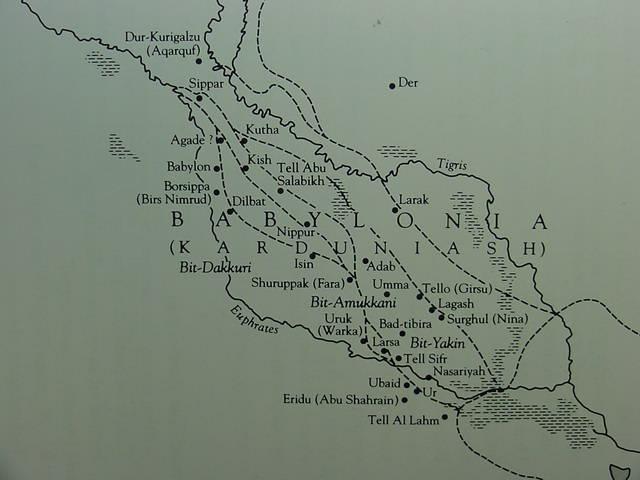
Also of interest is Saggs' comment about the Euphrates possessing THREE channels or streams in the third millennium BCE (However his map, cf. below, shows FOUR channels or stream beds). Factoring this in with Roaf's, Pollock's and Leick's observation that in the 4th milllennium BCE the Euphrates split from the Tigris, we have four streams crossing the floodplain in antiquity. Are these the four edenic streams recalled in Genesis? When the Tigris is factored in with the Euphrates' three channels (due to the latter's discharge into the former) we have the four rivers of Eden (edin).
Below, Professor Saggs' map shows that _all_ of the cities of ancient Akkad and Sumer with the exception of Larak drew their water from ONE RIVER, the Euphrates and its channels. To the degree that Genesis understands ONE RIVER waters God's garden in Eden, and some Mesopotamian myths state that the gods made man to tend and till their gardens which they had planted next to their cities (built before man's creation), AND Sagg's observation that ALL the cities of Southern Mesopotamia derived their water from ONE RIVER, the Euphrates, I see the below FOUR channels or streams (dotted lines) as recalling the Edenic river dividing into four streams (Note: He shows the "modern-day course" of the Euphrates and Tigris in solid lines). The four ancient river beds of the Euphrates' channels on the below map: Stream 1: Sippar, Agade, Babylon, Borsippa, Dilbat, Isin; Stream 2: Agade, Kish, Nippur; Stream 3: Kutha, Tell Abu Salabikh, Adab; Stream 4: Kutha, Tello/Girsu, Lagash, Surghul/Nina (For the map cf. p. 181. H. W. F. Saggs. Peoples of the Past: Babylonians. Berkeley, California. University of California Press. 2000 [The Trustees of the British Museum, London]. ISBN 0-520-20222-8)
Although Saggs' map shows the Euphrates subdividing into four streams or channels he has noted that as many as
_six channels_ (perhaps even more?) existed in ancient times:
"In southern Mesopotamia...most settlements were associated with the Euphrates. The Euphrates had at least six major channels, some of them further subdivided, and some flowing into lakes or disappearing into marshes..."
(p. 37. "City-States and Kingdoms." H.W.F. Saggs. Civilization Before Greece and Rome. New Haven & London. Yale University Press. 1989)
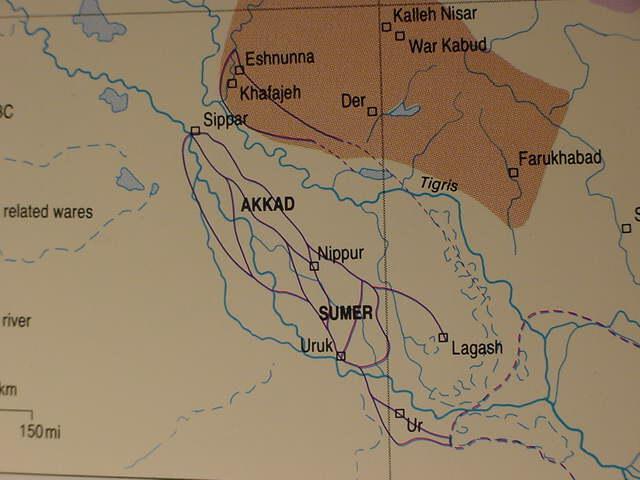
Below, the Euphrates near Sippar subdividing into four streams (violet lines) circa 3200-2400 B.C. (p. 80. Map titled: "Distribution of Pottery Styles in the 3rd Millennium." Michael Roaf. Cultural Atlas of Mesopotamia and the Near East. Oxford, England. An Equinox Book. 1990. Reprinted by Facts on File, New York, 1990).
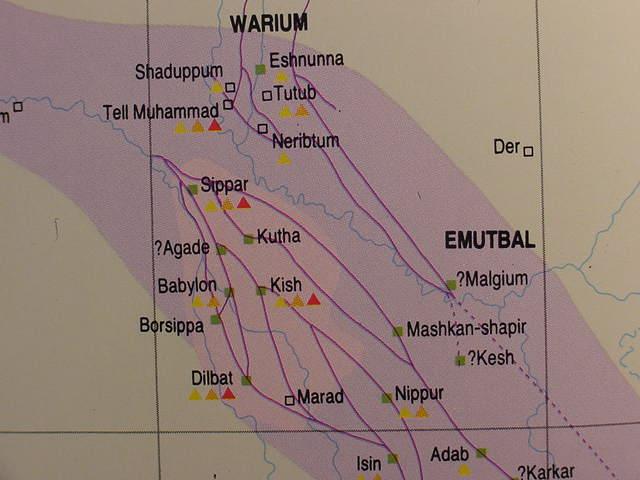
Below, a close-up of the above map, I note that this map shows the Euphrates as a single stream from Mari (destroyed by Hammurabi) to Sippar as a single stream. Near Sippar the Euphrates subdivides into four streams: (1) Sippar to Borsippa and Diblat; (2) Sippar to Agade and Diblat; (3) Sippar to Kutha, Adab and Larsa; (4) Sippar to Mashkan-Shapir.
I understand that the Garden in Eden and its Land of Nod are later Hebrew recastings of earlier Mesopotamian notions about the edin being a place of danger for man, a land possessing wandering tent-dwelling nomads some of whom are characterized as being murderers.
Mesopotamian myths reveal that the first city was Eridu in Lower Mesopotamia and it was built according to one myth by the God Enki with the help of the Igigi gods. Another account, the Eridu Genesis myth, contradicts this story and has man the wanderer being taken from the edin by the goddess Nintur to build Eridu which is then presented to Enki. Enki as an Anunnaki god is portrayed in one myth as being once upon a time a naked wanderer of edin, eating plants with his mouth like a sheep and in another myth he is responsible for "the shedding of blood" of his fellow-gods, Apsu at Eridu and We-ila at Nippur. So, like man, he is a wanderer and a shedder of blood; either way, the world's first city, be it Enoch or Eridu, is founded by a wanderer and shedder of blood, be it a man or a god.
I have argued that these concepts were recast by the Hebrews into Cain the wanderer and shedder of blood building the world's first city, Enoch, named in honor of his son. Enoch could refer to the Sumerian city of Unug (Uruk) as proposed in 1887 by Professor Sayce, or Eridu. If it is Eridu, then perhaps the founder of Eridu, Enki has been morphed into Enoch? Enki's Sumerian epithet, Nudimmud ("creator") might have been morphed into Nod, which is associated with the world's first city. The Bible denies that there are gods and goddesses, there is only one God, Yahweh-Elohim. The Bible denies that cities were built by the gods for them to dwell in before man was created. According to the Bible man created cities not gods and the first city was built by Cain in the Land of Nod and named Enoch after his son who apparently also dwelt in this location. The Mesopotamian myths have the first city being built either by or for Enki. In the latter case the goddess Nintur directs man to build Eridug _for_ Enki, while in the Bible it is another man, Cain who builds the first city for Enoch to dwell in. Because the Bible denies the existence of other gods in recasting the Mesopotamian myths about the world's first city being built for the god Enki, the Bible made this god into a "man": Enoch. That is to say, if there are no other gods but Yahweh, it simply will not do to have the world's first city occupied by a god called Enoch, it has to be occupied by a _man_ called Enoch. If Enoch's name is a morphing of Enki's then Eridug/Eridu probably is what lies behind Genesis' first city Enoch and accordingly the Land of Nod is in effect the great floodplain of Lower Mesopotamia that Eridug/Eridu lies in, a region once called Sumer. So Sumer is the land of Nod.
The un-named river which arose in Eden and watered Yahweh's garden and later split into four streams has been identified as the Euphrates from Mari to Sippar. Near Sippar this stream becomes four streams as noted on the above map of Hammurabi's and Abraham's world as well as Professor Saggs' map (cf. above). Between Mari and Eridu the Euphrates apparently subdivided into four major streams in antiquity, the 6th-2nd millenniums B.C. (Others understand the Euphrates subdivided into 3 streams near Sippar and a fourth stream the Hiddekel/Tigris joined these 3 streams in antiquity to become four streams). The "Land of Nod" east of Eden (east of the Garden in Eden) then becomes Lower Mesopotamia, most particularly ancient Sumer and Enoch is either Eridu or Unug or a fusion/morphing of the two locations. I understand that it was Abraham the polytheist of Ur and Haran who most probably changed the Mesopotamian myths and motifs (upon his giving up polythesim and embracing monotheism), recasting them into altered and transformed concepts that would later surface in the Book of Genesis, which I understand was composed in the Exile.
Mari has been proposed to be the biblical site for the Garden of Eden because to some degree it fits the biblical criteria: It was watered by _one_ stream and this stream left the city and eventually split into four streams in the great floodplain of Lower Mesopotamia as revealed on the above map of Abraham and Hammurabi's world (18th century B.C.). At Mari exists a wall mural showing two trees, one of which is a date palm guarded by fabulous winged beasts who may have been later transformed by the Hebrews into the Cherubim who guard the Tree of Life.
As noted above, Professor Sayce had proposed by 1887 that Unug (his Unuk) might be the prototype behind Genesis' "first" city Enoch founded in the land of Nod by Cain.
I noted elsewhere (please click here) that other scholars such as Professors Jastow (1898), Skinner (1910), Graves and Patai (1963) had remarked that certain themes and motifs associated with Enkidu and Shamhat appeared to have been recast and assimilated to Adam and Eve, an assessment I am in agreement with.
I have noted that the steppe Enkidu encountered Shamhat in (at a wateringhole) is _not_ rendered by the Akkadian word seru or tseru but rather that the Sumerian logogram edin/eden is used _in lieu of_ this word. I have proposed that Genesis' garden in eden is a recasting of the wateringhole in the eden/edin Shamhat and Enkidu met at.
When Enkidu and Shamhat leave eden/edin they clothe their nakedness and head for the city of Uruk to meet Gilgamesh. The Epic of Gilgamesh does _not_ use the Akkadian word Uruk, instead, it uses the Sumerian logogram UNUG. I understand Unug via a homonym confusion or morphing probably became the city of Enoch.
In the Bible it is _after_ man's expulsion from eden that he comes to settle and build the world's first city Enoch, and it is after Enkidu and Shamhat leave eden/edin that they settle at Unug (Uruk). I see a parallel here (allowing for the Hebrews' recasting of this myth in order to refute, deny and challenge the Mesopotamian notions about man's origins and purpose in life by creating a New Story about man's creation by one God instead of several gods and goddesses).
Thus I understand that Sayce is correct, Unug does indeed lie behind the city of Enoch, but the notion of a "first" city created by man appears to preserve the city of Eridu of the Sumerian myths, which was their "first" city built by or for Enki, who's name could have been another example of a homonym-confusion or morphing into Enoch.
Below is Heidel's quotation of a line from a Neo-Babylonian fragment of the Epic of Gilgamesgh revealing that the scribe wrote Uruk with the Sumerian logogram (UNUG):
"Not does Enkidu know To eat bread, (And) to drink strong drink He has not ... lines 188-91: si-bu-tum sa uruk(UNUG)ki ri-bi-tim zi-ik-ra u-te-er-ru a-na ..."
"This document corresponds to the second tablet of the Ninevite recension of the Epic of Gilgamesh and to the Old Babylonian version represented by the Pennsylvania Tablet (PBS, X, 3) and the Yale Tablet (YOSR, IV, 3)."
(Alexander Heidel. "A Neo-Babylonian Gilgamesh Fragment." Journal of Near Eastern Studies, Vol. 11, No. 2. April, 1952. pp. 140-143)
Strangely the 1st Century A.D. Jewish historian Flavius Josephus spoke of Nod as being a city (and a place), then corrects himself, having Cain create a city called Enoch:
"And when Cain had traveled over many countries, he, with his wife, built a city, named Nod, which is a place so called, where also he had children...he built a city, and fortified it with walls...and called that city Enoch, after the name of his oldest son Enoch."
(p. 31. "Concerning the Posterity of Adam..." Flavius Josephus. "The Antiquities of the Jews." Book 1, Chapter 2. Section 2. William Whiston [Translator]. The Works of Josephus, Complete and Unabridged. Peabody, Massachusetts. Hendrickson Publishers. The 1737 original translation was reprinted in 1987 with a new index by Hendrickson. Whiston lived 1667-1752)
So, I understand that Genesis' Eden is derived from the Sumerian eden/edin, the wilderness, a steppe or semi-arid desert plain through which courses the Tigris and Euphrates rivers. In Sumerian belief the eden/edin (also called arali) is a place of lawlessness and of danger to man, filled with cut-throat bandits and nomads who are wanderers and shedders of human blood, thus eden/edin from a Mesopotamian perspective is the "land of Nod," the "land of wanderers" and shedders of blood. Enoch is Sumerian Unug (Akkadian Uruk) fused with Eridu, the first city in Sumerian belief. That is to say Sumer's uncultivated wilderness surrounding the gods' city-gardens and fields is both Eden and Nod.
As noted earlier (above) Professor Sayce by 1887 had proposed that Cain's city of Enoch was Sumerian Unug (Uruk) thereby pinpointing the location of the land of Nod.
The late David J. Gibson (1904-1964), an amateur scholar like myself, in agreement apparently with Sayce associated the city of Enoch with Unug or Uruk and drew up a map showing the land of Eden and the land of Nod (please click here for Gibson's map showing Eden and Nod and click here for his accompanying text on Nod's location).
As regards Eden's location, by 1908 Pinches was quoting several scholars, Rawlinson, Sayce and Delitzsch that it was to be identified with the edin (edina, edinu) the plain between the Tigris and Euphrates rivers in Lower Mesopotamia and that the city of Eridu was Mesopotamian equivalent of the of the Garden in Eden (Note: Today edin is understood to be a Sumerian word while the Akkadian/Babylonian word is seru or zeru. Delitzsch made the edin = eden identification in 1881):
"It had long been known that one of the Akkadian names for "plain" was edina, and that that word had been borrowed by the Babylonians under the form of edinnu, but it was Professor Delitzsch, the well-known Assyriologist, who first pointed out to a disbelieving world that this must be the Eden of Genesis...he seems certainly to be right with regard to the Biblical Eden, and this is a decided gain, for it locates the position of that district beyond a doubt."
(p. 70. "From Creation to the Flood." Theophilus G. Pinches. The Old Testament In the Light of the Historical Records and Legends of Assyria and Babylonia. London. Society For Promoting Christian Knowledge. 1908, 3rd edition)
"This Eridu, as we shall see further on, was the "blessed city," or Paradise, wherein was the tree of life, and which was watered by the twin stream of the Tigris and Euphrates."
(p. 43. "The Early Traditions of the Creation." Theophilus G. Pinches. The Old Testament In the Light of the Historical Records and Legends of Assyria and Babylonia. London. Society For Promoting Christian Knowledge. 1908, 3rd edition)
"To Professor Sayce belongs the honour of identifying the Babylonian story of the nature and position of Paradise as they conceived it..."In Eridu a dark vine grew...between the mouths of the rivers (which are) on both sides...From the introductory lines above translated, we see that Eridu, "the good city," which Sir Henry Rawlinson recognized many years ago as a type of paradise, was to the Babylonians, as a garden of Eden, wherein grew a glorious tree, to all appearance a vine...To complete still further the parallel with the Biblical Eden, it was represented as a place to which access was forbidden, for "no man entered its midst," as in the case of the Garden of Eden after the fall."
(pp. 71-72. "From the Creation to the Fall." Theophilus G. Pinches. The Old Testament In the Light of the Historical Records and Legends of Assyria and Babylonia. London. Society For Promoting Christian Knowledge. 1908, 3rd edition)
For my part, I understand that the latin motto found on the money of the United States of America, E PLURIBUS UNUM "From Many, One," applies well to the problem at hand. In the Mesopotamian myths the world and man are created by many gods and goddeses. Many gods and goddeses later send a flood to destroy man. In the Hebrew recasting the creation of the World, Man and the Flood are the act of ONE GOD. In the Mesopotamian myths the gods and goddesses created man to work in their city-gardens relieving themselves of toil. EVERY CITY had its god's or goddess' city-garden that man toiled in. The Bible denies the existence of many gods and goddesses, there is only ONE God, ergo there cannot be MANY gods' and goddesses' Gardens in eden/edin, there can be only ONE God's garden in Eden. So Eridu is _not_ exclusively the "one" prototype for Genesis' Garden in Eden, it is _all_ the cities of Mesopotamia and their gods' and goddesses' city-gardens that were the "original" prototypes behind the Garden in Eden.
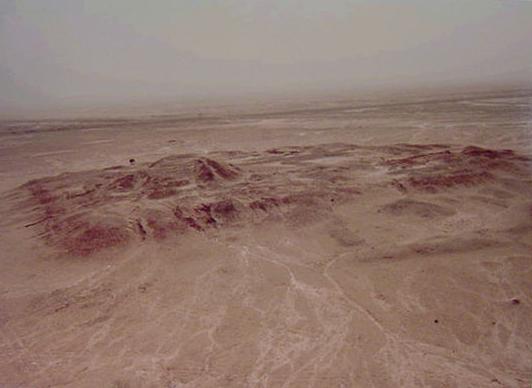
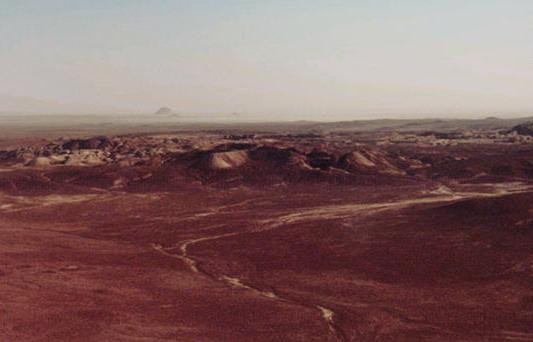
Cottrell (1965) quotes Loftus' (1850's) words on Warka's (Sumerian Unug, Akkadian Uruk) desolation:
"The same romantic feeling for landscape appears in the writings of a later explorer, William Kenneth Loftus, who writes of Warka, an ancient Sumerian city which he visited in the fifties.
'The desolation and solitude of Warka are even more striking than the scene presented by Babylon itself. There is no life for miles around. No river glides in grandeur at the base of its mounds, no green dates florish near its ruins. The jackal and the hyena appear to shun the dull aspect of its tombs. The king of birds never hovers over its deserted wastes. A blade of grass, or an insect, finds no existence there. The shrivelled lichen alone, clinging to the weathered surface of the broken brick, seems to glory in its universal dominion over these barren walls. Of all the desolate pictures I have ever beheld, that of Warka incomparably surpasses all.'
(p. 27. "A New Light on the Ancient East. Leonard Cottrell. The Quest For Sumer. New York. G.P. Putnam's Sons. 1965)
Leick on Sir Henry Creswicke Rawlinson's (1810-1895) suggestion that Uruk was the "mother-city" from which all later cities emerged:
"Sir Henry Rawlinson...was also convinced of Warka's very high antiquity, and regarded it as the mother-city from which all other cities sprang.
Almost 150 years later, we know that Warka was indeed the site of a city called Uruk by the Sumerians -the name having survived five millennia- and the question as to what extent it should or could be regarded as the 'mother of cities', as the matrix of urban development, continues to be hotly debated by archaeologists, historians and anthropologists."
(p. 30. "Warka and the 'Mother of Cities'." Gwendolyn Leick. Mesopotamia: The Invention of the City. London. Penguin Books. 2001, 2002)
Wood's "summary" ends with Civilization's beginnings in Iraq and the world's "first" city, Uruk (Sayce's city of Enoch built by Cain, the "first" city in the Bible):
"There is one last journey in this search for the origins of civilization, a journey back to the starting point, to Southern Iraq, to the Garden of Eden, and to Uruk, the first city on earth. Here the revolution happened five thousand years ago when people first began to live in cities, in a way of life which now shapes the lives of the mass of the population of the planet."
(p. 211. "Return to Uruk." Michael Wood. Legacy: The Search For Ancient Cultures. New York. Sterling Publishing Company. 1992)
Leick understands the earliest levels at Warka date to the early 5th millennium B.C., and _I_note_ she has Eridu dated to 4900 B.C. which would _also_ fall in the "early 5th millennium B.C.":
"Most of the excavation works have hitherto concentrated on the largest mounds, the most prominent of which, known in antiquity as Eanna, occupies the centre of the ruin. It has a dense sequence of nineteen building levels for the early fifth millennium and fourth millennium, with some later remains from the second millennium."
(p. 33. "Warka and the 'Mother of Cities'." Gwendolyn Leick. Mesopotamia: The Invention of the City. London. Penguin Books. 2001, 2002)
Roaf on Uruk being Mesopotamia's most important city in the 4th millennium B.C.:
"In the fourth millennium B.C. Uruk was the most important city in Mesopotamia...The earliest evidence for writing was also discovered at...Uruk..."
(p. 60. "Uruk: The Urban Explosion." Michael Roaf. Cultural Atlas of Mesopotamia and the Ancient Near East. New York & Oxford. Facts on File. 1990)
Maisels on Uruk's (Unug's) size in comparison to other cities like King Herod's Jerusalem of 120 hectares, Augustus Caesar's Rome of 360 hectares (Note: 1 hectar = 2.471 acres):
"By the end of the Ubaid period, Eridu had reached about 12 hectares, Ur around 10 hectares and Uruk a massive 70 hectares...In the Late Uruk period, at the end of which writing appears, the city of Uruk encompassed an area of at least 2.5 square kilometres, or 259 hectares....within two or three hundred years the size of Uruk more than doubled again, approaching 600 hectares by around 2900-2800 B.C."
(p. 175. Charles Keith Maisels. Early Civilizations of the Old World. London & New York. Routeledge. 1999, 2000)
Below, a map showing Uruk's (Sumerian: Unug, Arabic: Warka, Biblical: Erech) main features as unearthed by archaeologists (cf. p. 31. Map titled: "Uruk Period." Gwendolyn Leick. Mesopotamia: The Invention of the City. London. Penguin Books. 2001, 2002).
Wood understands that Eridu is probably the location for the Garden of Eden and Uruk, for him, is the world's "first" city. He apparently was unaware that Sayce had identified Uruk (Unug) with the Bible's "first" city, Enoch, nor was he aware that Sayce had identified the Garden of Eden with Eridu:
"Eridu...If anywhere...is the origin of the Biblical story of the garden of Eden. For what the Bible calls paradise, Eden, was simply the Sumerian word Edin, the wild, uncultivated grassland of the south, the natural landscape which lay outside the artificial landscape of the city. And after picking over the debris of paradise, it is not hard to see the psychological truth of the Bible story...The Eridu myths then perhaps are reflections of a real historical process...which Sumerian myth believed originated in Eridu and were passed on by the gods to future ages from Eridu to the first true city on earth, Uruk...There were two settlements here before 4000 B.C., a sizable city during the next millennium...Uruk increased four times in size in just a few generation from about 3000 to 2700 B.C....With the ups and downs of any living organism, the city of Uruk and its institutions lasted through to about 300 A.D. A small settlement outside the walls survived till the Arab conquest. Indeed, even in the eighth century the local Christian bishop, still called himself 'Bishop of Uruk and Kaskar.' But by then it was dead, after a life of over five thousand years."
(pp. 21 & 24, 25, 29. "The First Cities. Iraq: The Cradle of Civilization." Michael Wood. Legacy: The Search For Ancient Cultures. New York. Sterling Publishing Company. 1992).
The editors of Time-Life on some archaeologists understanding that Uruk may be older than Eridu and thus it might lay claim to being the "first city" of southern Mesopotamia:
"Although the Sumerians themselves regarded Eridu as the first city, archaeologists today would be inclined to award that particular title to Uruk, and only with the dawning of the third millennium would the rest of southern Mesopotamia finally catch up."
(p. 58. "Milestones on the Road to Civilization." Thomas H. Flaherty, Editor, et al. Sumer: Cities of Eden. Alexandria, Virginia. Time-Life Books. 1993. [Lost Civilizations Series])
Leick understands Eridu is the Mesopotamian equivalent of the Bible's Garden of Eden:
"Eridu is the Mesopotamian Eden, the place of creation...All lands were sea...Then Eridu was made...the gods take up residence on earth and live in cities. And because the gods have the dwelling of 'their hearts' delight' in cities, Mesopotamian cities are always sacred. Thus the Mesopotamian Eden is not a garden but a city, formed from a piece of land surrounded by the waters. The first building is a temple. Then mankind is created to render service to god and temple. This is how Mesopotamian tradition presented the evolution and function of cities, and Eridu provides the mythical paradigm. Contrary to the biblical Eden, from which man was banished for ever after the fall, Eridu remained a real place, imbued with sacredness but always accessible."
(pp. 1-2. "Eridu, Creating the First City." Gwendolyn Leick. Mesopotamia: The Invention of the City. London. Penguin Books. 2001, 2002)
Below, a map showing the Euphrates subdividing into four streams (light gray lines) in antiquity just south of modern Baghdad. Uruk, Sumerian Unug, identified by Professor Sayce in 1887 with the city of Enoch founded by Genesis' Cain, lies on one of the four streams. Note also Eridu, Sumerian Eridug, the world's first city according to Sumerian myths (p. 13. map titled: "Southern Iraq, showing the old courses of the Tigris and Euphrates. Iraq: The Cradle of Civilization." Michael Wood. Legacy: The Search For Ancient Cultures. New York. Sterling Publishing Company. 1992).
So dear reader, in conclusion, the above map showing ancient Sumer in reddish-brown _for me_ marks off the boundaries of not only the "earliest" Sumerian edin (a precursor of biblical Eden) but also the "earliest" Land of Nod, "the land of Wanderers and Murderers" who in Sumerian myths built the world's FIRST CITIES, and Cain's city of Enoch is recalling Sumerian Unug (Uruk) and Eridug (Eridu).
Back-cover endorsement from Leick's book (2001) on Mesopotamian cities (emphasis mine):
"Over 7,000 years ago in Mesopotamia, urban living began...Mesopotamia, situated roughly where Iraq is today, was one of the greatest ancient civilizations. IT WAS HERE THAT THE VERY FIRST CITIES WERE CREATED, and where the familiar sights of modern urban life -public buildings and gardens, places of worship, even streets and pavements- were originally invented.
This remarkable book is the first to reveal everyday life as it was in ten long-lost Mesopotamian cities, beginning with ERIDU, THE MESOPOTAMIAN EDEN, and ending with Babylon, the first true metropolis..."
(Back-cover endorsement from the Independent on Sunday. Gwendolyn Leick. Mesopotamia, the Invention of the City. London. Penguin Books. 2001, 2002)
Leick on Uruk's and Eridu's origin as a village in the Ubaid period, both later becoming "cities":
"Ur, like Uruk and Eridu, had its origin in the Ubaid period, the very beginning of permanent settlements in southern Mesopotamia."
(p. 109. "Ur." Gwendolyn Leick. Mesopotamia, the Invention of the City. London. Penguin Books. 2001, 2002)
"Ubaid period: prehistoric period in southern Mesopotamia...The duration of Ubaid sequences varies from site to site (between 4000 and 3500 B.C.)...the Ubaid culture has characteristic painted pottery and is associated with settled farming communities and the beginnings of social stratification."
(p. 283. Gwendolyn Leick. "Ubaid period.' [Glossary]. Mesopotamia, the Invention of the City. London. Penguin Books. 2001, 2002)
Note: Leick has Eridu's shrine being founded in Ubaid I circa 4900 B.C., so Ubaid is _not_ between 4000 to 3500 B.C., its between 4900 B.C. to 3500 B.C. (cf. below for Leick's comment).
Leick on Eridu's 5th millennium B.C. founding (recalling she has Uruk being founded about the same period of time):
"At the lowest level, 'on a dune of clean sand', they disovered the very first building, 'a primitive chapel' no larger than 3 metres square...The proposed date for this 'chapel' is 4900 or Ubaid level I."
(pp. 5-6. "Digging up Eridu." Gwendolyn Leick. Mesopotamia: The Invention of the City. London. Penguin Books. 2001, 2002)
Whereas the Bible has the world's first city being built in the Land of Nod the Sumerian myths have the world's first city (Eridug/Eridu) being built in the Land of Sumer. Archaeologists understand Eridu was founded around 4900 B.C.
Of interest here is that some conservative Protestant scholars understand from the Bible's internal chronology that the "Land of Eden" emerged from a water-covered planet earth circa 4004 B.C.
That is to say a remarkable chronology emerges: In Sumerian myth the earth is at first covered in water, then land emerges from this water and Enki founds Eridug. Both dates, 4900 B.C. and 4004 B.C. fall within the 5th millennium B.C. I find it curious and amazing that "the first land emerging from a watery world" that Eridug is built upon is dated by archaeological findings to the 5th millennium B.C. the same millennium the Bible has the earth emerging from a watery world. Genesis' "first land" is called Eden and God creates a garden here and places man in it to care for it in the 5th millennium B.C. whereas in Sumerian myth Enki is credited with creating man to work in his garden at Eridu in the midst of an uncultivated land called Edin in the 5th millennium B.C. So in both myths, Sumerian and Biblical, a "first earth," a "first man," and a "first city" emerge within the context of a 5th millennium B.C. world at a location called edin/eden.
Professor Saggs on Eridu being the "oldest" Sumerian settlement and "south Mesopotamia" being where cities _began_ (Genesis has the world's first or oldest city _beginning_ in the land of Nod):
"...the city of Eridu, probably the oldest Sumerian settlement..." (p. 270. "Ancient Religion." H.W.F. Saggs. Civilization Before Greece and Rome. New Haven & London. Yale University Press. 1989)
"It was in south Mesopotamia that cities began, and it was there that the greatest concentration was found in the pre-classical world." (p. 114. "Living in Cities." H.W.F. Saggs. Civilization Before Greece and Rome. New Haven & London. Yale University Press. 1989)
Professor Barton (1934) noted that the earliest ideogram or sign for Eridu was nunki meaning "fishing place," was Mesopotamia's "first city" nunki (Eridu) later morphed into Enoch, Genesis' "first city"?
"...if we now turn to southern Babylonia we find that the earliest ideogram for the name of the city of Eridu was nunki "fishing-place"..."
(George A. Barton. "Some observations as to the origin of the Babylonian syllabary." Journal of the American Oriental Society. Vol. 54. No. 1. March 1934. pp. 75-79) Note: For some scholars nun means "powerful" or "prince" while nin is rendered as "fish" so nun-ki would translate as "place of the prince," or "land of the prince," or "land of the powerful one [Enki/Ea]."
The editors of Time-Life on the world's first cities and "civilization" arising in Sumer in the course of the 5th millennium B.C.:
"...the fact remains that in Sumer during the fifth millennium B.C., people were, for the first time in human history, spared the demands of catching or growing food for their sustenance...Civilization...was born...rich cities..."
(pp. 12-13. "History's Forgotten People." The Editors of Time-Life. Sumer: Cities of Eden. Alexandria, Virginia. Time-Life Books. [Lost Civilizations Series]. 1993)
Roaf on the transition from villages to cities in Lower Mesopotamia (Sumer) beginning in the 5th millennium B.C. (contra Leick who has Ubaid 4900-3500 B.C. he has Early and Middle Uruk periods 4300-3450 B.C.):
"The importance of southern Mesopotamia in the development of urban life is generally acknowledged...The crucial transition from village to city took place in the Early and Middle Uruk periods which, according to radiocarbon dating, probably lasted between 700 and 1,000 years (about 4300-3450 B.C.)."
(p. 58. "The Urban Explosion (4000-3000 B.C.)." Michael Roaf. Cultural Atlas of Mesopotamia and the Ancient Near East. New York & Oxford. Facts on File. 1990)
Adams on Sumer's cities emerging from villages around 4000 B.C. (I note some conservative Protestant Bible scholars date the creation of the Cosmos and planet Earth along with Eden and Adam to 4004 B.C., just a scant 4 years off from the 4000 B.C. date for the beginning of the rise of cities in Sumer):
"In any case the gathering forces for urbanization first became evident around 4000 B.C...Four archaeological periods can be distinguished in the tentative chronology of the rise of the Mesopotamian city-state. The earliest was Ubaid...it may have lasted for a century or two past 4000 B.C., giving way to the relatively brief Warka period. Following this the first written records appeared during the Protoliterate period, which spanned the remainder of the fourth millennium. The final part of our story is the Early Dynastic period, which saw the full flowering of independent city-states between about 3000 and 2500 B.C."
(pp. 174-175. Robert M. Adams. "The Origin of Cities." pp.171-177 in C.C. Lamberg-Karlovsky, editor.
Hunters, Farmers, and Civilizations: Old World Archaeology. San Francisco. W.H. Freeman and Company. 1979 [This article first appearing September 1960 in the Scientific American magazine])
The rise of villages in Lower Mesopotamian plain which would eventually become cities like Eridu, Uruk, and Ur is circa 6200 B.C. through 4000 B.C.:
"In the period 5500–4000 B.C., much of Mesopotamia shared a common culture, called Ubaid after the site where evidence for it was first found. Characterized by a distinctive type of pottery, this culture originated on the flat alluvial plains of southern Mesopotamia (ancient Iraq) around 6200 B.C. Indeed, it was during this period that the first identifiable villages developed in the region, where people farmed the land using irrigation and fished the rivers and sea (Persian Gulf). Thick layers of alluvial silt deposited every spring by the flooding rivers cover many of these sites. Some villages began to develop into towns and became focused on monumental buildings, such as at Eridu and Uruk."
(The Ubaid Period 5500-4000 B.C. Heilbrunn Timeline of Art History. The Metropolitan Museum of Art)
Interestingly Genesis has Adam living 930 years (Ge 5:5), for some conservative Protestant scholars Adam would have lived circa 4004-3074 BC, during which time Cain, the founder of the world's first city would have been born and lived too. That is to say Genesis' "first city" founded by Cain falls within the general parameters of the rise of Sumerian cities according to Professor Roaf.
However some Catholic scholars understand from the Bible's internal chronology that God created the Cosmos, planet Earth, Eden and Adam in 5199 B.C. not 4004 B.C. Why? Their Bibles give different ages for the pre-flood patriarchs in contrast to Protestant Bibles. Lower Mesopotamian villages begin to appear as early as circa 6200 B.C. Leick noted Eridu was dated 4900 B.C. all of which falls within the Catholic scholar's parameters of 5199 B.C. less 930 years for Adam or 4269 B.C. for his death. Cain would have been old enough by age 30 to "found" a city if one assumes his birth about 5199 B.C. after Adam's expulsion from eden.
Please note: Adam, Eve, Cain and the land of Eden and Nod are for me myths, they never existed. I am merely "playing around" here with dates for the founding of the first city of Enoch by Cain, noting that these biblical dates parallel "somewhat" the rise of cities in ancient Sumer. Roaf (cf. above) dated the transition from village to city circa 4300-3450 B.C. and the Bible's date for the beginning of the world for some Protestants is 4004 B.C. while some conservative Jews opt for 3750 B.C.E., both dates falling within Roaf's parameters. That is to say the book of Genesis appears to be unaware of the world unearthed by archaeologists in the Ancient Near East possessing villages from the 12th to 6th millenniums B.C. which preceded "cities."
Is it just a "coincidence" that Genesis' first city, Enoch in the land of Nod, appears within the chronological parameters of the world's first cities in Sumer, erected in the midst of the edin/eden of 5199-40000 B.C. for some Catholic scholars or 4004-3000 B.C. for some Protestant scholars or 3750 B.C.E. for some conservative Jewish scholars?
Is it is another "coincidence" that the Mesopotamians understood the edin surrounding their cities to be a "land of wanderers and murderers," a place where one's life is in danger as per Gilgamesh's statement?
Is it just a "coincidence" that the Mesopotamian myths have a wanderer and shedder of blood in the edin founding the world's first city Eridug/Eridu (Enki being portrayed as an Anunnaki god wandering naked the edin then building a city, having slain his ancestor Abzu/Apsu at Eridug and a fellow-god We-ila at Nippur)?
Is it just a "coincidence" that other Mesopotamian myths (the Eridu Genesis myth) have man a naked "wanderer" of the edin who is tasked with building the world's first city, Eridug, for Enki, in the midst of the edin (recalling the Bible having a man who is wanderer, Cain, building the first city)?
For me there are _too_many_ "coincidences" here, the Hebrews have taken the earlier Mesopotamian concepts regarding the founding of cities by wanderers and shedders of human blood and recast these motifs into a new story who's intent is to refute, challenge, and deny the Mesopotamian understanding of where, when, how, and why cities first came to be built by having the world's first city being built in a land called Nod rather than in a land called Edin/Eden (Nod being "east of" Eden according to Genesis 4:16):
"Then Cain went away from the presence of the Lord, and dwelt in the land of Nod, east of Eden."
Genesis portrays man's life in the beginning as being idyllic in the Garden of Eden, he sins and is expelled and later Cain the murderer and wanderer founds a city. His descendants (some of whom are city-dwellers) boast of killings. The Bible suggests life for man _degenerated_ from an idyllic beginning. This concept is denied in the Mesopotamian myths to a degree. Man's beginnings are portrayed as brutal and savage. He has been created and abandoned by the gods to live life as a naked grass-eating beast wandering the edin/eden with herbivores (gazelles and wild cattle) for companions, animals who are naked like himself, he does _not_ have the gods for companions to fellowship with. Later he is taken from the edin/eden by the gods and made their slave, he will tend their city-gardens surrounded by the uncultivated edin/eden and dwell in cities where he will come into contact with the gods and become in a sense "like a god" in that his life as a naked beast ends, he will wear clothing like a god (knowing it is wrong to be naked like a god), dwell in a city like a god, eat the same food the gods eat: fruits, bread, vegetables instead of eating grass, he will consume alcoholic beverages (wine, beer) like the gods instead a lapping water at the watering holes of edin/eden with beasts, and tend city-gardens like the gods. In other words in the Mesopotamian worldview in the beginning life was _not_ idyllic for man the naked grass-eating beast in edin/eden, his _life _improved_ after _leaving_edin/eden_and settling in cities which the gods built for themselves to dwell in _before_ man's creation. The Hebrews have apparently _inverted_ these Mesopotamian concepts as they have Cain the murderer founding cities whose dwellers are sinners and murderers. So we have two different worldviews on man's beginnings: the Mesopotamian, portraying man's beginnings as being brutal and savage but _improving_ when edin/eden is left for life in cities and contact with the gods as their slave or servant vs. the Hebrew notion that life in the beginning for man was idyllic in eden but that after leaving eden life _degenerated_ for man into a world of sin, murder and the shedding of human blood in the cities occupied by the descendants of Cain the murderer and founder of city life.
To the degree that Genesis has the world's "first" city, Enoch, being built by Cain and some Sumerian myths attribute the founding of the world's first city Eridug (Nunki, Eridu) to the Sumerian god Enki, below is a cylinder seal impression showing what Cain's (and Enoch's) "pre-biblical prototype" looked like in the 3rd millennium B.C. Enki, meaning "Lord Earth" (en=lord, ki=earth), is shown seated on a throne probably at Eridug with a crown possessing bull's horns identifying him as a god. From his body erupt two streams of water perhaps representing the Tigris and Euphrates rivers with fish frolicking above them. He was the god of wisdom and he was the god associated with providing freshwater to Sumer's kings for their city-gardens of the gods in the midst of the edin/eden, the uncultivated plain associated with the Tigris and Euphrates. All this is to say Enki (Akkadian/Babylonian Ea) is not only one of several pre-biblical prototypes for Cain he is also one of several pre-biblical prototypes for Yahweh-Elohim who banished Cain to the land of Nod, "the land of wanderers" (for the below photograph of the cylinder seal described as Akkadian circa 2334-2154 B.C., cf. figure 428, p. 30. "The Surena Collection of Ancient Near Eastern Cylinder Seals." Christies Auction Catalogue. New York City. Sale of 11 June 2001).
Professor Saggs on Eridu being Sumer's oldest settlement according to the Sumerian King List:
"...kingship was one of the basic institutions of human life devised by the gods for mankind. This view was well represented by a work called the Sumerian King List. This composition, originally compiled just before 2100 B.C., purported to list all the kings of all the dynasties ruling all Sumer from the beginning. Its opening words read
When the kingship was lowered from heaven, the kingship was in Eridu
and it then goes on to name two kings in Eridu...Eridu was indeed, as archaeology confirms, perhaps the most ancient of settlements inhabited continuously into Sumerian times, and in that sense it was the oldest centre of Sumerian civilization."
(p. 36. "City-States and Kingdoms." H.W.F. Saggs. Civilization Before Greece and Rome. New Haven & London. Yale University Press. 1989)
Thompson, who excavated (1920) at Eridu is describing the scene of desolation all about him as he stands atop the ruins of the ziggurat called Tell Abu Shahrein (Enki/Ea's Abzu shrine), Muqaiyar is ancient Ur:
"From the ziggurat as far as the eye can see there is naught but awful solitude; you look down on sombre desert which encircles you for miles. Northwards lie the flat lands, yellow in April and unrelieved except for sparse arabesques of salt speading like mares'-tails in a breezy sky, while afar, just visible as a little pimple in the mornings but blotted out in the afternoon haze, is the temple-tower of Muqaiyar. Towards the north-east, especially when the sun is setting, the sandstone ridge on the skyline is thrown into vivid relief as a white streak six miles away. Eastwards, not far from the mound, the grass has sprung up, marking the dry site of the winter lagoon which lies between you and the sandstone ridge; southwards towards Dafna and Qusair are the distant low sandstone hills circling round and completing a wide arc to westward. Between you and the sunset is a broad green tract of scrub and coarse grass wherein lie the wells two miles away. Not a tree is in sight, and the only fuel is that provided by the little dry brushes."
(p. 131. "The Heartland of Cities." Charles Keith Maisels. The Emergence of Civilization, From hunting and gathering to agriculture, cities, and the state in the Near East. London & New York. Routeledge. 1990, 1999)
Thompson's description of the winter lagoon describes it as lying between Tell Abu Shahrein, where he is standing, and the limestone ridge, six miles away. The satellite images reveal a depression between the sandstone ridge and Eridu's trapzoidal walls. The Lagoon or Sebkha, also called the Abzu or Apsu, lies east of Eridu. Please click here for satellite photos of Eridu and its Abzu Sebkha-Lagoon, both of which lie in a great depression or basin south of Abraham's Ur of the Chaldees.
Below, a picture, an aerial photo (taken 05 June 2008) of Sumerian Eridug, Akkadian/Babylonian Eridu, the "first" city according to Mesopotamian myth. Eridu consists of 7 mounds the below photo is of the Ziggurat mound. Eridu may have been recast and fused with Unug/Uruk as Enoch, the Bible's first city. Eridug was created by/for the god Enki; was Enki morphed into Enoch? Note the desolate wilderness waste known to the Sumerians as the edin where roamed naked man with wild animals for companions and wandering murderers in fear of their lives, thus the edin/eden was the equivalent of The Land of Nod, "the land of wanderers" and murderers. According to Mesopotamian myth man was created at Eridug by Enki to replace the rebelling Igigi gods who wanted an end to their toil in its city-garden in the midst of the eden/edin. Two fabulous trees grew in Eridug's garden: the Kiskanu and the Mesu Tree. Here a man called Adapa was allowed to obtain godly forbidden knowledge but denied immortality by his god, Ea (Sumerian Enki, who bore the Sumerian epithet ushumgal meaning "great serpent-dragon"), who did not want man to become a god and thereby loose him as his servant. I understand Enki (Akkadian Ea) the "great serpent-dragon" or ushumgal was later transformed by the Hebrews into the walking, talking Serpent in Eden's Garden who tempted Adam and Eve, causing them to lose at a chance to obtain immortality for themselves and mankind with its deceitful words. So Eridug/Eridu is not only a Garden in Eden prototype it is also a city of Enoch prototype as well, in the Land of Nod, ancient Sumer in Lower Mesopotamia (modern Iraq), and Eridu's god, Enki/Ea is one of several prototypes behind Yahweh-Elohim the God of Eden; paradoxically he is also a prototype of Eden's Serpent. That is to say, Eden's Serpent being identified by Christianity with Satan, means that ultimatelyYahweh and Satan are simply nothing more than two aspects of Enki's persona or alter egos: (1) Enki _created_ man and was his benefactor and (2) Enki the ushumgal or "great serpent-dragon" conned man (Adapa) to prevent his eating the food which would have given him and mankind immortality and was thus man's nemesis. Please click here for more photos of Eridu. I understand this photo is of the city of Enoch built by Cain in the land of Nod (Sumerian edin, Genesis' Eden), it is also the "Garden of Eden" in that here man (Adapa) lost out on a chance to obtain immortality for himself and mankind by obeying his lying god's (Ea's) warning not to eat the forbidden food or he would die.
Below, a map showing the boundaries of ancient Sumer in reddish-brown. To the degree that edin is a Sumerian word for uncultivated steppeland or plains, ancient Sumer's "uncultivated" lands which surrounded Sumerian cities and their "cultivated" city-gardens or fields is the pre-biblical prototype for Genesis' land of Eden in which Yahweh-Elohim planted his garden. That is to say, Sumer's 4th-3rd millennium B.C. boundaries are, in effect, edin's boundaries. By the late 4th millennium B.C. Sumerian trade colonies (Uruk IV period colonies of Habuba Kabira and Jebel Aruda) had been established near the Euphrates in Syria or Upper Mesopotamia and various cities in this area reveal that the scribes were trained in writing Sumerian as well as Akkadian. So by the late 4th through 2nd millenniums B.C edin as "uncultivated" steppeland has been extended to embrace both Upper as well as Lower Mesopotamia. In effect, then, by the late 4th millennium B.C. edin's borders were Upper and Lower Mesopotamia marked in blue on the below map. That is to say Haran in Upper Mesopotamia and Ur of the Chaldees in Lower Mesopotamia were two locations in the edin associated with Abraham the polytheist who originally worshipped the many gods and goddesses of edin, who later became a monotheist worshipping only one deity: Yahweh-Elohim the God of `eden . In other words the below map shows "two" edins circa 3200-2500 B.C. (reddish-brown) and 2500-2360 B.C. (blue). As I have noted earlier, above, the edin was a land _wandered_ by nomadic herdsmen, cut-throats, murderers and bandits and _from a Mesopotamian perspective_ the edin would be in effect the land of Nod, "the land of wanderers" a location where man fears for his life like Cain. So the reddish-brown area is not only the "earliest" edin (biblical Eden) but also the "earliest" land of Nod circa 3200-2500 B.C. and it is in this Sumerian edin that archaeologists unearthed the worlds "earliest" cities and first great Civilization and the world's "first city," Eridug (Eridu), according to Sumerian creation myths (cf. the wonderfully illustrated book for the story: Sumer: Cities of Eden. Alexandria, Virginia. Time-Life Books. 1993)
So what's going on here? Why for over 100 years (since 1881) have scholars been showing the Persian Gulf's shore near Ur and Eridu? The answer is quite amazing. Scholars were "misunderstanding" the ancient cuneiform texts! In 1960 Georges Roux surveyed the area east of Ur and Eridu and west of modern-day Basra and discovered the remains of several ancient settlements dating from the 2nd millennium B.C. possessing wells, cisterns, and irrigated fields. Passing near these settlements was the ancient remains of the Euphrates river! These sites are located east of Ur and Eridu, and lie to the south of the Hor al Hammar Lagoon. Professor Potts (cf. pp. 36-39. D.T. Potts. Mesopotamian Civilization: The Material Foundations. Ithaca, New York. Cornell University Press. 1997) has called attention to this apparently _not well-known_ research and the fact that it is impossible for the Persian Gulf to have extended to the vicinity of Ur and Eridu (Please click here to see this research by Roux and Potts and accompanying maps). The area east of Ur and Eridu was known to the ancient Mesopotamians as the mattamti or mat tamtim "Land of the Sea" or "Sea Lands." Apparently they conceived of this marshy area with its lagoons and areas of open land as the primitive "first-earth" which rose from the depths of the sea which covered the world. Near this area the Sumerian god Enki created the world's "first city" Eridu. Enki means "lord earth" (en = lord, ki = earth). Perhaps because in myths the "first" earth/land arose from the sea in the vicinity of Eridu, thus Eridu's god came to be called En-ki, "lord of the [first] earth/land"?
Professor Potts:
"Finally, had the Gulf actually reached the area of Ur, Eridu or Tello, one must ask whether these sites could have then existed. W. Nutzel has noted that the tidal pattern in the northern Gulf affects the waters of the Shatt al-Arab in that salt-waters enters it at least as far as Abdul Khasib, circa 10 kilometers east of Basra. The interchange of salt and sweet water would have made irrigation from such water impossible, for none of the staple cereals grown in antiquity would have been able to tolerate water with such a high salt content. Therefore, settlements must always have been situated outside the zone affected by such an interchange. The very existence of sites like Ur, or for that matter, the mounds discussed above in the Hor al-Hammar district, Nutzel argues, precludes the possibility that salt-water was present in close proximity to them (Nutzel 1980:98-9)."
(p. 39. D. T. Potts. Mesopotamian Civilization: The Material Foundations. Ithaca, New York. Cornell University Press. 1997)
Georges Roux's below (1960) map of the Hawr al Hammar Lagoon and area reveals that in antiquity the Euphrates apparently winded its way (the Euphrates being the dotted line extending from Ur to Tell Abu Salabikh) through the marshlands..
Roux discovered along this river a number of ancient settlements dated to the 2d millennium B.C. That is to say Eridu, despite the texts declaring it lay "at the edge of the Sea," was _not_ the easternmost settlement in Lower Mesopotamia!
The marshlands east of Ur and Eridu had the following "pre-Islamic" settlements (triangles or pyramids), listed here from West to East of Ur and Eridu (inverted or upside-down triangles/pyramids are Islamic sites), all of which lay within the "alluvium" boundary caused by the Euphrates' waters, which fed the marshes and the lagoons: (1) Tell Murajib, (2) Tell Abu Rasain, (3) Tell Tuwayyil, (4) Tell Lahm, (5) Tell Jabarah, (6) Tell Jedejdah, (7) Tell Agram, (8) Tell Abu Salabikh, (9) Tell Nahr 'Umar (cf. p. 37, map titled "The Hor al-Hammar." Figure 1.17. Archaeological sites in the Hor al-Hammar (after Roux 1960: Map 1)." D. T. Potts. Mesopotamian Civilization, The Material Remains. Ithaca, New York. Cornell University Press. 1997. For Roux's commentary accompanying the below map cf. Georges Roux. "Recently discovered ancient sites in the Hammar Lake District (southern Iraq)." Sumer. Vol. 16. 1960. pp. 20-31. Missing from this map is another 2d millennium B.C. site, Tell al Kirbasi east of Tell Agram. Please note the four triangles/pyramids north of the Hor al-Hammar and south of Hor Sallar which are un-named, they apparently mark other 2d millennium B.C. sites?)
Below: A picture, an aerial photo (taken 06 June 2008) of Uruk (Sumerian Unug). If Sayce is correct, that Unug (Uruk) is the pre-biblical prototype for the biblical city of Enoch then the wilderness abutting Unug's/Uruk's walls is "THE LAND OF NOD" known to the Sumerians as THE EDIN. Looking at the below picture I cannot imagine a more God-forsaken wilderness befitting for Cain, the world's first murderer, to build the world's "first" city, Enoch, in. I realize that for the viewer it must come as a shock that this desolate wilderness waste is also Eden (Sumerian edin). Please click here for additional Uruk photos.
So, dear reader, before you is a picture of what _I understand_ to be the desolate LAND OF NOD (the land of edin/eden) and its city, Enoch, Sumerian Unug, Akkadian/Babylonian Uruk, Genesis' Erech. YES, I realize we have here several _contradictions_: Unug or Uruk is _both_ Genesis' Enoch and Erech, and edin is Eden _and_ the land of Nod! but, dear reader, that is one of the "delightful mysteries" my research has uncovered: Contradictions abound in the ancient Mesopotamian myths as well as the biblical myths regarding the Garden of Eden and the land of Nod.
Bibliography:
Robert M. Adams. "The Origin of Cities." pp.171-177 in C.C. Lamberg-Karlovsky, editor.
Hunters, Farmers, and Civilizations: Old World Archaeology. San Francisco. W.H. Freeman and Company. 1979 [This article first appearing September 1960 in the Scientific American magazine].
Lloyd R. Bailey. Noah, the Person and the Story in History and Tradition. Columbia, South Carolina. University of South Carolina Press. 1989.
George A. Barton. "Some observations as to the origin of the Babylonian syllabary." Journal of the American Oriental Society. Vol. 54. No. 1. March 1934. pp. 75-79.
Umberto Cassuto. A Commentary on the Book of Genesis. Vol. 1. [From Adam to Noah]. Jerusalem. The Hebrew University. 1944-1968 in Hebrew; 1961-1989 in English. ISBN 965-223-480-X.
Leonard Cottrell. The Quest For Sumer. New York. G.P. Putnam's Sons. 1965.
Harriet Crawford. Sumer and the Sumerians. Cambridge, United Kingdom. Cambridge University Press. 1991, 2004.
Stephanie Dalley. "The Epic of Gilgamesh." Myths From Mesopotamia: Creation, The Flood, Gilgamesh And Others. Oxford & New York. Oxford University Press. 1989, 1991.
James R. Davila. "Nod." p. 1133. Vol. 4. David Noel Freedman. Editor. The Anchor Bible Dictionary. New York. Doubleday. 1992.
D. M. C. Englert. "Nod." p. 557. Vol. 3. George A. Buttrick. Editor. The Interpreter's Dictionary of the Bible. Nashville & New York. Abingdon Press. 1962.
Tikva Frymer-Kensky. In the Wake of the Goddesses, Women, Culture and the Biblical Transformation of Pagan Myth. Ballantine Books. 1993. First Edition by Freepress 1992.
David G. Gibson. The Land of Eden Located. A rough-draft manuscript (1964) made available by his son Dan Gibson on the internet. cf. http://nabataea.net/eden8.html
Robert Graves & Raphael Patai. Hebrew Myths: The Book of Genesis. New York. Doubleday & Company. 1963, 1964. Reprinted 1983 by Greenwich House.
James Hastings. Editor. The Expository Times. Edinburgh. T. & T. Clark. Oct. 1893-Sept. 1894.
Alexander Heidel. "A Neo-Babylonian Gilgamesh Fragment." Journal of Near Eastern Studies, Vol. 11, No. 2. April, 1952. pp. 140-143.
Thorkild Jacobsen. "The Eridu Genesis." pp. 129-142 in Richard S. Hess & David Toshio Tsumura. Editors. I Studied Inscriptions From Before the Flood, Ancient Near Eastern, Literary, and Linguistic Approaches to Genesis 1-11. Winona Lake, Indiana. Eisenbrauns. 1994.
Morris Jastrow, Jr. Hebrew and Babylonian Traditions, The Haskell Lectures delivered at Oberlin College in 1913. New York. Charles Scribner's Sons. 1914.
Samuel Noah Kramer. The Sumerians, Their History, Culture, and Character. Chicago & London. University of Chicago Press. 1963. Reprint of 1972.
Gwendolyn Leick. A Dictionary of Ancient Near Eastern Mythology. London. Routledge. 1991. Reprint 1997.
Gwendolyn Leick. Mesopotamia: The Invention of the City. London. Penguin Books. 2001, 2002.
Charles Keith Maisels. Early Civilizations of the Old World. London & New York. Routeledge. 1999, 2000.
Charles Keith Maisels. The Emergence of Civilization From hunting and gathering to agriculture, cities, and the state in the Near East. London & New York. Routledge. 1990, 1993, 1999.
Theophilus G. Pinches. The Old Testament In the Light of the Historical Records and Legends of Assyria and Babylonia. London. Society For Promoting Christian Knowledge. 1908, 3rd edition.
D.T. Potts. Mesopotamian Civilization: The Material Foundations. Ithaca, New York. Cornell University Press. 1997.
Michael Roaf. Cultural Atlas of Mesopotamia and the Near East. Oxford, England. An Equinox Book. 1990. Reprinted by Facts on File. New York. 1990.
Archibald Henry Sayce. The Hibbert Lectures of 1887, Lectures on the Origin and Growth of Religion, as illustrated by the religion of the Ancient Babylonians. London & Oxford. Williams & Norgate. 1897, fourth edition. Reprinted by Kessinger Publishers of Whitefish, Montana in paperback.
H.W.F. Saggs. Civilization Before Greece and Rome. New Haven & London. Yale University Press. 1989.
H. W. F. Saggs. Peoples of the Past: Babylonians. Berkeley, California. University of California Press. 2000 [The Trustees of the British Museum, London]. ISBN 0-520-20222-8.
Alessandro Scafi. Mapping Paradise, A History of Heaven on Earth. Chicago & London. The University of Chicago Press and The British Library. 2006.
James Strong. "Nod" p. 77. # 5110-5113. "Hebrew and Chaldee Dictionary." Strong's Exhaustive Concordance, Complete and Unabridged. Waco, Texas. Word Books. 1977.
"The Surena Collection of Ancient Near Eastern Cylinder Seals." figure 428, p. 30. Christies Auction Catalogue. New York City. Sale of 11 June 2001.
The Editors of Time-Life. Sumer: Cities of Eden. Alexandria, Virginia. Time-Life Books. [Lost Civilizations Series]. 1993.
William Whiston, Translator. The Works of Josephus, Complete and Unabridged. Peabody, Massachusetts. Hendrickson Publishers. [1737] reprinted 1987.
Michael Wood. Legacy: The Search For Ancient Cultures. New York. Sterling Publishing Company. 1992.
Abraham S. Yahuda."The Story of Paradise." pp. 164-165; 168. The Accuracy of the Bible, the stories of Joseph, the Exodus and Genesis Confirmed and Illustrated by the Egyptian Monuments and Language. London. William Heinemann Ltd. 1934.
Enki (Ea) is not the only pre-biblical prototype for Genesis' Cain, there are others. As noted above above by 1887 Professor Sayce had proposed that Uruk, Sumerian Unug, was the pre-biblical prototype for Cain's city of Enoch in the land of Nod. Both Enkidu and Gilgamesh are associated with "shedding of blood" and "wandering" themes as well as having "connections" with Sayce's city of Enoch (Unug, Unuk). Enkidu is a "wanderer" of the edin before leaving this location to take up residence at Unug/Uruk with Shamhat the Harlot. In Genesis Adam and Eve are banished from the Garden of Eden, but, apparently not from Eden, it is their son Cain who is banished from Eden to become a wanderer in the land of Nod, founding the city of Enoch. Enkidu leaves edin to dwell at Unug/Uruk just as Cain leaves Eden to dwell at Enoch. Gilgamesh who dwells at Unug/Uruk becomes a wanderer _after_ shedding the blood of Huwawa the guardian of the cedar mountain in the Lebanon. His wandering begins _after_ the death of his "brother" Enkidu, just as like Cain's wandering begins after his "brother's" death and both wind up at Unug (Sayce's Enoch). In his wanderings he expresses a fear of dying, just as Cain expressed a fear over dying. Please click here for pictures of Enkidu and Gilgamesh, pre-biblical prototypes of Cain in addition to Enki/Ea. Enki/Ea is not only a pre-biblical prototype of Cain he is a pre-biblical prototype of Eden's God Yahweh-Elohim Please click here for Enki's assimilation with Yahweh-Elohim. Please click here for Enki's transformation into Eden's serpent. Please click here for satellite images of Eridu.
Update of 15 May 2009:
Eridu, 12 miles south of Ur of the Chaldees, lies in a great depression called the Khor el Nejeif which seasonally fills to become four lagoons by the end of May or early June by a flooding Euphrates river (please click here for a satellite photo of 06 June 2006 showing these flood-filled lagoons). This basin's south side borders the great highland plain called the Najd or Nejd (najd meaning "upland plain or plateau"). Could Eridu's (Nun-ki's) nearness to the Najd/Nejd have been recast or "morphed" into the world's first city Enoch "in" the land of Nod (Najd/Nejd)? This area does possess "wandering" bedouin tribes (cf. J.E. Taylor's 1855 account, he excavated Eridu), "wanderers" like Cain who, until recent times exacted tribal blood feud revenge slaying any who murdered of their adversaries, a life for a life, a tooth for a tooth. Allowing that Sumer's edin meaning "back" but applied to uncultivated land "backing" city-gardens via either assonance, homophone or homonym confusion became Hebrew 'eden meaning "delight," perhaps the Najd or Nejd became via the same process Nod? Alternately, one of Enki's epithets was Nudimmud "Creator," was Nod derived from Nudimmud?
For the Mesopotamians the world's first city was _not_ called Enoch, it was called in Sumerian Eridug and in Akkadian/ Babylonian Eridu. Professor A. H. Sayce of Oxford (1887) proposed that Eridu was the Mesopotamian equivalent of Genesis' Garden of Eden, a notion still championed by some PhD scholars even today. The below satellite photo shows Eridu and Ur of the Chaldees where some scholars understand Abraham lived. The distance between the two sites is approximately 12 miles. About 2100 BC Ur's king Ur-Nammu built a ziggurat shrine at Ur and at Eridu. He is understood to be a contemporary of Abraham of Ur of the Chaldees who is dated circa 2100 BC by some scholars. On a clear day visitors can still today see Eridu's ziggurat from the top of Ur's ziggurat. That is to say, Abraham, circa 2100 B.C. could see from the top of Ur-Nammu's ziggurat at Ur the Eridu ziggurat. In other words Abraham could "see" from Ur, the Mesopotamian equivalent of Genesis' Garden of Eden, where a man called Adapa, living at Eridu was denied immortality for himself and mankind by his god Ea of Eridu (some PhD scholars understanding Adapa was recast as Adam and Ea was recast as Yahweh). That is to say, Abraham at Ur "lived next door to" the Mesopotamian Garden of Eden at Eridu as well as the Mesopotamian equivalent of the world's first city in the Bible, Enoch in the land of Nod. Is Nod the Nejd? Below, I have drawn in ink the modern levee highway linking Eridu to Ur and the modern levee walls about Eridu to keep the area from being flooded by the nearby Sebkhas. Professor Herman V. Hilprecht (1903) noted that from May-July, the area about Ur is flooded, a great marsh exists, making Ur like an island, the only way to get to it is by boat, hence perhaps why a modern highway built atop a levee to connect today Ur and Eridu (this area apparently still floods and boats today are not practicable)?